

This is a joint FSA and FSS publication.
1. Introduction
Schizochytrium sp. oil rich in DHA and EPA, also known as DHA-O, is an authorised novel food in the UK. It was originally authorised by the UK and EU under 258/97 EC as an application from Martek Biosciences Corporation, USA, in 2012, for use in a range of food categories and food supplements (FSA, 2012a, FSA, 2012b; EFSA, 2012). An extension of use to increase the use level in food supplements was authorised in 2015, (Commission Implementing Decision 2015/546). These authorisations were added to the list of authorised novel foods in assimilated Commission Regulation (EU) 2017/2470.
In 2023, an extension of use for the novel food was received for two further food categories (meat analogues and fish analogues) in GB under assimilated Regulation (EU) 2015/2283. A positive FSA/ FSS Safety Assessment was published in 2024.
The FSA and FSS have undertaken the safety assessment of the change of conditions of use for Schizochytrium sp. oil rich in DHA and EPA as listed in the GB list of authorised novel foods to amend the specification level for DHA to ‘equal to or greater than 15.0%’ for Schizochytrium sp. oil rich in DHA and EPA.
Under Article 3(4) of assimilated Commission Implementing Regulation (EU) 2017/2469, it may not be necessary for the applicant to provide all the data required under Article 5 of this Regulation when a novel food application seeks to modify the conditions of use, the specifications, additional specific labelling requirements or post-market monitoring requirements of an authorised novel food. Verifiable justification explaining that the intended changes do not affect the results of the existing safety assessment is provided by the applicant. Given that the novel food is identical, subject to the sought changes in specification, to the novel food reviewed in the previous assessment, this new safety assessment has focused on the impact of the intended changes of specification for DHA.
The evaluation by the FSA and FSS assessed the food safety risks of the novel food and its production, in line with Article 11 of assimilated Regulation (EU) 2015/2283 and Article 7 of assimilated Commission Implementing Regulation (EU) 2017/2469. The basis and structure of the assessment was conducted in accordance with the relevant technical guidance put in place by the European Food Safety Agency (EFSA) for full novel food applications (EFSA, 2016) which the FSA and FSS considers is relevant and should be applied to this novel food application owing to similarities in the regulatory regimes.
This assessment outlines the conclusions of the FSA and FSS on the change of conditions of use of Schizochytrium sp. oil rich in DHA and EPA as a novel food to amend the specification to 15.0% or greater DHA content.
2. Assessment
2.1. Introduction
In 2012, the UK under the terms of the previous novel food regulation 258/97 EC, conducted the original safety assessment for Schizochytrium sp. oil rich in DHA and EPA and concluded the novel food was safe under the intended conditions of use. This was then subject to the consultation procedure. No reasoned objections were raised by Member States, and the novel food was authorised by the UK on behalf of EU Member States in July 2012.
In 2013, the same novel food produced by a different production strain and an increase in the proposed use level in food supplements was evaluated by the UK. Reasoned objections were raised and so EFSA produced an opinion. This request was authorised through Commission Implementing Decision 2015/546.
These authorisations were incorporated into the Union list (assimilated Commission Implementing Regulation 2017/2470) as part of the implementation of the new novel food regulation assimilated EU regulation 2283/2015.
In 2023, an application was received in GB to extend the use of this novel food into two new food categories: meat and fish analogues. A positive assessment was published in 2024 and is subject to the risk management process.
The information set out in this FSA-FSS opinion concerning the identity of the novel food, history of use, proposed use, Absorption, Distribution, Metabolism and Excretion (ADME), nutritional information, toxicological information and allergenicity, was provided by in the original novel food application.
The information in these specific sections of the original novel food application have not been updated and remain the same in this submission, unless otherwise stated.
The FSA and FSS have assessed the relevant information in these sections of the original novel food application and agree that the conclusions of the original assessment by the UK and EFSA remain accurate and reliable in the context of the intended changes to the conditions of use to amend the minimum specification level for DHA. As such the previous assessment has been used as a starting point and the focus of this review has been the impact of the changes to the conditions of use requested.
2.1.1. Identity of the Novel Food
The novel food is Schizochytrium sp. oil rich in DHA and EPA (DHA-O), which is an algal oil containing docosahexaenoic acid (DHA) and eicosapentaenoic acid (EPA). The content of DHA and EPA in the novel food is a minimum of 150 mg/g and 100 mg/g, respectively.
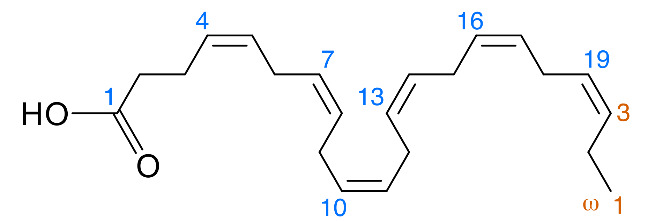
Docosahexaenoic acid (Figure 1) is classified by the following information:
-
Chemical name: (4Z,7Z,10Z,13Z,16Z,19Z)-Docosa-4,7,10,13,16,19-hexaenoic acid
-
Chemical Formula: C22H32O2
-
CAS number: 6217-54-5
-
Molecular weight: 328.49 g/mol
.png)
Eicosapentaenoic acid (Figure 2) is classified by the following information:
-
Chemical name: (5E,8E,11E,14E,17E)-icosa-5,8,11,14,17-pentaenoic acid
-
Chemical Formula: C20H30O2
-
CAS number: 1553-41-9
-
Molecular weight: 302.50 g/mol
.png)
There is no change to the identity of the novel food in this application, as the DHA and EPA remain unchanged. The change from this application comes in relation to the ratio of the two characterising components as currently defined in the specification outlined in Commission Implementing Regulation 2017/2470.
2.1.2. Production Process
Schizochytrium sp. oil rich in Docosahexaenoic acid (DHA) and Eicosapentaenoic acid (EPA) (DHA-O) is produced via a self-contained fermentation process using the algae Schizochytrium. The algae are grown in a pure, heterotrophic fed, batch fermentation process and recovered from the fermentation broth. The subsequent oil recovery stages may be applied to either the recovered dried algae, or the fermentation broth may be used directly. In the latter scenario, a pasteurisation step may be employed. Suitable antioxidants are added to the fermentation broth to aid stability during processing.
The newly proposed production process for Schizochytrium sp. oil rich in Docosahexaenoic acid (DHA) and Eicosapentaenoic acid (EPA) (DHA-O) varies from the original application in regard to the levels and ratios of nutrients used during the culture phase. The changes are critical for optimisation of the production process. This leads to an increase in EPA and slight decrease in the DHA formed. This is reflected in the proposed change to the novel food’s specifications set out within this application (Section 2.1.5).
In the original assessment, it was concluded that the data provided on the production process was sufficient and did not give rise to any safety concerns. Upon review, the FSA and FSS agree with this decision and the changes to the production process sought do not change this opinion.
2.1.3. Compositional Information
The composition of the novel food is changed in this application regarding the content of both DHA and EPA. Table 1 outlines the change in composition as a result of the optimisation of the production process.
The analytical data in table 1 indicate that the change of conditions alter the ratio of DHA to EPA but the proportion of the combined fatty acids remains similar to that in the current authorisation, which are minimal levels. Table 2 shows the wider composition of the novel food under the current and proposed specification. This indicates the other characterising parameters of the novel food – other than DHA and EPA level - are unchanged by the optimisation of the production process.
A full fatty acid profile, lipid class composition, and steroid profile analysis have been provided on three batches of the originally authorised novel food and three batches of the newly proposed novel food (Tables 3 - 5). No significant changes in fatty acid profile are seen between products (with exception to both DHA and EPA, for which the compositional contents have been intentionally modified in this application). No significant changes in lipid class composition and sterol profile are seen between products.
Analyses for contaminants were conducted on both the originally authorised novel food and the newly proposed novel food, covering dioxins, solvents, polycyclic aromatic hydrocarbons, pesticides, mycotoxins, acrylamide, and microbiological contaminants. The results confirmed that no significant levels of contaminants are present in both products.
No microbial contamination is expected from the optimisation of the production process as the controls in place to manage this hazard remain in place.
Upon review, the FSA and FSS agree the changes to the composition have been appropriately characterised and no new hazards for the novel food identified.
2.1.4. Stability
Additional unpublished stability data was provided for this assessment. This included an accelerated conditions stability study (40 C/ 75% relative humidity for 6 months), and a long-term stability study (25 C for 24 months) on the newly proposed novel food.
The applicant concludes that there are no significant changes to the novel food’s composition over the timeframe assessed in both stability studies. The results show the novel food remains stable under long-term storage for up to 24 months.
The stability of the novel food was assessed in the original authorisation and no concerns were raised. Upon review, the FSA and FSS agree with this decision and the changes to the specification and composition sought do not change this.
2.1.5. Specification
This application proposes changes to the specification for Schizochytrium sp. oil rich in DHA and EPA (DHA-O). The proposed specifications, alongside the currently authorised specifications, can be found in Table 6. The proposed changes affect only the level of DHA in the novel food and all other specifications remain unchanged.
Upon review, the FSA and FSS agree that the proposed changes to the specification level for DHA and EPA do not raise additional concerns on safety under the proposed conditions of use.
2.1.6. History of Use
Schizochytrium sp. oil rich in docosahexaenoic acid (DHA) and eicosapentaenoic acid (EPA) is currently authorised as a novel food in the UK. Details of the authorisations for the novel food in the UK and EU are outlined in the introduction above.
2.1.7. Intended Use and Maximum Use Levels
Information concerning the intended use of the novel food was assessed in the original assessment (FSA, 2012b) and in the previous extension of use request for two new food categories (FSA, 2024). The proposed uses remain as authorised under assimilated Commission Implementing Regulation 2017/2470.
2.1.8. Absorption, Distribution, Metabolism and Excretion (ADME)
Information concerning the ADME of the novel food was assessed in the original assessment (FSA, 2012b) or the recent assessment of the extension of use to new food categories (FSA, 2024). No concerns were raised concerning the ADME of the novel food. Upon review, the FSA and FSS agree with this decision and the changes to the conditions of use sought do not change this opinion.
2.1.9. Nutritional Information
There is no substantive change to the nutritional profile of the novel food. The change in the production process changes the ratio of DHA to EPA but continues to be rich in these substances. The original assessment concluded that the novel food was not nutritionally disadvantageous for consumers. Upon review, the FSA and FSS agree with this decision and the changes to the conditions of use sought do not change this opinion.
2.1.10. Toxicological Information
The toxicity of DHA and EPA-rich oils produced from different strains of Schizochytrium sp. has been reviewed and investigated. In previous reviews and investigations, the competent authorities in the UK and EU have concluded that there were no concerns with regards to genotoxicity and sub-chronic toxicity of the tested materials (FSA, 2012b; EFSA, 2012).
There are no changes to the toxicological profile of the novel ingredient since the original authorisation for DHA-O oil. A NOAEL was identified at 200g per person, per day of DHA-O or 100g per person, per day of DHA and EPA.
In the previous assessments undertaken while we were a member of the EU, the toxicology of DHA and EPA rich oil was assessed and tolerable upper intake levels established for DHA and EPA combined, and for DHA or EPA alone (EFSA, 2012). This stated:
“The Panel considers that supplemental intakes of EPA and DHA combined at doses up to 5 g/day, and supplemental intakes of EPA alone up to 1.8 g/day, do not raise safety concerns for the adult population. The Panel also considers supplemental intakes of DHA alone up to about 1 g/day do not raise safety concerns for the general population. No data are available for DPA when consumed alone. The Panel notes that in the majority of the human studies considered, fish oils, which also contained DPA in generally unknown (but relatively low) amounts, were the source of EPA and DHA.”
It was noted that the proposed uses are not intended to change in this application and as such the exposure to the novel food remains the same. In the initial letter (FSA, 2012a) on the increase in use for food supplements it was noted that:
In the event that high level consumers of fortified foods also consumed high dose supplements providing the maximum proposed dose of 3000 mg/day, this would result in a maximum consumption of DHA and EPA of 4.72 g/day. When assessing the DHA and EPA oil the ACNFP noted that this combined estimate is below 5 g/day, a level of intake that EFSA do not regard to cause safety concerns (EFSA, 2012) and accepted that this provides sufficient reassurance of the safety of this extension of use.
Potential exposures to EPA and DHA were considered for the extension of use to meat and fish analogues assessed in GB. (FSA/FSS 2024). These did not suggest that intakes of EPA or DHA were approaching the levels identified as supplemental intakes. As such it is unlikely that the change in the specification would lead to over exposure of consumers to EPA and DHA.
There have been no additional data produced since the previous application. It is considered that the conclusions from the previous assessments (FSA, 2012b; FSA 2024) remain relevant for the proposed change of conditions of use.
2.1.11.Allergenicity
The original assessment did not consider the novel food to carry any allergenic risks due to the highly refined nature of the oil. Upon review, the FSA and FSS agree with this decision and the changes to the conditions of use sought do not change this opinion.
3. Discussion
This application seeks to change the specifications for Schizochytrium sp. oil rich in DHA and EPA (DHA-O) as a novel food to modify the levels of DHA and EPA in the final product. This is a result of optimisation of the production process which leads to changes in the composition of the novel food. No other changes to the novel food are proposed in this application.
The proposed changes to the specifications are in regard to the minimum levels of DHA in the novel food. This would see a reduction in the minimum amount of DHA in the novel food from ≥ 22.5% to ≥ 15.0%. The resulting compositional changes therefore see an increase in EPA content inversely proportionate to the DHA content. However, the overall content of the two fatty acids remain similar to that seen in the current authorisation.
The Toxicity of DHA and EPA was assessed in the original UK assessment, (FSA, 2012b) where it was stated that combined intakes (DHA + EPA) of up to 5 g/day and EPA alone of up to 1.8 g/day, did not raise any safety concerns.
The proposed uses and proposed use levels remain unchanged in this application; as a result, no additional risks are expected to arise from the proposed changes to the specification and production process.
4. Conclusions
The FSA and FSS have undertaken the assessment of the changes to the conditions of use for Schizochytrium sp. oil rich in DHA and EPA and concluded that the proposed changes in the specification of the novel food are safe under the intended conditions of use and does not pose a safety risk to human health. The anticipated intake levels and the intended uses in food were not considered to be nutritionally disadvantageous.
These conclusions were based on the information in the novel food dossier and the supplementary information submitted by the applicant, including previous assessments and extension of use requests (FSA, 2012b; FSA 2024; EFSA, 2012).