
Lay Summary
Campylobacter is a leading cause of food poisoning in the UK, and chicken meat is one of the main ways people are exposed to it. As a result, reducing contamination at every stage of the food chain is important for protecting public health.
This report focuses on the steps taken in poultry slaughterhouses and whether they are effective at reducing levels of Campylobacter contamination. To understand how well different parts of the process in slaughterhouses help reduce the bacteria, an umbrella review was carried out. This type of review brings together evidence from several existing reviews, each of which has already analysed multiple studies.
The review found that scalding (dipping birds in hot water before feather removal) was one of the most effective ways to reduce contamination, showing large drops in bacterial levels. This makes scalding a key safety step in slaughterhouses. In contrast, the removal of feathers (known as defeathering) often increases contamination, likely because of contaminated equipment transferring bacteria between birds. This means defeathering is a high-risk stage where improvements could be made. The step where internal organs are removed (known as evisceration) showed mixed results. In some cases, removal of internal organs decreased contamination, but in other cases it increased contamination. This suggests that better process control is needed to make this stage reliably effective.
The review also highlighted that washing and chilling can help reduce Campylobacter, but their impact depends on water temperature and how long the treatment is applied for. Chilling and washing with chemicals is reported to deliver large reductions in Campylobacter. However, these substances are not approved for use in poultry processing in the UK or EU; their discussion in the review reflects global practice rather than permitted UK approaches.
Among chilling methods, immersion chilling - cooling birds in cold water - was found to be effective, especially when used for longer periods. Freezing the meat after processing also reduced contamination more effectively than standard refrigeration. A technique called crust freezing, where only the outer layer of the meat is rapidly frozen, also showed promising results.
Taken together, the results highlight areas where improvements can be made. This includes managing defeathering as a high-risk stage, controlling the evisceration stage, and improving washing and chilling by using the right conditions (temperature, duration). While no single step in slaughterhouses eliminates Campylobacter on its own, coordinated improvements across the stages may significantly reduce contamination and help keep consumers safe.
Executive Summary
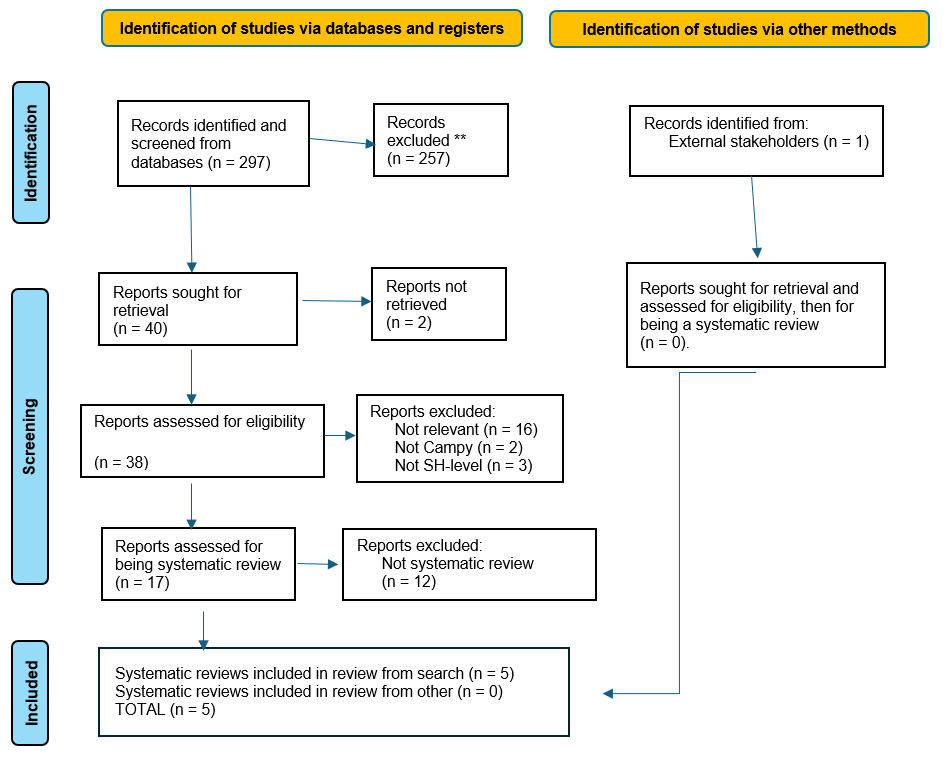
An umbrella review, based on systematic reviews which included meta-analysis, was conducted to evaluate the efficacy of slaughterhouse-level interventions in reducing Campylobacter contamination on broiler carcases. This review focused on interventions applied across key processing stages: scalding, defeathering, evisceration, washing, and chilling. A comprehensive literature search was performed across databases, applying predefined inclusion and exclusion criteria. Five systematic reviews met the eligibility criteria and were included in the final synthesis.
The response variable recorded was the log₁₀ reduction in Campylobacter concentration with pooled effect estimates derived through meta-analysis. Scalding as a processing intervention achieved the highest reductions with up to 2.16 log₁₀ CFU/unit. However, defeathering was associated with increased contamination, with reviews reporting negative reductions ranging from -0.88 to -1.65 log₁₀. Evisceration showed inconsistent effects: reductions ranged from -0.15 to 0.49 log₁₀. These findings highlight scalding as a key control point, defeathering as a higher-risk stage requiring targeted interventions, and evisceration as an area needing further optimisation to ensure microbial control.
Washing and chilling were identified as critical control points, with their effectiveness strongly influenced by operational parameters such as temperature, duration, and the use of antimicrobial chemicals. While several chemical interventions demonstrated high antimicrobial efficacy, it is important to note that these substances are not approved for use in poultry processing within the United Kingdom or the EU. Their inclusion in this review reflects global practices.
Immersion chilling was found to be effective, particularly when combined with antimicrobial chemicals and extended exposure times. When storing the products, freezing was also found to be more effective than refrigeration. Crust freezing also emerged as a promising alternative, achieving up to 2 log₁₀ CFU/unit reduction while maintaining the product’s “fresh” classification under EU regulations (retained in the UK) (EU, 2004).
This review highlights several promising and effective interventions for reducing Campylobacter contamination in poultry at the slaughterhouse level. While it underscores key limitations which contribute to uncertainty in the pooled estimates, including inconsistent reporting across studies and the inclusion of small-scale trials, it also provides a foundation for further research.
Abbreviations
Introduction
Campylobacter species, particularly Campylobacter jejuni and Campylobacter coli, are the leading cause of bacterial gastroenteritis in the UK, contributing to significant public health and economic burden. In England there were 70,352 laboratory confirmed cases of Campylobacter infections in 2024 (UKHSA, 2025). Source attribution studies in the UK and other EU countries have identified the consumption of chicken meat as the most frequent source of Campylobacter infection (Cody et al., 2019; EFSA, 2023; McCarthy et al., 2025).
Colonisation of chicken can occur at any point along the farm-to-fork pathway, with C. jejuni and C. coli responsible for approximately 90 to 95% of cases globally (including infections acquired by both poultry and other products). While C. jejuni is typically the dominant species in most regions and settings, the relative contribution can vary depending on factors such as geography, host species, and food production systems (FAO & WHO, 2024). Campylobacter spp. are non-spore forming, micro-aerophilic, motile spiral-shaped cells with optimal growth temperatures between 37°C and 43°C. Therefore, poultry can host the pathogen because of their intestinal temperature of 42°C (ACMSF, 2019).
Colonised poultry can carry the bacteria into processing environments, where contamination can spread during critical processing stages such as evisceration (UKHSA, 2025; Zhang et al., 2018). Evisceration refers to the removal of the internal organs, including the intestinal tract, and improper handling can lead to leakage of intestinal contents, increasing the risk of cross-contamination of carcases, equipment, and surfaces (Zhang et al., 2018).
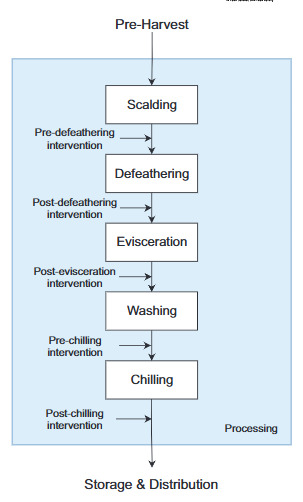
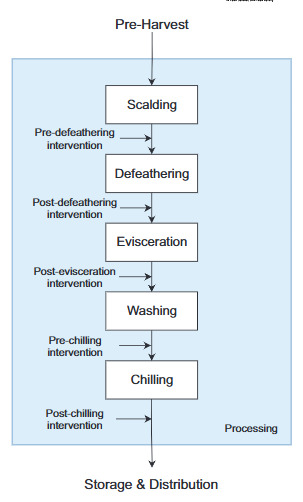
To assess possibilities for interventions, it is important to understand the slaughter process: live birds are usually transported to abattoirs and processing plants in crates after which they are rendered unconscious, commonly via electrical stunning or controlled atmospheric system and killed by exsanguination (Humane Slaughter Association, 2016). After the birds have been bled, they undergo scalding and defeathering, where they are submerged in hot water (50 to 60°C) to loosen the feathers and then mechanically defeathered using rotating rubber fingers. The internal organs of the birds are removed during evisceration, either mechanically or manually. After evisceration, the carcases are washed with high pressure water to remove any visible contamination before they are chilled to lower their temperature. This pathway is shown in (Figure 1) (Dogan et al., 2021)
Each stage of poultry processing presents opportunities for the spread of Campylobacter spp. across and between carcases. A study reported that the prevalence of Campylobacter detected in 10 pairs of collected and full caeca selected from 303 eligible broiler batches, was 75.8%, while 87.3% of broiler carcases were contaminated post-processing (Powell et al., 2012). The discrepancy indicates that carcase contamination can occur independently of caecal colonisation, likely due to cross-contamination during processing, as well as transfer via equipment and environmental surfaces (Gherman et al., 2023; Ovuru et al., 2023; Rouger et al., 2017). However, there are many opportunities during the process to reduce the spread of contamination. The British Poultry Council (2014) have identified key intervention points within the poultry slaughterhouse process that can mitigate Campylobacter contamination. These include:
-
Crates and modules
-
Scalding practices
-
Washing practices
-
Heat treatments
-
Cold treatments
Over the past two decades, extensive research has been conducted globally to evaluate interventions aimed at reducing Campylobacter in the poultry food chain. This has led to the publication of numerous systematic reviews assessing the effectiveness and practicality of various control measures. In the UK, the Food Standards Agency (FSA) and, before its formation in 2000, the Department of Health, have commissioned multiple studies, through the Advisory Committee on the Microbiological Safety of Food (ACMSF) and external providers, to identify interventions most likely to reduce the burden of campylobacteriosis.
The ACMSF released a report on Campylobacter in 1993, outlining control measures across the food chain (ACMSF, 1992). These included control measures such as water activity, salinity, pH, oxygen, storage temperature and heating which could be used to reduce the risk. The report also introduced the need for HACCP implementation and personnel training, with specific recommendations for slaughterhouses focused on preventing cross contamination. In 2002, the ACMSF established a working group to assess progress and identify knowledge gaps following the initial report. This led to the publication of a second report in 2005, which focused specifically on reducing Campylobacter in poultry meat. It presented 33 recommendations for both government and industry, reinforcing the importance of hygienic practices in slaughterhouses as a key strategy for minimising contamination.
The third ACMSF report on Campylobacter, published in 2019, built on earlier findings by evaluating the effectiveness of processing interventions within poultry slaughterhouses (ACMSF, 2019). It recognised that several techniques, particularly thermal processing and rapid surface chilling, can reduce Campylobacter contamination. These methods are effective due to the biological characteristics of the organism: Campylobacter spp. are heat-sensitive with contamination typically restricted to the surface of poultry meat. The report emphasised that optimising existing equipment and processing methods is key to minimising the spread of contamination within slaughterhouses and recommended further adoption and investigation of these technologies to enhance their efficacy.
Despite extensive research into Campylobacter interventions at the slaughterhouse level, systematic reviews often report conflicting findings due to inconsistencies in processing practices, laboratory methods, strain differences, and the feasibility of applying interventions in commercial settings (Birk et al., 2010; Dogan et al., 2021; Leone et al., 2024). Both the Food Standards Agency and Food Standards Scotland have funded projects to address the challenges associated with Campylobacter contamination of poultry (FSA et al., 2013; FSS, 2012). In 2024, a joint article by FAO and WHO (2024) was also produced on the control of Campylobacter spp. in chicken meat, which attempted to provide a comprehensive assessment of control measures throughout the chicken production chain, including the slaughterhouse.
This umbrella review aims to synthesise evidence from existing systematic reviews and key reports from the FSA and FSS to evaluate the effectiveness of current intervention strategies used in poultry slaughterhouses. By comparing findings and identifying gaps in the literature, the review seeks to provide a holistic understanding of Campylobacter control in processing environments and inform future policy and industry practices.
Method
An umbrella review was carried out in accordance with the process described by Aromataris et al., 2015. The search strategy and selection process were carried out according to PRISMA recommendations (Page et al., 2021).
This review consolidated previously published literature on intervention methods for the control of Campylobacter spp. to answer the research question: “What interventions have been tested for reducing Campylobacter load in chicken meat across the food chain and which ones have been found to be effective?”. This report discusses interventions that have been used at the slaughterhouse stage only.
This review also compares the findings from systematic reviews with six FSA/FSS funded projects, dating from 2005 to 2022, all commissioned to understand the control of Campylobacter in broiler slaughterhouses.
Inclusion and exclusion criteria
The PICO method was used to identify the inclusion criteria:
Population (P) - Broiler carcases in slaughterhouse, processing plants or abattoir, Intervention (I) -
-
Processing stage interventions (e.g., scalding, defeathering, evisceration, washing)
-
Chemical interventions (e.g., lactic acid, peracetic acid, chlorine-based solutions)
-
Chilling and freezing
-
Physical interventions
Comparator (C) – No intervention
Outcome – Log scale reduction in Campylobacter concentration measured as log10 CFU/carcase or log10 CFU/unit. Dogan et al., 2021 refers to ‘unit’ as a generalised term allows for the inclusion of diverse study designs and sampling approaches, but it also introduces variability in the interpretation of concentration values (Dogan et al., 2021). For example, a unit may represent a whole broiler carcase in one study, while in another it may reflect a single portion of meat. Despite this variability, the log-scale reduction per unit remains a useful comparative measure of intervention efficacy across studies.
Search strategy and selection process
The FSA’s Lit Fetch tool (a literature search and filtering application) was used to perform keyword searches on EBSCO Information Services, PubMed, Scopus, and Springer, using the online search interfaces for each service. This tool provides automatic de-duplication when a reference is returned by multiple services. The search was performed on 24 May 2024 to identify systematic reviews and meta-analysis that had been carried out on the interventions for the control of Campylobacter in slaughterhouses since 1 January 1980. The search terms that were used are “Campylobacter AND review AND (slaughterhouse OR abattoir OR processing)”.
After the database search was completed, the title and abstract screening was carried out by an author on this report based on the eligibility criteria. To ensure consistency, a second author independently reviewed reports in parallel and compared each included study. Reports that did not include any Campylobacter interventions and those that were not at the slaughterhouse level were excluded. Full text screening was then carried out by two reviewers to determine if the report was a systematic review; those that were not systematic reviews and/or meta-analysis were excluded. Other reports identified from the FAO/WHO also went through the screening process described above (WHO & FAO, 2024).
Data extraction
Data extraction was carried out by two reviewers using Microsoft Excel. To ensure accuracy and consistency, a third team member carried out a quality assurance check by reviewing the original papers and cross-referencing them with the extracted data. The following qualitative information was extracted from the included studies:
-
description/purpose of study
-
search terms used
-
databases searched
-
date searched
-
inclusion and exclusion criteria
-
numbers of publications included in the study
-
countries/regions included or excluded
-
Campylobacter interventions
-
conclusions
-
recommendations
-
study limitations.
For each of the included studies, quantitative data associated with each intervention were retrieved, such as numbers of studies performed in laboratory, pilot scale or slaughterhouses, Campylobacter concentration change, Campylobacter prevalence changes (%), and other associated statistical data such as confidence intervals, p-values and heterogenicity.
Calculating primary study overlap using Corrected Covered Area (CCA)
This umbrella review synthesised five systematic reviews. To quantify the degree of overlap among primary studies included in these reviews, we applied the Corrected Covered Area (CCA) method, which measures redundancy using the formula (Kirvalidze et al., 2023) :
CCA=((N−r)/(r×(c−1)))×100
Where:
-
N = Total number of study occurrences across all reviews
-
r = Number of unique primary studies
-
c = Number of systematic reviews
Data synthesis
A narrative synthesis and comparison of the key findings from each review were conducted.
To assess the consistency of log reductions across studies included in the meta-analyses, the I² (I-squared) value, a statistical measure used to quantify the degree of heterogeneity, was included (Ruppar, 2020). Heterogeneity refers to the variability in study outcomes beyond what would be expected by chance alone. The I² statistic is expressed as a percentage to quantify the proportion of total variation across studies that is due to heterogeneity rather than chance.
Heterogeneity is a critical component of meta-analytic reporting as it helps assess the reliability and generalisability of the pooled effect size. A low I² value (e.g., arbitrarily <25%) suggests that the included studies are estimating a common effect, thereby increasing confidence in the summary estimate. Conversely, a high I² value indicates that the studies differ significantly in their findings, which may be due to differences in study design, populations, interventions, or outcome measurements. Therefore, a value of 100% would mean that all observed variability is due to heterogeneity, suggesting that the studies are estimating very different effects.
For analyses with high heterogeneity (>80%, arbitrary number), the pooled effect estimate may be statistically significant, however, this does not imply consistency across studies. Therefore, such results should be interpreted with caution (Ruppar, 2020).
Data analysis for Guerin et al (2010)
The review by Guerin et al., 2010 reported results from individual studies and had not pooled results. This was inconsistent with the other reviews included in this report; thus, the FSA Statistics team performed a meta-analysis of the data. Log₁₀ values were calculated, followed by the determination of log₁₀ reductions to quantify changes in Campylobacter concentration. Standard errors were computed for each estimate to facilitate the weighting of studies, allowing for a more accurate pooled effect size than a simple arithmetic mean.
Weighted estimates were used to reflect the relative contribution of each study to the overall effect. A random-effects meta-analysis was performed using the metafor 4.8-0 package in R version 4.3.2 (R Core Team, 2024; Viechtbauer, 2010), which accounts for both within-study and between-study variation This analysis produced a single summary estimate with associated 95% confidence intervals, I² statistics to assess heterogeneity, and p-values to evaluate statistical significance.
Comparative analysis of the umbrella review with FSA/FSS projects
A comparative analysis of the results of this umbrella review and five studies on Campylobacter interventions in slaughterhouses funded by FSA and FSS was carried out. Data extraction and quality assurance of the FSA/FSS studies followed the same process as described for systematic reviews.
Results
Systematic reviews
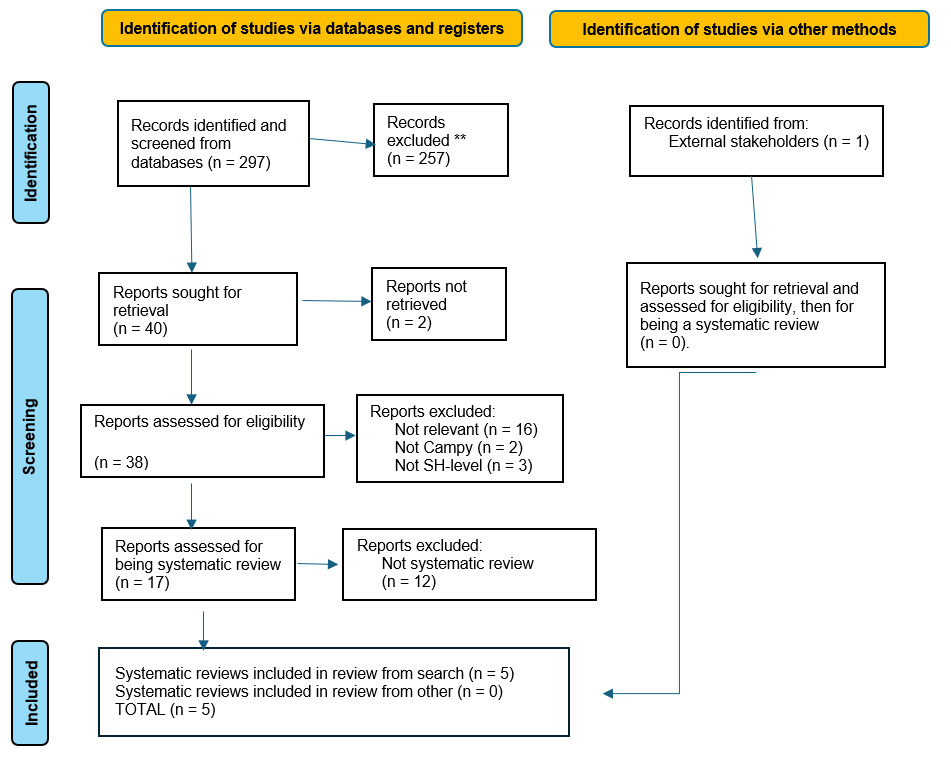
This review draws on five systematic reviews (Figure 2) that explore various interventions and processing stages affecting Campylobacter spp. concentration in broiler chicken meat. Gichure et al., 2022 and Dogan et al., 2021 present systematic reviews and meta-analysis evaluating the effectiveness of processing stages and chemical treatments, and physical interventions, in reducing Campylobacter contamination. Leone et al., 2024 contributes recent findings on intervention outcomes, particularly in controlled challenge trials. Bucher et al., 2015 conducted a systematic review and meta-analysis focused specifically on the impact of chilling during primary processing, while Guerin et al., 2010 examines changes in Campylobacter prevalence throughout the processing chain. Together, these studies form a comprehensive evidence base for assessing intervention effectiveness and identifying opportunities for optimisation in both laboratory and commercial settings.
Effect size reporting and assessment of heterogeneity
In this study, we report log₁₀ reductions as point estimates with accompanying 95% confidence intervals, as standard practice for summarising antimicrobial intervention effects on Campylobacter. However, we do not apply predefined categories to the magnitude of effectiveness, as no universally accepted thresholds currently exist for log reduction in this context. Regarding heterogeneity, we follow conventional thresholds as described in the Methods section: I² values below 25% are considered low, and values above 80% are considered high. These thresholds help guide interpretation but are inherently arbitrary and should be used with caution. Differences in point estimates and confidence intervals (CIs) across studies may reflect variations in methodology, bacterial populations, sampling variations or processing conditions. Therefore, while pooled estimates are informative, they should be interpreted within the context of study design and quality, and not as definitive comparative metrics.
Study Design Considerations
Many of the results documented in this report were derived from two different design protocols: Challenge trials and Before and After trials. Challenge trials typically involve the inoculation of carcases with known concentration of Campylobacter, allowing for controlled assessment of intervention efficacy. Before-After trials rely on naturally occurring contamination levels, which can vary and are influenced by multiple uncontrollable factors such as flock health, processing conditions, and environment contamination. As a result, challenge trials may be more sensitive at detecting reductions, while Before-After trials reflect real world conditions. Therefore, differences in intervention outcomes are expected due to differences in methodology and should not be directly compared.
Overlap among reviews
As discussed in the methodology, we calculated the degree of overlap among primary studies included in the systematic reviews using the Corrected Covered Area (CCA) method. For this review, N = 185, r = 125, and c = 5, and the CCA result was 12%. Although no universally agreed threshold exists, the CCA offers a way to quantify study overlap by estimating the proportion of shared studies. Overlap is typically interpreted as low (<5%), moderate (5 to10%), or substantial (>10%) based on commonly used benchmarks (Kirvalidze et al., 2023). This suggests that while the overall evidence base is relatively diverse, there is still a notable degree of duplication among studies. The presence of frequently cited foundational studies may disproportionately influence the perceived effectiveness of certain interventions. Therefore, results should be interpreted with caution, considering the quantitative overlap.
Processing interventions
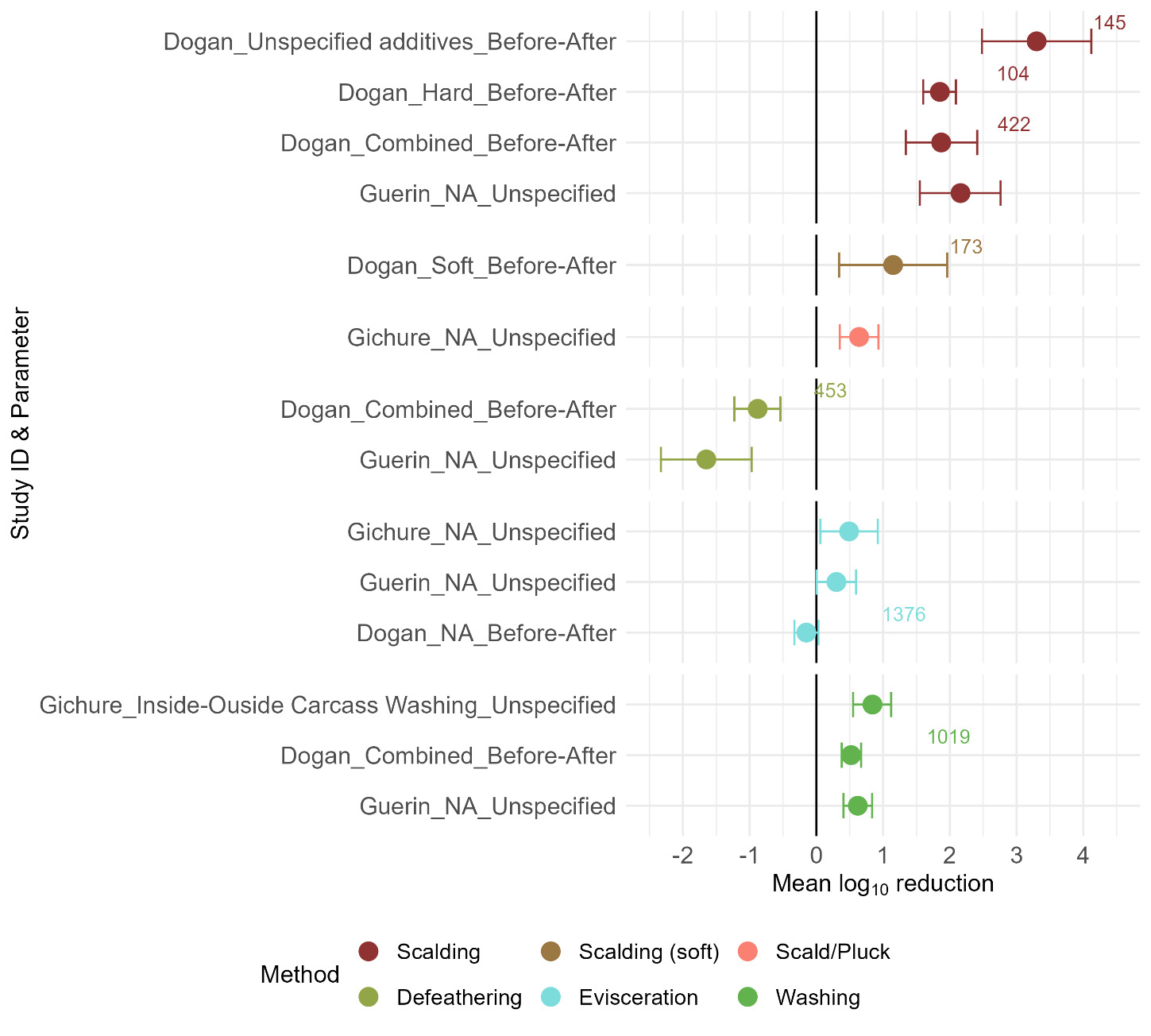
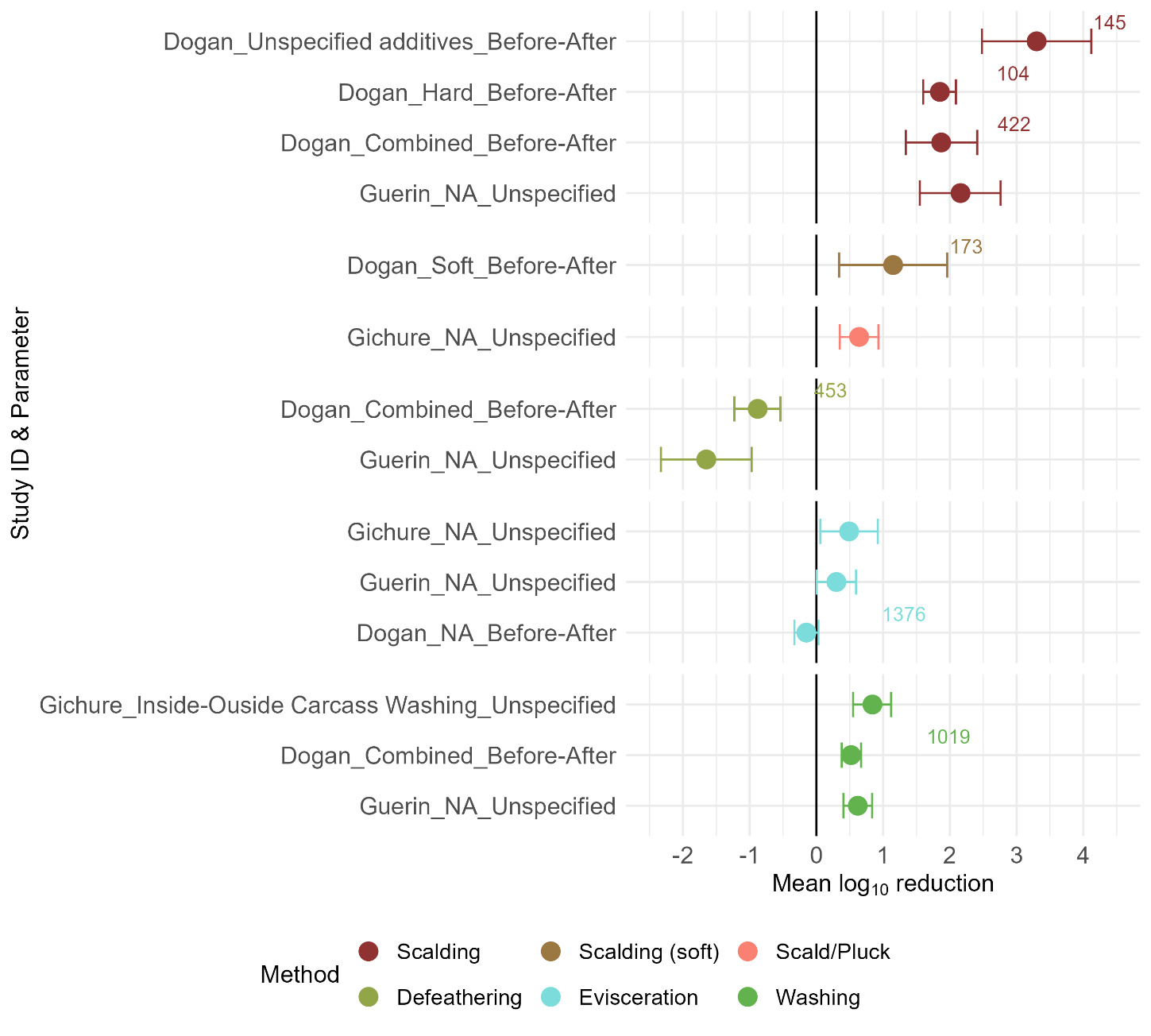
This section presents findings from the systematic reviews evaluating the effectiveness of poultry processing interventions in reducing Campylobacter contamination on broiler carcases. The interventions assessed include scalding, defeathering, evisceration, and washing, each representing a critical stage in the slaughterhouse workflow. The primary outcome across studies was the log₁₀ reduction in Campylobacter concentration with pooled estimates derived through meta-analysis (Figure 3).
Scalding
Scalding involves immersing poultry carcases in hot water. Its primary purpose is to loosen feathers before plucking, but it also has an antimicrobial effect. Scalding was evaluated in three reviews (Figure 3). Guerin et al., 2010 showed a log₁₀ reduction of 2.16 (95% CI 1.55-2.76) over 4 studies. While this suggests scalding can be effective, it may not be fully representative of all evidence, as other reviews reported lower reductions and heterogeneity was not assessed. It is important to note that, for consistency, the Food Standards Agency Statistics Team calculated this result to ensure alignment with the methodology applied in other reports, rather than presenting values exactly as reported in the original publication. Consequently, the figure shows the calculated estimates rather than verbatim extraction. Similarly, Dogan et al., 2021 reported a significant log₁₀ reduction of 1.87 (95% CI: 1.34 to 2.41, I²=89%) over 17 Before-After scalding trials in 6 studies. This analysis included hard and soft scalding, as well as scalding with additives. When broken down, hard scalding, which uses higher temperatures (typically 60 to 65°C) showed a mean reduction of 1.85 log₁₀ CFU (95% CI: 1.60 to 2.09, I²=0%) across 7 trials from 2 studies, suggesting a reliable effect. It should be noted that zero heterogeneity in the case does not necessarily mean ‘no heterogeneity’ and can result from various causes such as one or more studies having wide confidence intervals that overlap with confidence intervals from other studies. In contrast, soft scalding at lower temperatures (50 to 54°C) also reduced contamination, but results were more variable, with pooled data from 7 trials across 3 studies showing a 1.15 log₁₀ CFU reduction (95% CI: 0.34 to 1.96, I² = 83%). Scalding with additives (additives not specified) showed the highest reduction of 3.30 log₁₀ CFU (95% CI:2.48 to 4.12, I²=85%), but due to limited reporting on processing conditions, no definitive conclusions could be drawn.
In contrast, Gichure et al., 2022 showed scalding (without additives) resulted in a log10 reduction of 0.64 (95%CI: 0.35 to 0.93, I²=98%) across 33 trials over 11 studies. However, while the reduction is less pronounced, it is still a positive effect. This indicates that trial results were not consistent, and pooled values should be interpreted with caution. Mean log reductions were inconsistent, potentially due to differences in study methodology, populations, parameters, or other factors.
Defeathering
Defeathering was evaluated in two reviews (Figure 3). Dogan et al., 2021 reported a significant negative log₁₀ reduction (i.e. an increase in contamination) of -0.88 (95% CI: -1.23 to -0.54, I²=95%). This result was pooled to include the combination of defeathering with processing aids (cloacal plugging, organic acids, and chlorine dioxide spray) from 16 Before-After trials across 7 studies. Guerin et al. reported an even more pronounced negative reduction of –1.65 log₁₀ (95% CI: -2.33 to -0.97, I² not available). The results for both studies suggest that defeathering increases the concentration of Campylobacter on chicken.
Evisceration
Evisceration showed inconsistent effects on microbial contamination across three systematic reviews (Figure 3). Gichure et al., 2022 reported a log₁₀ value of 0.49 (95% CI: 0.06 to 0.92, I²=96%), indicating a reduction in bacterial load. Similarly, Guerin et al., 2010 showed a log₁₀ reduction of 0.3 (95% CI: 0.01to 0.59 I² not available). In contrast, Dogan et al., 2021 found a slight increase in contamination, with a log₁₀ change of -0.15 (95% CI: -0.33 to 0.03, I²=93%), suggesting that evisceration may contribute to microbial spread during processing.
Washing
Carcase washing application was assessed in three reviews (Figure 3). Gichure et al., 2022, reported that Inside-Outside Carcase Washing (IOCW) resulted in a log₁₀ reduction of 0.84 CFU/carcase (95% CI: 0.55 to 1.12, I²=69%). This is a mechanical washing process that involves spraying the carcases with water, both on the inside and outside. Guerin et al., 2010 reported a similar reduction of 0.62 log₁₀ (95% CI: 0.41 to 0.84, I² not available) for this processing step. Lastly, Dogan et al., 2021 found a slightly lower reduction of 0.52 log₁₀ (95% CI: 0.38 to 0.67, I²=92%). Therefore, all three reviews demonstrate a statistically significant positive effect.
The studies also report overlapping confidence intervals, suggesting that the differences between the reviews may not be statistically significant.
Chemical Interventions
This section presents findings from chemical decontamination trials reported in the systematic reviews (separate from the washing stage), alongside evidence from FSA and FSS reports, evaluating antimicrobial efficacy against Campylobacter on broiler carcases. While several chemical agents demonstrated promising reductions in microbial load, it is important to note that no chemical decontaminant is authorised for use in poultry processing within the UK or EU. The following chemicals section was split into seven categories: Organic Acids, Inorganic Acids and Bases, Oxidising Agents, Combined treatments, Other Chemicals, Edible films and Plant Extracts.
Organic Acids
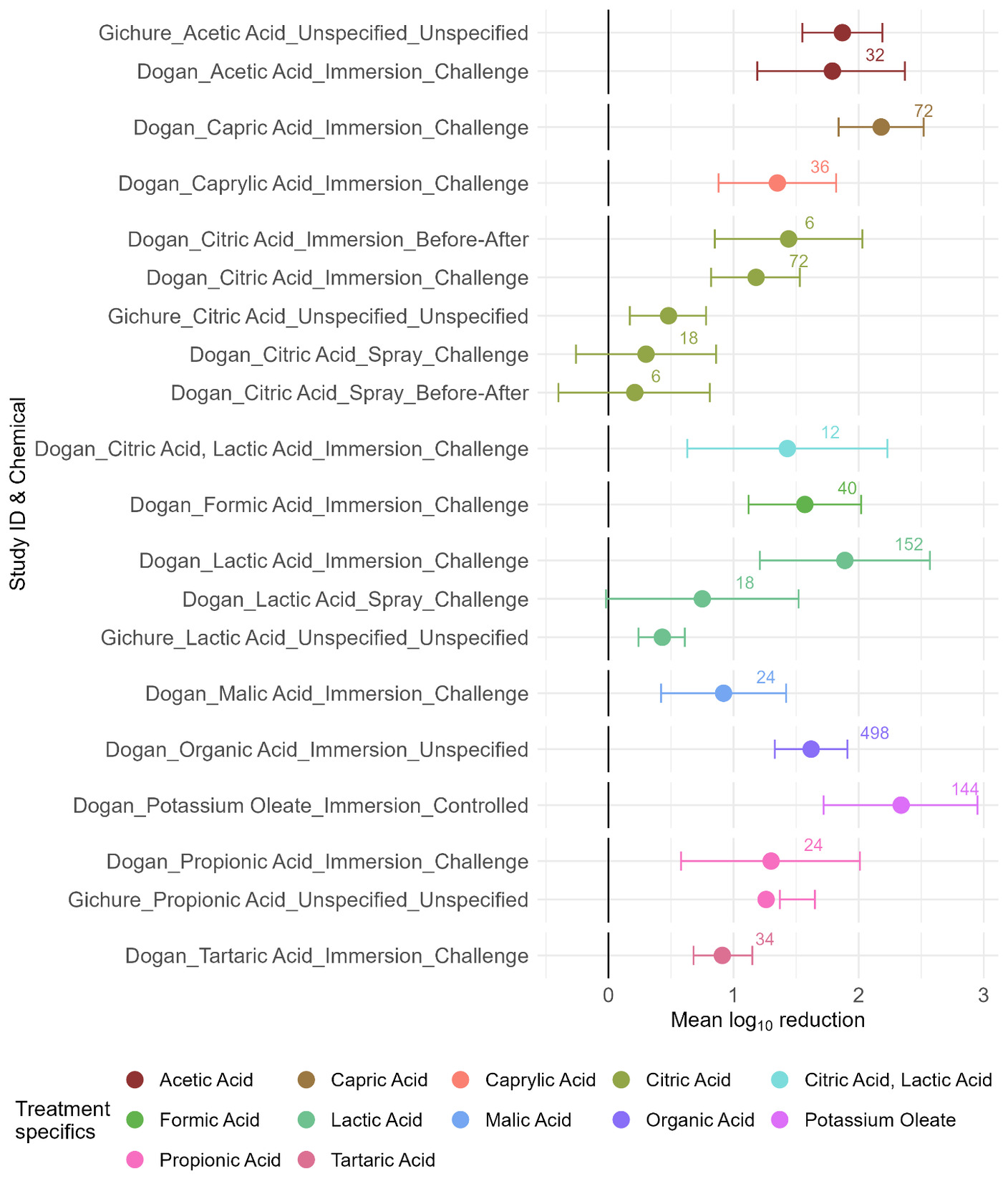
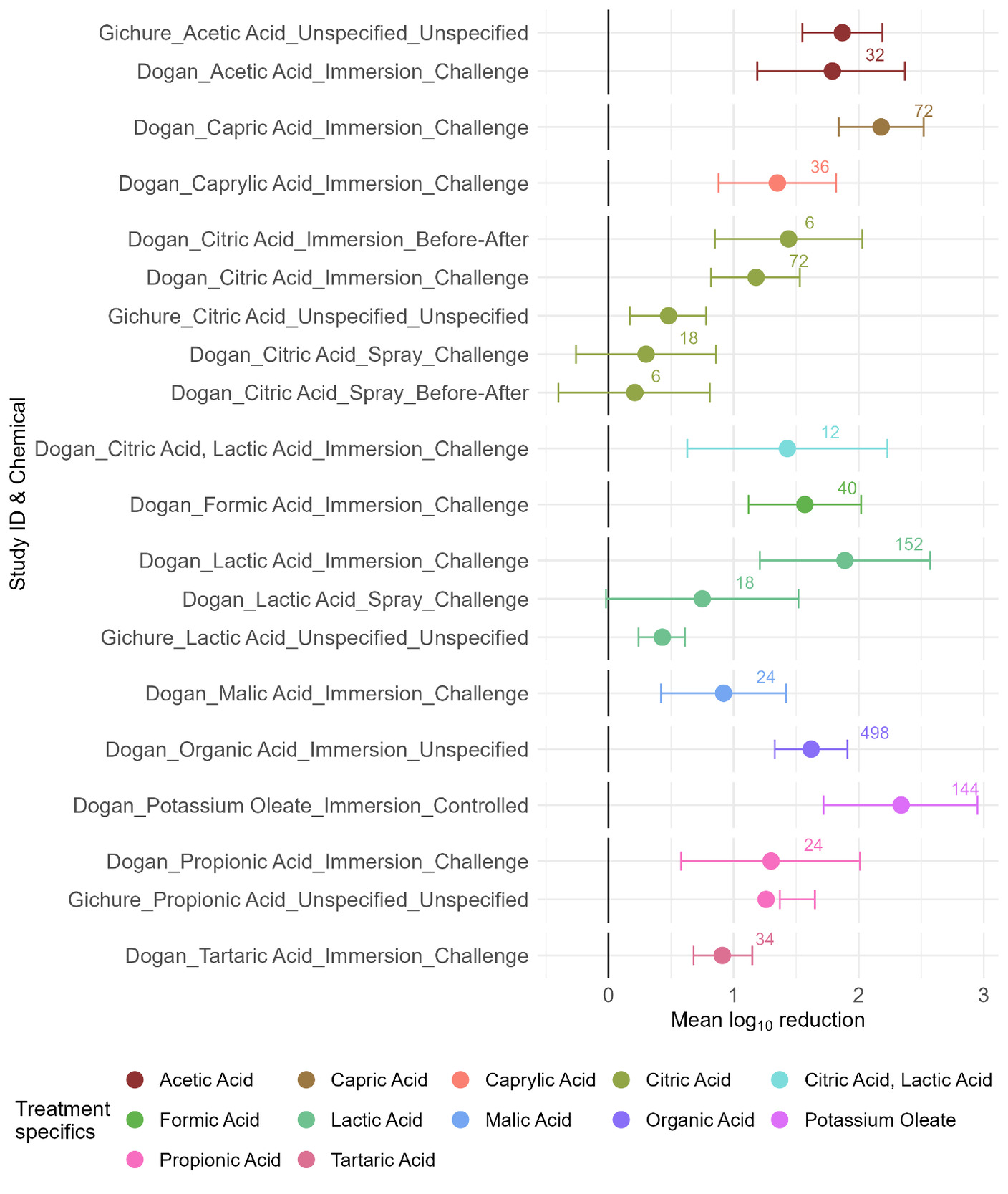
Organic acids are known for their antimicrobial properties, pH-lowering effects, and roles in metabolic processes. In this assessment, a range of organic acids were assessed for their antimicrobial efficacy against Campylobacter on poultry carcases and cuts, using different application methods (immersion, spray, and unspecified). The following organic acids were evaluated: acetic acid, capric decanoic acid, caprylic acid, citric acid, lactic acid, formic acid, malic acid, propionic acid, tartaric acid, and potassium oleate (Figure 4).
Citric acid
Citric acid was tested in both immersion and spray forms (Figure 4). Immersion, reported by Dogan et al., 2021 from one trial in a single study, achieved a significant reduction of 1.44 log₁₀ CFU/unit (95% CI: 0.85 to 2.03, I² not available). Conversely, the spray application did not significantly reduce the bacterial count (0.21 log₁₀ CFU/unit; 95% CI: -0.40 to 0.81, I² not available). Gichure et al., 2022 reported a reduction of 0.48 log₁₀ CFU/unit (95% CI: 0.17 to 0.78) for citric acid (unspecified application).
Lactic acid
Lactic acid was evaluated for its antimicrobial effectiveness in several studies (Figure 4). Results varied depending on concentration, application methods (spray or immersion), and experimental conditions.
Gichure et al., 2022, analysed 32 trials from three studies (concentration between 1 and 10% w/v) and reported a mean reduction of 0.43 log₁₀ CFU/unit (95% CI: 0.24 to 0.61, I² = 92%). Dogan et al., 2021 assessed the effectiveness of lactic acid across different application methods via challenge trials: immersion and spray. Spraying had no significant effect (median log10 reduction of 0.75 CFU/unit; 95% CI: -0.02 to 1.52, I² = 0%) in one challenge trial under laboratory settings. However, immersion showed a significant pooled reduction of 1.89 log₁₀ CFU/unit (95% CI: 1.21 to 2.57, I² =97%) across 10 challenge trials from 6 studies. Combining lactic and citric acid in immersion resulted in 1.43 log₁₀ CFU/unit reduction (95% CI: 0.63 to 2.23; I² = 0%).
Moreover, lactic acid was evaluated in study FS121014B/M01059 (Table 9), which included eight trials assessing effectiveness in reducing Campylobacter on poultry carcases. The conditions that were evaluated included application method (spray by hand, electrostatic or tunnel), concentration of the lactic acid (1.9 to 8%), pH control, flow rate of application, contact time and pre- or post-chill application. More details for each of the trials can be found in Table 12 in the supplementary information.
The results were mixed and context-dependent:
-
Trial 1 (Campden BRI, 2010–2011) showed a statistically significant reduction in Campylobacter prevalence on the day after slaughter when lactic acid (4%) was hand-sprayed post-washer (pre-chill) (p < 0.001).
-
Trial 2 was inconclusive due to insufficient number of positive carcases for Campylobacter.
-
Trial 3 found a 1.0 log₁₀ CFU reduction using electrostatic spray to apply ~1.9% lactic acid, when comparing the control to treated samples at day 6 post-slaughter (pre-chill).
-
Trials 5–7 showed minimal reductions, ranging from -0.2 to 0.3 log₁₀ CFU/g, with some variability depending on storage time and methodology. In-line spray tunnel pre-chill used 1.9% lactic acid in trials 5 and 6 and 4% in trial 7.
-
Trial 8 found that 4% lactic acid (tunnel spray) reduced counts by 0.6-log10 (breast) on day one and 0.38 log10 on day 7, while 8% acid (hand spray) achieved a 1.9-log reduction at both day 1 and 7.
Therefore, trial 8 demonstrates a dose-dependent effect as 8% lactic acid achieved immediate and more substantial bacterial reductions. However, observations noted unacceptable greying of carcase skin at 8%, raising concerns about product quality and consumer acceptance.
Overall, lactic acid demonstrates antimicrobial potential, but effectiveness is highly context dependent. The most consistent reductions are seen with higher concentrations and immersion methods, but there may be a trade-off in product quality. Therefore, further research is needed to optimise concentration, combinations, and application timing to maximise efficacy.
Acetic acid
Acetic acid was reviewed by both Dogan et al., 2021 (specified as an immersion) and Gichure et al., 2022. Dogan et al., 2021 found in challenge trials that acetic acid treatment resulted in a log10 reduction of 1.79 CFU/unit (95% CI: 1.19 to 2.37, I² = 94%) similar to Gichure et al., 2022 (application method not specified) who found a log10 1.87 CFU/unit reduction (95% CI: 1.55 to 2.19, I² not available) (Figure 4).
Capric acid, Caprylic acid, Formic acid, Malic acid, Propionic acid, Tartaric acid, and Potassium Oleate (PO).
Dogan et al., 2021 assessed a range of other organic acid interventions (Figure 4). Capric acid, applied via immersion in challenge trials, demonstrated the highest antimicrobial effect among these acids, with a log10 reduction of 2.18 CFU/unit (95% CI: 1.84 to 2.52, I² = 36%). Caprylic acid immersion in one challenge trial and showed a log10 reduction of 1.35 CFU/unit (95% CI: 0.88 to 1.82, I² = 0%). Formic acid immersion showed a log10 reduction of 1.57 CFU/unit (95% CI: 1.12 to 2.02, I² = 0%), based on one trial from one study.
Propionic acid immersion showed a log10 reduction of 1.30 CFU/unit (95% CI: 0.58 to 2.01, I² = 82%) when assessed by Dogan et al., 2021 (from two challenge trials across one study) and a very similar log10 reduction of 1.26 CFU/unit (95% CI: 1.37 to 1.65, I² not available) when assessed by Gichure et al., 2022.
Malic acid immersion showed an antimicrobial effect, with a log10 reduction of 0.92 CFU/unit (95% CI: 0.42 to 1.42, I² = 96%). Tartaric acid demonstrated a similar effect, with 0.91 log₁₀ CFU/unit reduction (95% CI: 0.68 to 1.15; I² = 0%).
Potassium oleate (PO) achieved one of the highest reductions among all treatments, with 2.34 log₁₀ CFU/unit (95% CI: 1.72 to 2.95; I² = 89.9%) in controlled immersion trials. This suggests PO may be a highly effective intervention; however, further research is needed to confirm its efficacy across different settings as the result is from one trial study.
Inorganic Acids and Bases
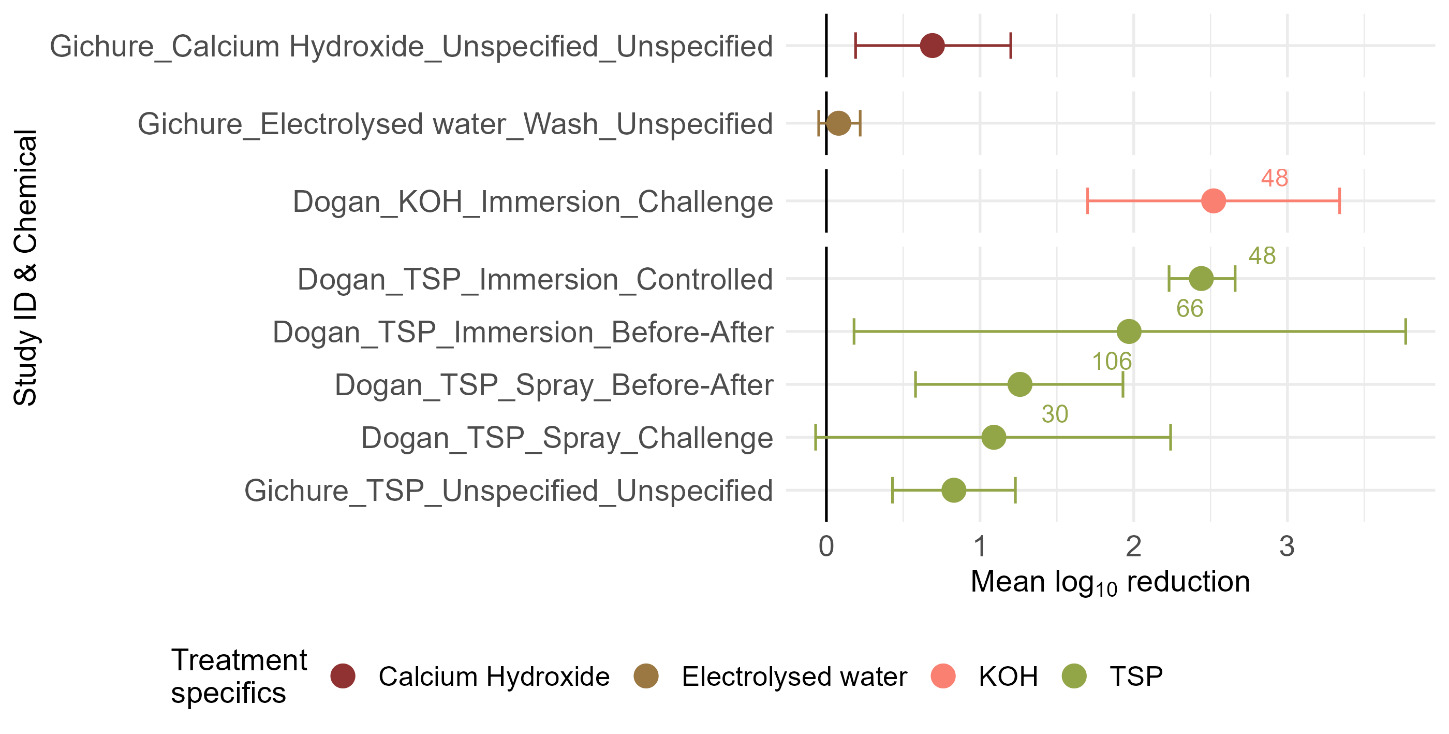
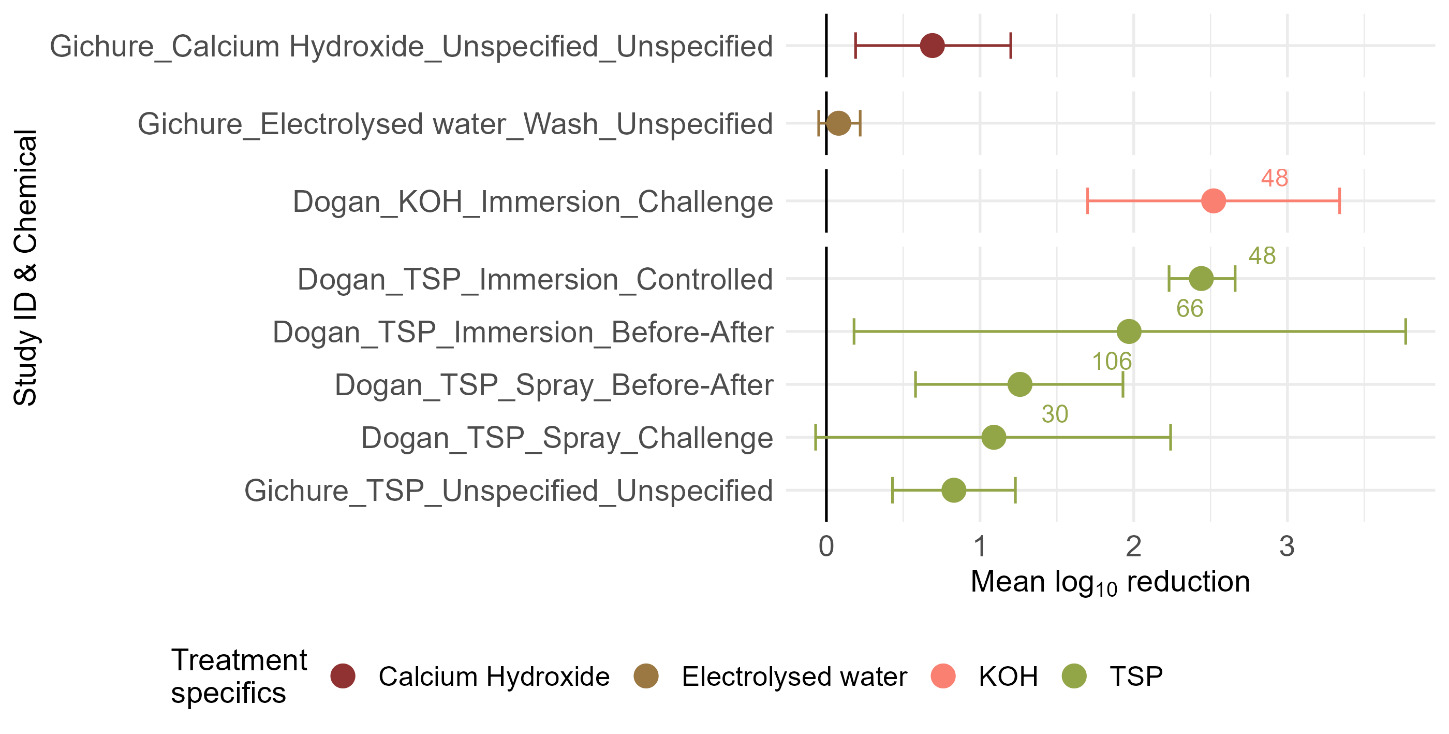
Inorganic chemicals, including acids, bases, and salts exhibit strong alkalinity or oxidative potential, making them effective at reducing microbial contamination on food surfaces. In this review, the following inorganic treatments were evaluated for their ability to reduce Campylobacter contamination on poultry carcases and cuts: Calcium hydroxide, electrolysed water, potassium hydroxide (KOH) and trisodium phosphate (TSP) (Figure 5).
These treatments were assessed across different application methods, including immersion, spray, and wash, to determine their effectiveness under varying conditions.
Calcium hydroxide
Calcium hydroxide was evaluated by Gichure et al., 2022 in two trials with unspecified application methods, showing a reduction of 0.69 log₁₀ CFU/unit (95% CI: 0.19 to 1.20; fixed effect model), indicating limited antimicrobial potential.
Electrolysed water
Electrolysed water was assessed in nine trials (unspecified wash application) by Gichure et al., 2022 and demonstrated negligible effect, with a pooled reduction of 0.08 log₁₀ CFU/unit (95% CI: -0.05 to 0.22; I² = 60.2%), suggesting no meaningful antimicrobial benefit under the conditions tested (Figure 5). This is supported by the FS121014A / M01058 study as three trials were conducted using electrolysed water generated from different salt solutions and applied to chicken meat (Table 2).
Statistical analysis indicated no significant effects. Therefore, electrolysed water, as applied in these trials, demonstrated limited and unreliable impact on Campylobacter reduction.
Potassium hydroxide (KOH)
Potassium hydroxide (KOH) immersion was evaluated by Dogan et al., 2021 and showed 2.52 log₁₀ CFU/unit reduction (95% CI: 1.70 to 3.34, I² = 93%). This was pooled from 4 challenge trials from one study.
Trisodium phosphate (TSP)
Trisodium phosphate (TSP) was assessed by Dogan et al., 2021 using both immersion and spray application methods (Figure 5). Controlled immersion trials reported by Dogan et al., 2021 achieved a reduction of 2.44 log₁₀ CFU/unit (95% CI: 2.23 to 2.66; I² = 0%), based on four trials, suggesting highly consistent performance under controlled conditions. Before-after immersion trials demonstrated a pooled reduction of 1.97 log₁₀ CFU/unit (95% CI: 0.18 to 3.77; I² = 99.4%) across two trials.
Spray application in 5 trials across 2 Before-after studies, showed a slightly lower efficacy and reduced bacterial counts by 1.26 log₁₀ CFU/unit (95% CI: 0.58–1.93, I² = 91%). Challenge spray trials reported a reduction of 1.09 log₁₀ CFU/unit (95% CI: -0.07 to 2.24; I² = 90.3%).
Gichure et al., 2022 reported the effect of TSP at 5-10% w/v, which had a smaller effect of 0.83 log₁₀ CFU/unit (95% CI: 0.43–1.23, I² = 81%) which was pooled across 11 trials from 3 studies.
TSP was also evaluated in FS990010/M1039 (Table 10). It was applied using a misting spray system on both breast and neck skin for 30 seconds, achieving reported reductions of 1.37 log₁₀ reduction on breast skin and >2.41 log₁₀ reduction on neck skin.
Combined treatments
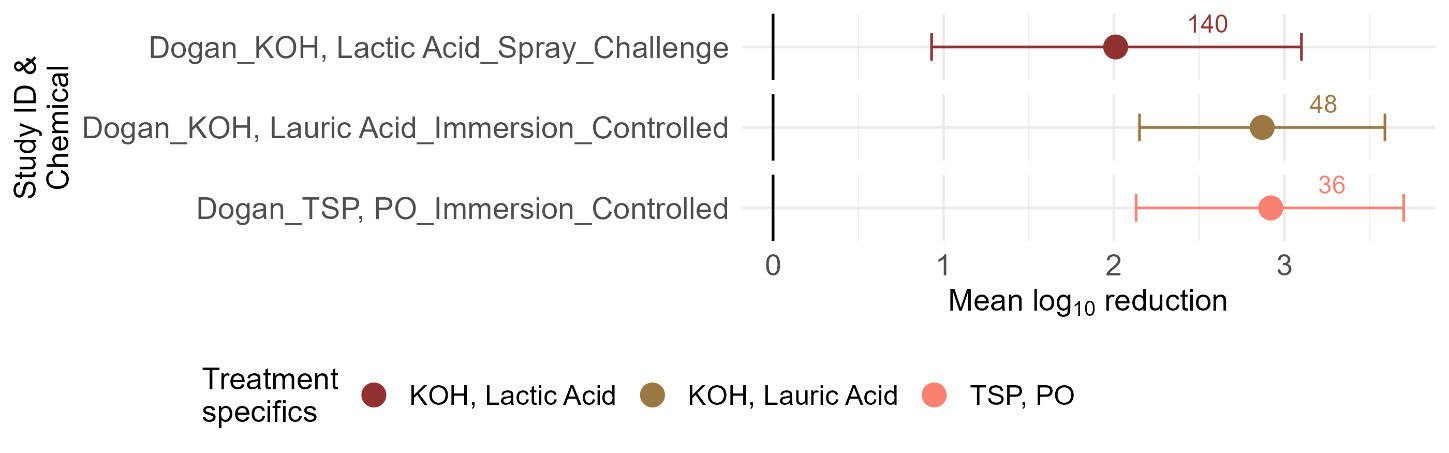
Combined chemical treatments were evaluated by Dogan et al., 2021 to determine whether pairing interventions could enhance efficacy compared to single-agent applications. These combinations included alkaline agents with organic acids and applied via spray or immersion. In this review, three combined treatments were assessed: Potassium hydroxide (KOH) and lactic acid (Spray), potassium hydroxide (KOH) and dodecanoic acid (Immersion), and trisodium phosphate (TSP) + potassium oleate (Immersion) (Figure 6).
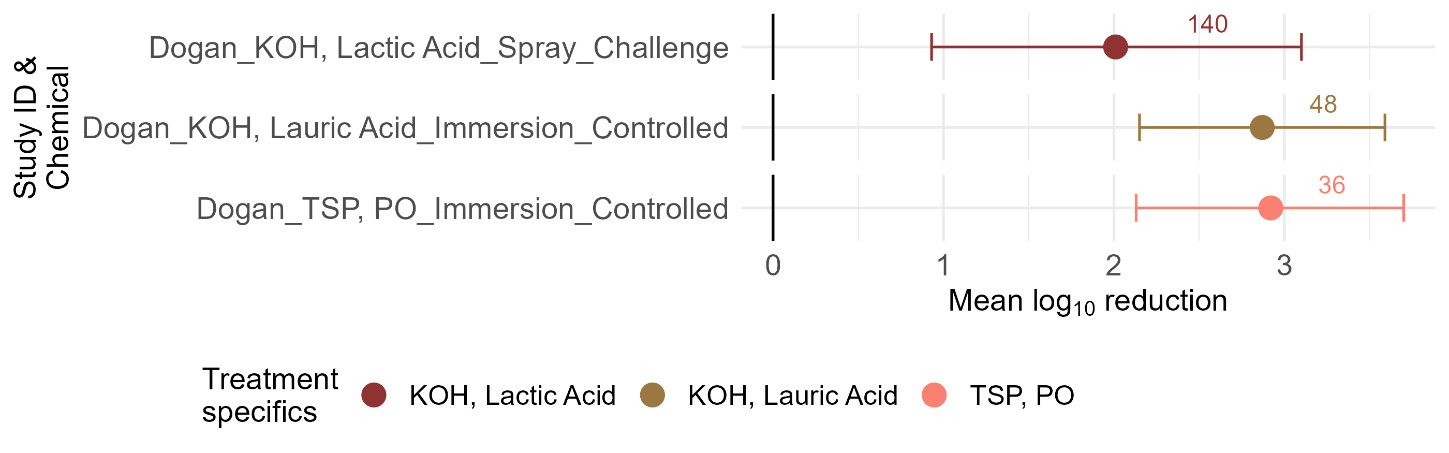
Dogan et al., 2021 reported that potassium hydroxide (KOH) combined with lactic acid, applied via spray in seven challenge trials, achieved a mean reduction of 2.01 log₁₀ CFU/unit (95% CI: 0.93 to 3.10; I² = 99.7%). KOH alone achieved a log reduction of 2.52 log10 CFU/unit (95% CI: 1.70 to 3.34; I2: 92.84). However, immersion-based combinations were more effective. KOH combined with lauric acid achieved 2.87 log₁₀ CFU/unit (95% CI: 2.15 to 3.59; I² = 90.5%) across four controlled trials, while trisodium phosphate (TSP) combined with potassium oleate (PO) produced a reduction of 2.92 log₁₀ CFU/unit (95% CI: 2.13 to 3.70; I² = 87.8%) from three controlled trials. TSP alone showed a reduction of 2.44 log₁₀ CFU/unit (95% CI: 2.23 to 2.26; I² =0) and PO alone showed a reduction of 2.34 log₁₀ CFU/unit (95% CI:1.72 to 2.95 ; I² =89.91). Lauric acid alone was not tested. These findings suggest that combining chemicals can be effective.
Oxidising Agents
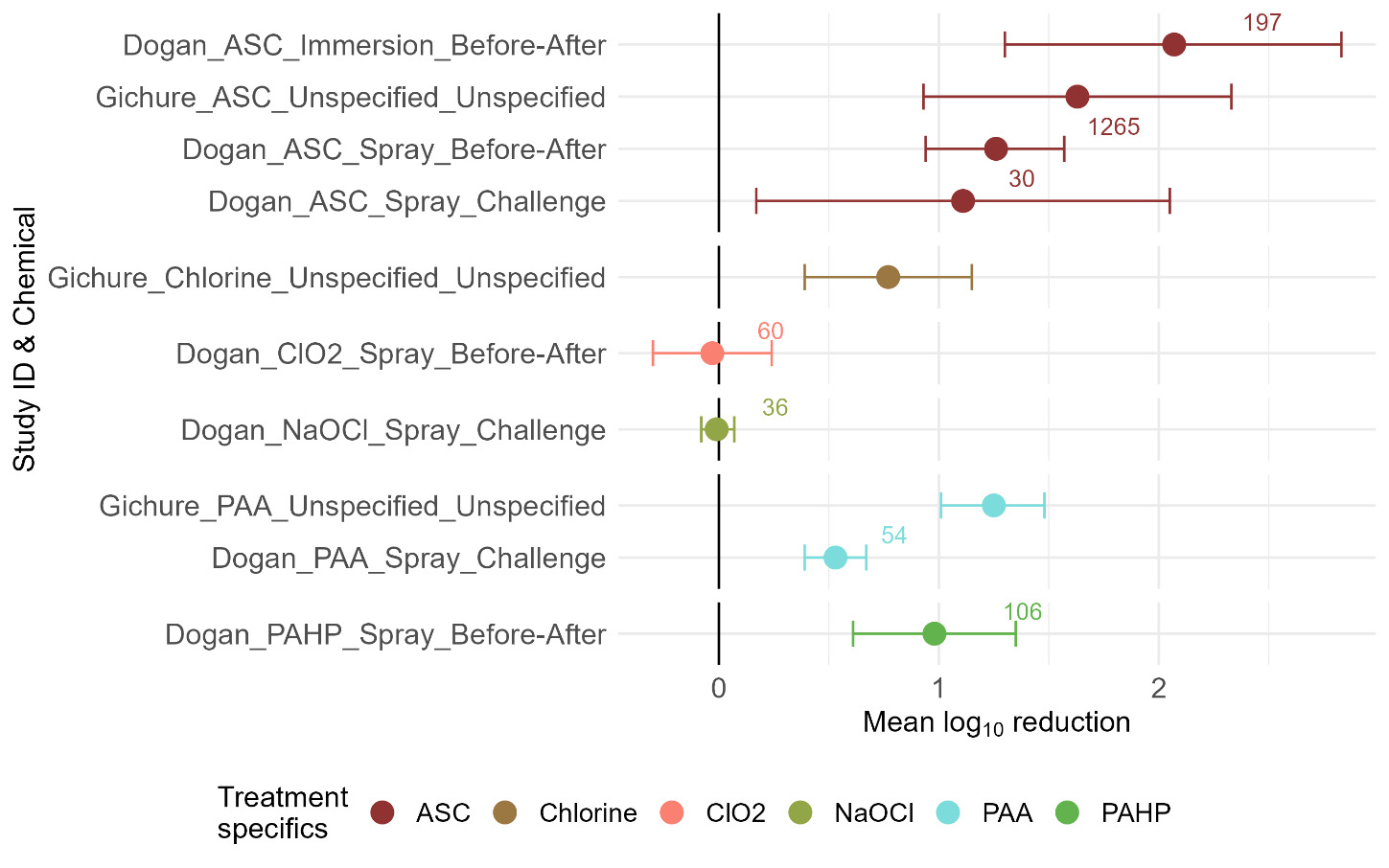
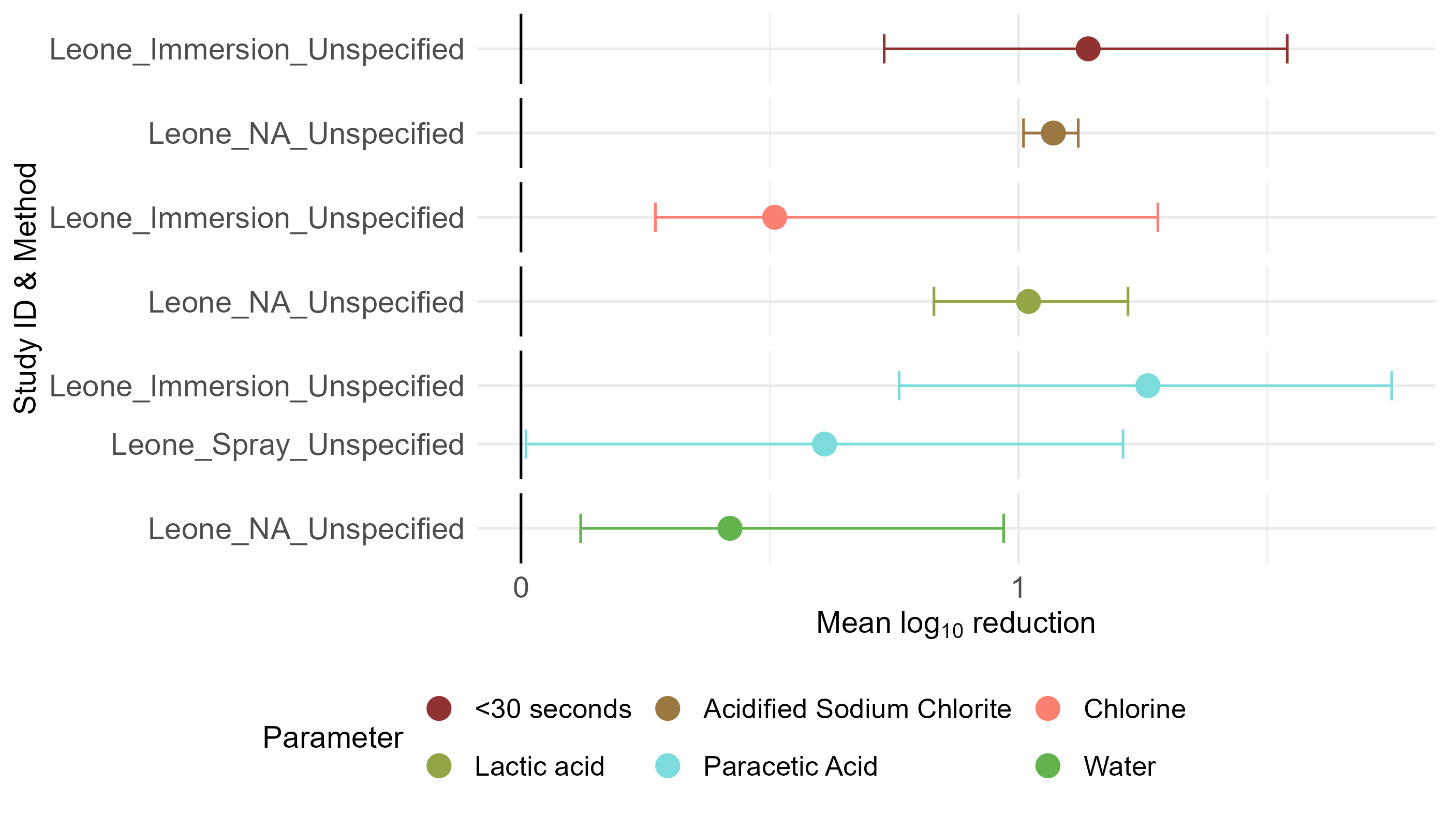
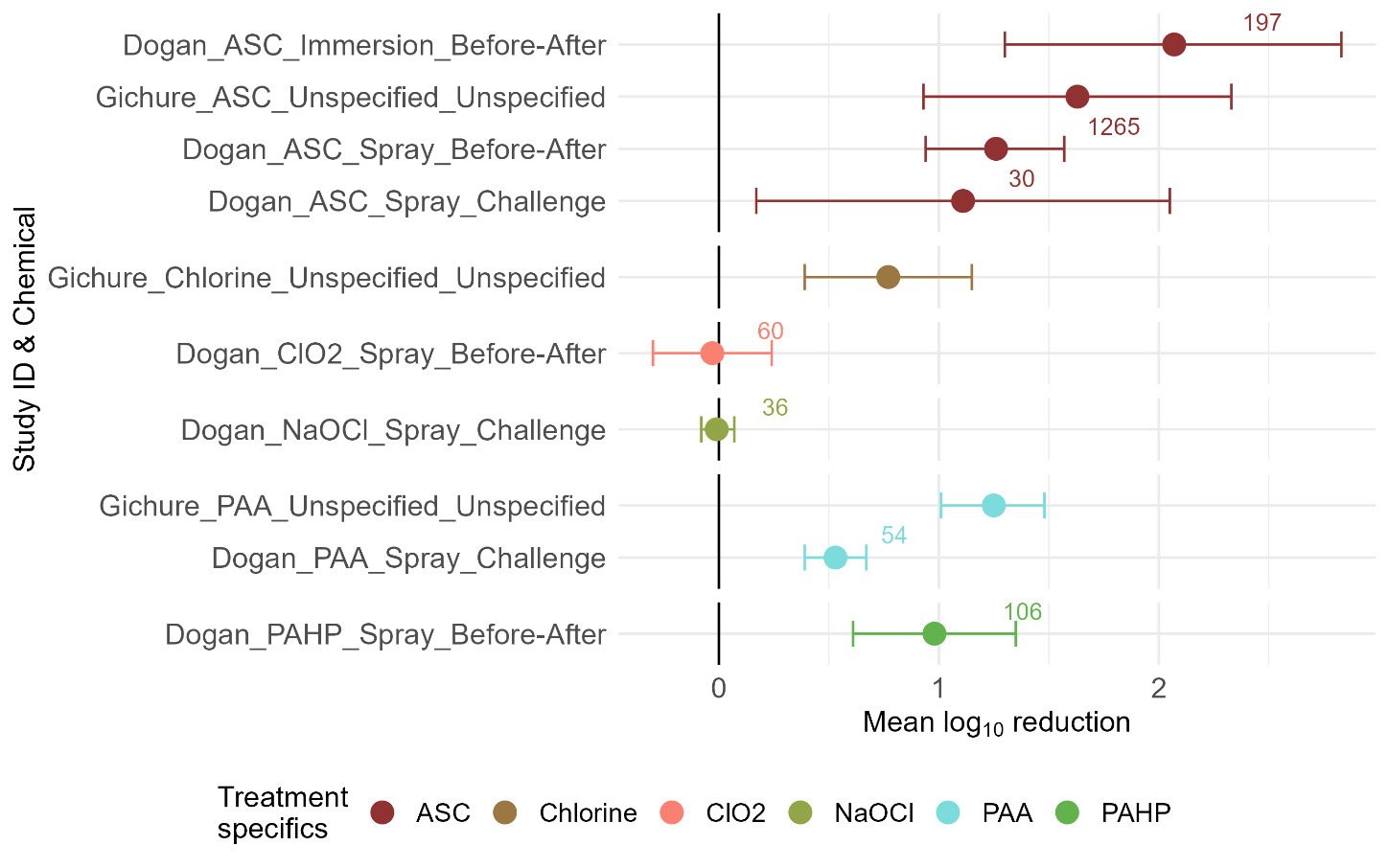
Oxidising agents can inactivate microorganisms through oxidative damage to cell membranes, proteins, and nucleic acids. These chemicals are often applied as sprays, washes, or immersion treatments and can vary in effectiveness depending on concentration, contact time, and application method. In this review, the following oxidising agents were assessed for their antimicrobial efficacy against Campylobacter on poultry carcases and cuts: acidified sodium chlorite (ASC), chlorine, chlorine dioxide (ClO₂), sodium hypochlorite (NaOCl), peroxyacetic (peracetic) acid (PAA) and peroxyacetic hydrogen peroxide (PAHP) (Figure 7).
Acidified Sodium Chlorite (ASC)
Acidified sodium chlorite (ASC) was evaluated in both immersion and spray applications (Figure 7). Immersion treatments, reported by Dogan et al., 2021, showed a significant microbial reduction of 2.07 log₁₀ CFU/unit (95% CI: 1.30 to 2.83, I² = 88%) pooled from three before-after trials. Spray application, as reported by Dogan et al., 2021, also resulted in a significant reduction of 1.26 log₁₀ CFU/unit (95% CI: 0.94 to 1.57, I² = 50%) across four trials. Challenge spray trials demonstrated a reduction of 1.11 log₁₀ CFU/unit (95% CI: 0.17 to 2.05, I² = 82%) from two trials. This may reflect more standardised application methods or less variability in exposure.
Moreover, Gichure et al., 2022 reported an effect of 1.63 log₁₀ CFU/carcase (95% CI: 0.93 to 2.33, I² = 97%). However, the application method used to apply ASC was not specified in the report.
In study FS990010/M1039 (Table 10), ASC was an effective chemical for reducing Campylobacter on poultry carcases. It was applied using a misting spray system on both breast and neck skin, with the following results:
-
>1.45 log₁₀ reduction on neck skin (Trial 2): misted for 15 seconds.
-
>1.60 log₁₀ reduction on neck skin (Trial 4): misted for 30 seconds.
-
>1.57 log₁₀ reduction on breast skin (Trial 1): misted for 10 second
-
>1.82 log₁₀ reduction on breast skin (Trial 37): misted for 10 seconds, 5-minute dwell, 5-second rinse
These findings suggest that ASC can be an effective chemical intervention but that efficacy depends on application type and parameters such as duration of treatment, with greater effects seen for longer misting times and post-application dwell periods. This highlights the importance of application parameters, as small adjustments to protocols can improve outcomes.
Chlorine and Chlorine Dioxide (ClO₂)
Chlorine was assessed by Gichure et al., 2022 across 16 trials with unspecified application methods, showing a pooled reduction of 0.77 log₁₀ CFU/carcase (95% CI: 0.39 to 1.15; I² = 95.3%) (Figure 7).
Chlorine dioxide spray, reported by Dogan et al., 2021 was the least effective chemical intervention among those reviewed. No significant microbial reduction was seen (-0.03 log₁₀ CFU/unit; 95% CI: -0.30 to 0.24, I² = 22%).
Further evidence from study FS121014A / M01058 (Table 9) supports this conclusion. In this study, chlorine dioxide was applied via an inside and outside washer using concentrations of 0.5 ppm free chlorine, 0.7 ppm total chlorine, and 1.0 to 1.1 ppm chlorine dioxide at the point of carcase application. There is no described justification for the concentration chosen for the chlorine dioxide application. A slight increase of 0.18 log₁₀ CFU/g was recorded one day post-slaughter in treated versus control carcases, and only a minimal decrease of 0.04 log₁₀ CFU/g was observed by day seven.
These findings collectively suggest that chlorine dioxide, under the tested parameters described above, has minimal antimicrobial efficacy in poultry processing.
Sodium Hypochlorite (NaOCl)
Sodium hypochlorite spray was evaluated by Dogan et al., 2021 in two challenge trials and showed no significant effect (average of -0.01 log₁₀ CFU/unit; 95% CI: -0.08 to 0.07; I² = 0%) (Figure 7). It can be concluded that this chemical intervention is ineffective for reducing Campylobacter under the conditions tested.
Peracetic Acid (PAA)
Peracetic Acid (PAA) (at 400-1000 ppm) was evaluated by Gichure et al., 2022, (across 9 trials from 3 studies) who reported a mean reduction of 1.25 log₁₀ CFU/carcase (95% CI: 1.01 to 1.48, I² not available) (Figure 7). The confidence interval suggests a reliable effect.
Dogan et al., 2021 evaluated PAA spray in three challenge trials, observing a reduction of 0.53 log₁₀ CFU/unit (95% CI: 0.39 to 0.67; I² = 69.4%). These findings suggest PAA may be effective but further research is needed to confirm optimal conditions and application methods.
Peroxyacetic Hydrogen Peroxide (PAHP)
PAHP was evaluated by Dogan et al., 2021, in four before-after spray trials, achieving a significant reduction of 0.98 log₁₀ CFU/unit (95% CI: 0.61 to 1.35; I² = 0%), indicating efficacy.
Other Chemicals
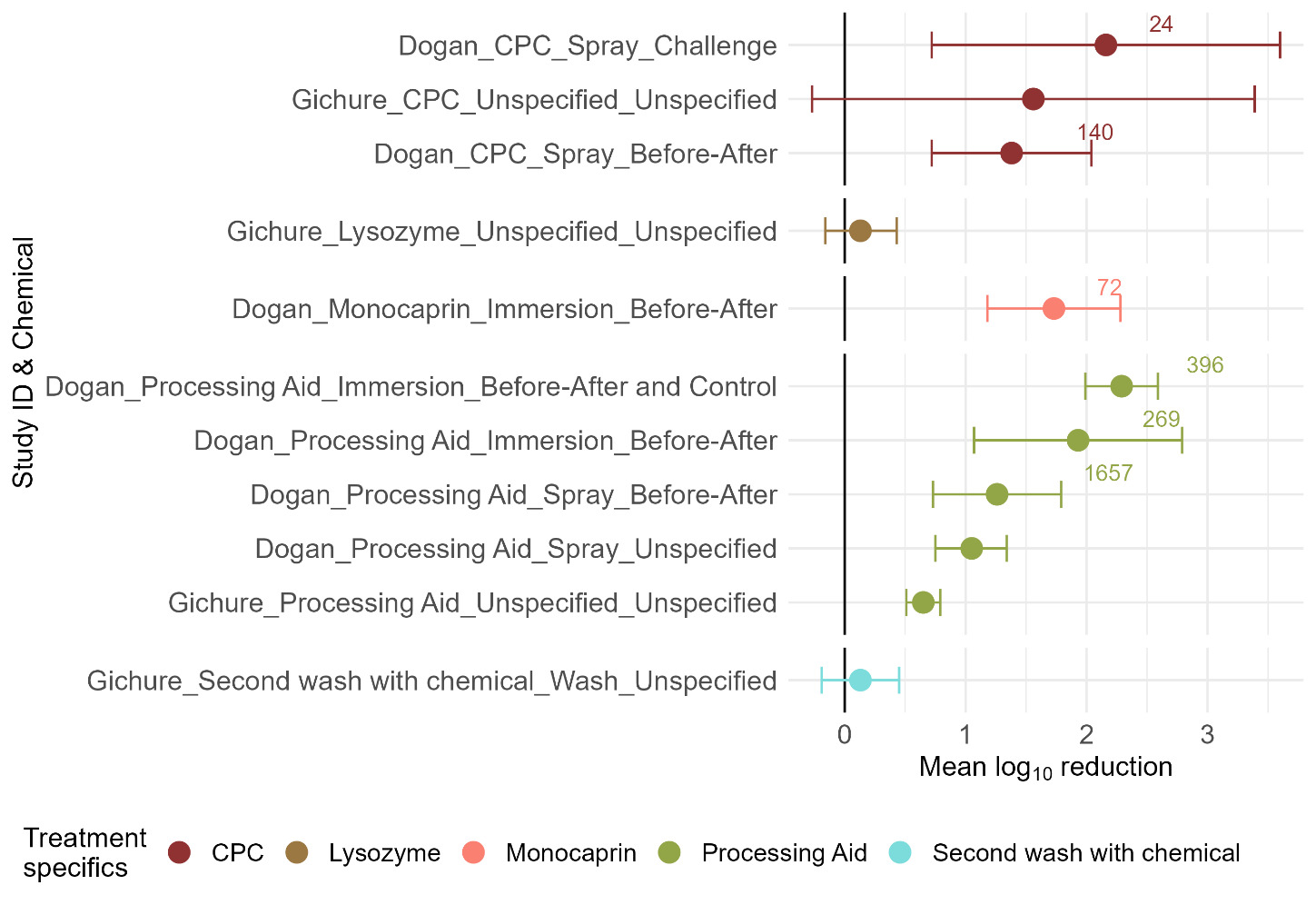
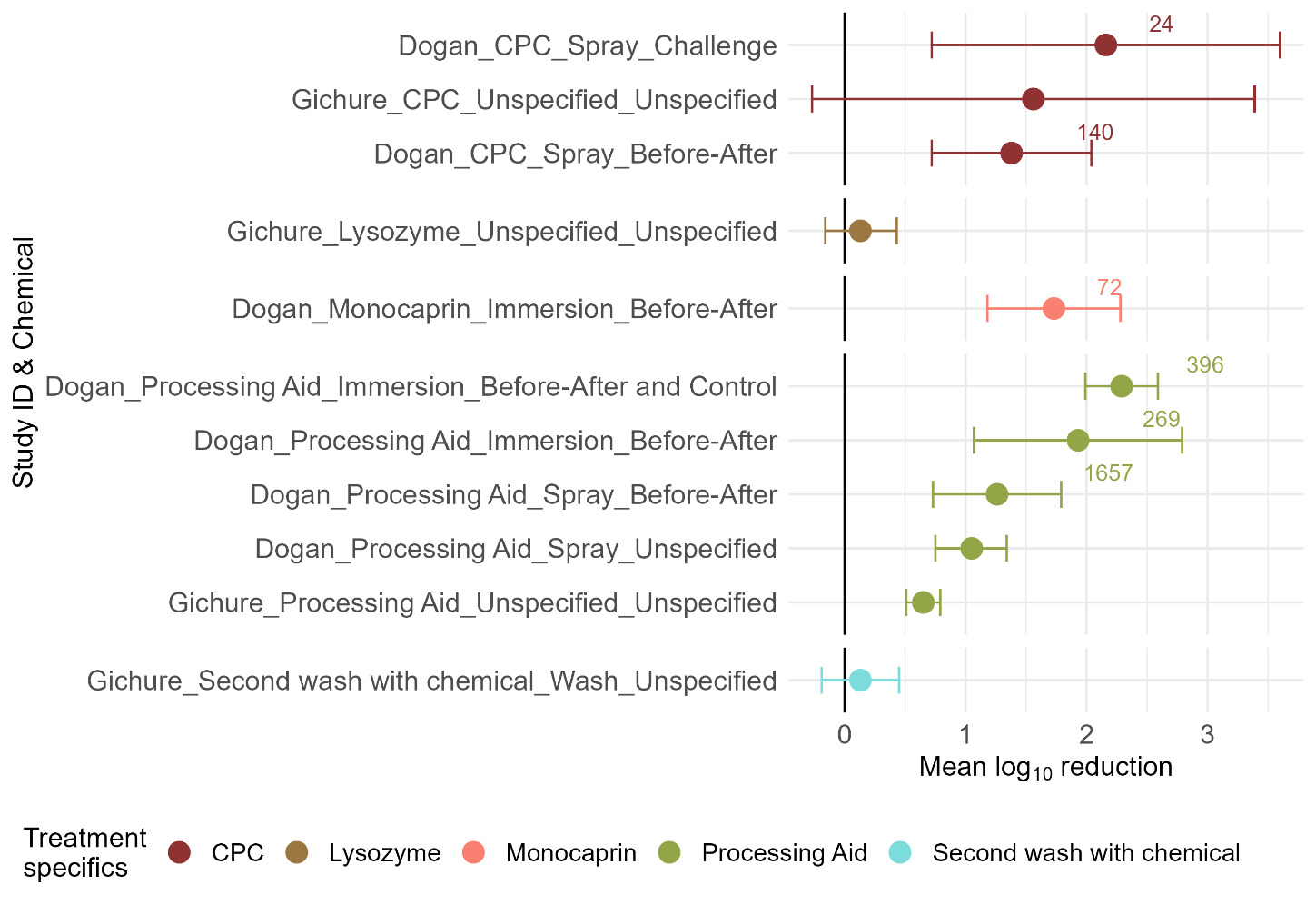
In addition to organic acids, inorganic chemicals, and oxidising agents, several other chemical interventions were assessed for their potential to reduce Campylobacter contamination on poultry carcases and cuts. These included cetylpyridinium chloride (CPC), lysozyme, monocaprin, processing aids (unspecified chemicals), and secondary chemical washes (chemical unspecified) (Figure 8). The following section summarises their antimicrobial performance across different application methods and experimental conditions.
Cetylpyridinium Chloride (CPC)
Cetylpyridinium Chloride (CPC) at 0.5% concentration was assessed by Gichure et al., 2022, and Dogan et al., 2021. Gichure et al., 2022 reported a single trial with a reduction of 1.56 log₁₀ CFU/carcase (95% CI: -0.27 to 3.39, I² not available) but this result was not statistically significant, with a confidence interval crossing zero.
Dogan et al., 2021 found a more consistent effect from CPC spray across 4 Before-After trials from 2 studies, with significant reductions of 1.38 log₁₀ CFU/unit (95% CI: 0.72 to 2.04, I² = 99%) on the carcase, and of 2.16 log10 (95% CI: 0.72 to 3.60, I²=99%) on the skin (2 trials across one challenge study). However, it is important to note that the carcase trials were conducted in processing environments, while the skin trials were part of a controlled laboratory challenge study. This difference in context may influence the observed effectiveness, as lab conditions often allow for more precise application and control over variables, whereas processing environments introduce real-world variability. This highlights the need to optimise application methods to ensure consistent outcomes across different settings.
Unspecified Processing Aids
Immersion trials pooled by Dogan et al., 2021 found reductions of 2.29 log₁₀ CFU/unit (95% CI: 1.99 to 2.59; I² = 94.8%) across 39 trials and 1.93 log₁₀ CFU/unit (95% CI: 1.07 to 2.79; I² = 98.3%) across six trials (Figure 8). Spray applications also demonstrated reductions, with 1.26 log₁₀ CFU/unit (95% CI: 0.73 to 1.79; I² = 99.6%) from 20 trials and 1.05 log₁₀ CFU/unit (95% CI: 0.75 to 1.34; I² = 97.3%) from unspecified spray trials. Gichure et al., 2022 reported 0.65 log₁₀ CFU/unit (95% CI: 0.51 to 0.79; I² = 94.9%) from 107 unspecified trials. These findings suggest the processing aids tested are effective, however, the usefulness of this information is limited as we lack specific details about the processing aid (e.g., chemical, concentration, duration of application).
Monocaprin, lysozyme and Secondary Wash
Monocaprin immersion was evaluated by Dogan et al., 2021 in 12 trials, showing a reduction of 1.73 log₁₀ CFU/unit (95% CI: 1.18 to 2.28; I² = 91.8%), indicating moderate efficacy.
Lysozyme was assessed by Gichure et al., 2022 in two unspecified trials, showing negligible effect of 0.13 log₁₀ CFU/unit (95% CI: -0.16 to 0.43). Similarly, a second wash with chemical achieved 0.13 log₁₀ CFU/unit (95% CI: -0.19 to 0.45; I² = 99.5%), suggesting these interventions provide minimal benefit and may not warrant further investigation.
Edible films
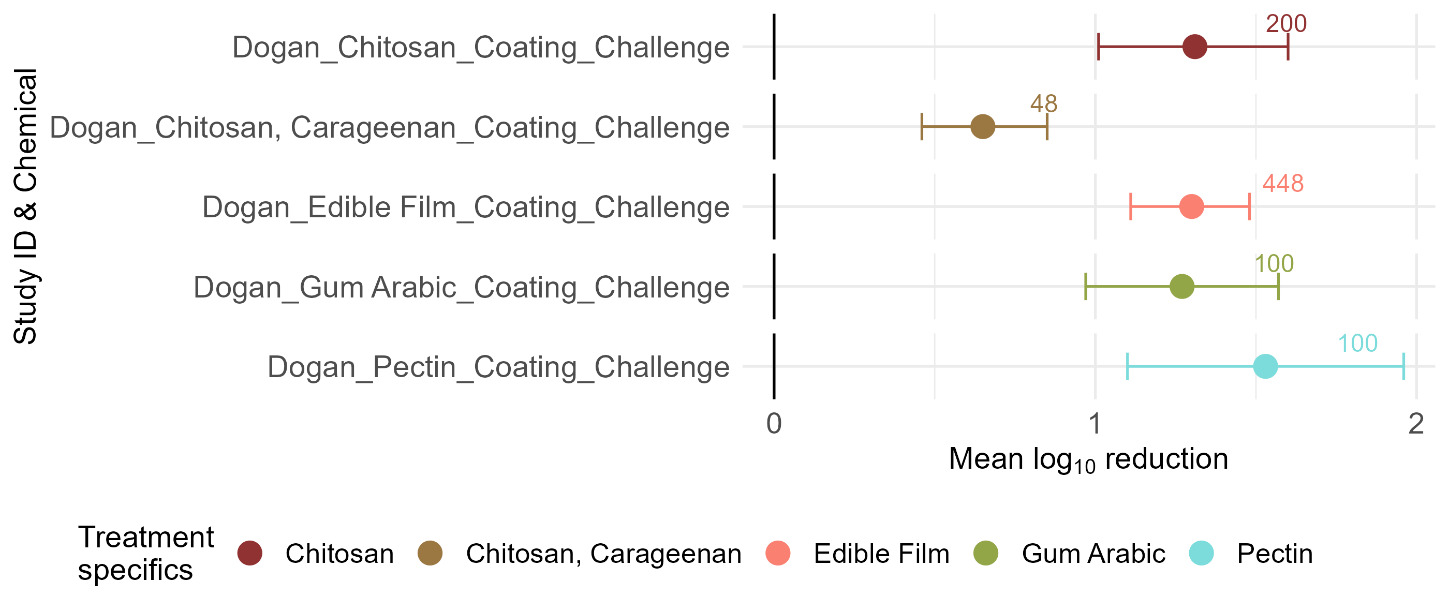
Edible films and coatings represent an alternative intervention strategy aimed at reducing Campylobacter contamination on poultry surfaces. These treatments form a physical barrier and may incorporate antimicrobial compounds to inhibit bacterial growth. In this review, several coatings were evaluated, including chitosan, chitosan combined with carrageenan, gum arabic, pectin, and other edible films (Figure 9). All were applied as surface coatings in challenge trials to determine their effectiveness under controlled conditions.
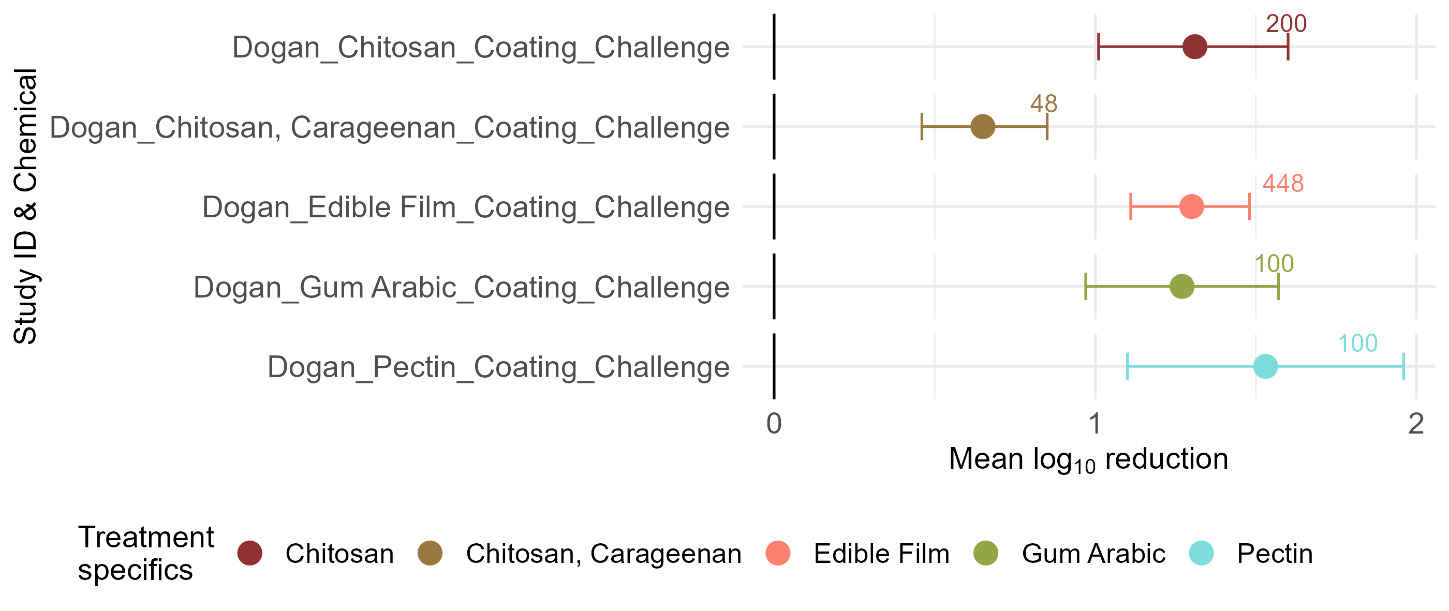
Dogan et al., 2021 reviewed several natural and edible coatings for antimicrobial effectiveness in challenge trials, noting differences in outcomes depending on coating type and formulation (Figure 9). The review did not include detailed procedural descriptions of coating application. The mean log10 reductions with the associated CIs and heterogeneity (I2 %) can be found in Table 3 below. While most treatments averaged reductions between 1.3 and 1.5 log10, the combination of chitosan and carrageenan resulted in a comparatively lower mean reduction of 0.65 log10.
Plant Extracts
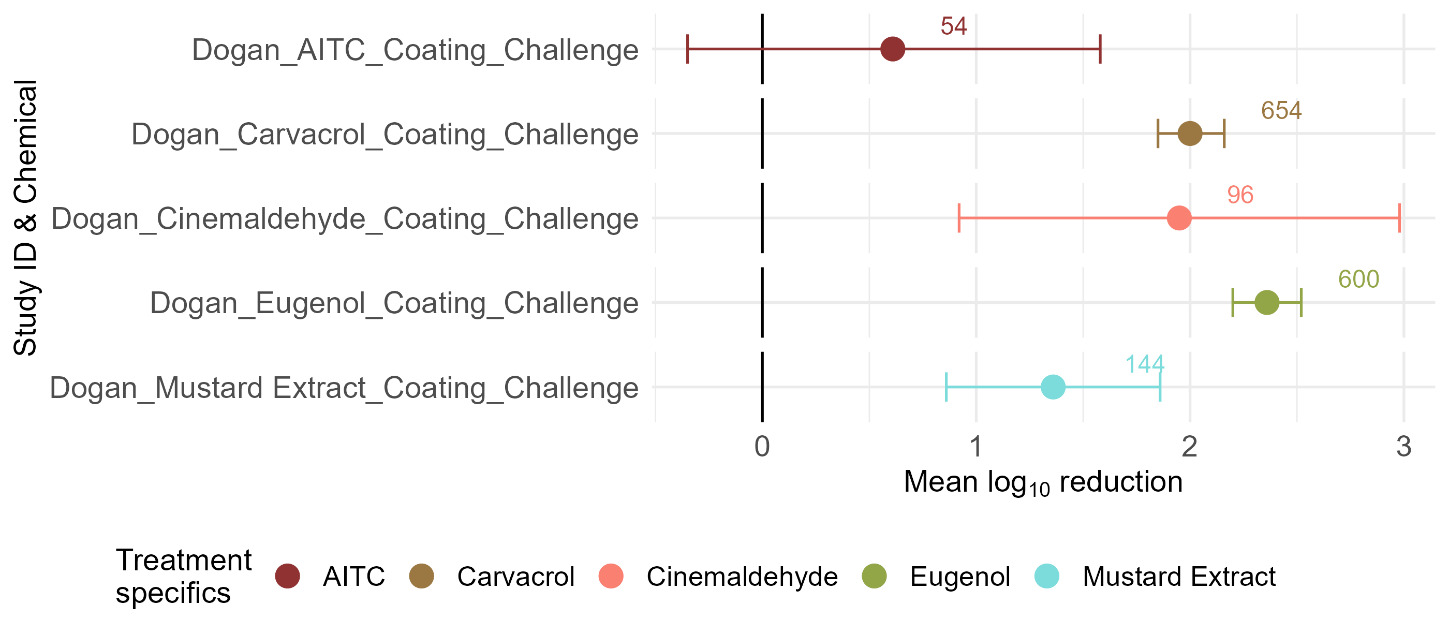
Edible coatings incorporating plant-derived antimicrobials represent an alternative intervention strategy aimed at reducing microbial contamination on poultry surfaces. In this review, several plant-based coatings were evaluated, including eugenol, carvacrol, cinnamaldehyde, mustard extract, and allyl isothiocyanate (AITC) (Figure 10). All were applied as surface coatings in challenge trials to assess their effectiveness under controlled conditions as the intervention is within developmental stage.
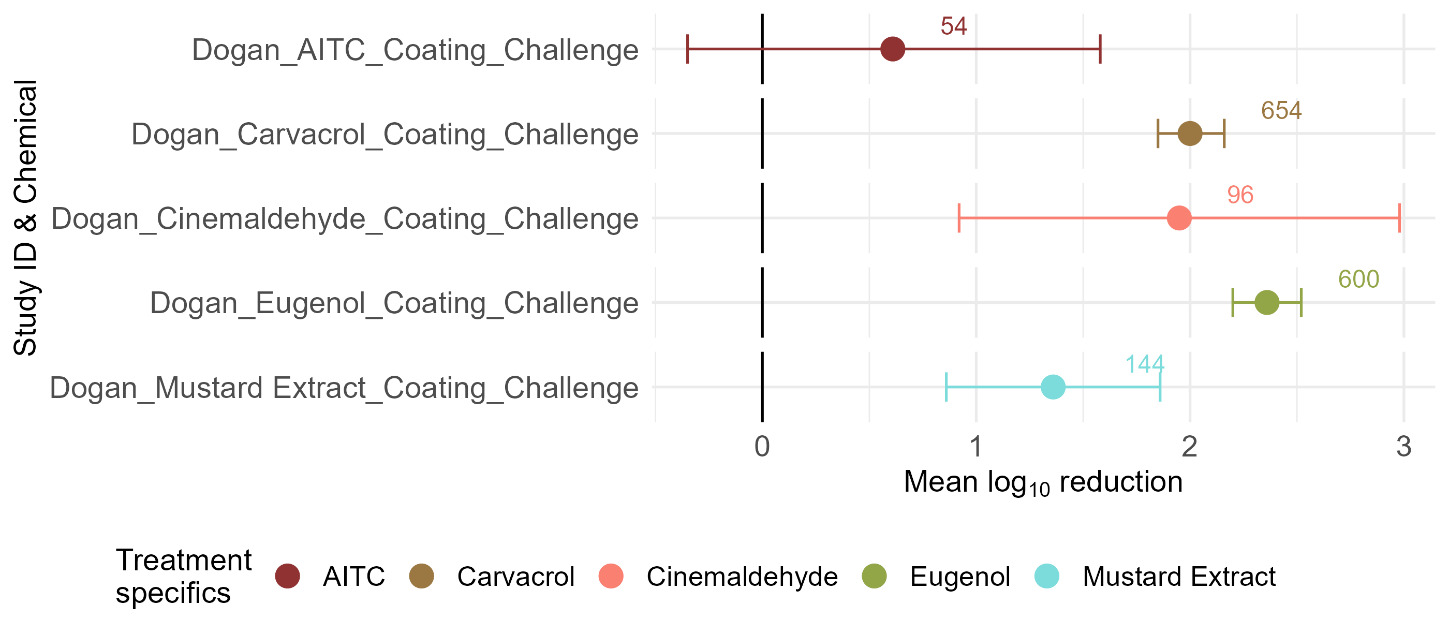
Dogan et al., 2021 evaluated edible coatings incorporating plant extracts for antimicrobial efficacy in challenge trials (Figure 10). Eugenol-based coatings achieved the greatest reduction, with a mean log₁₀ decrease of 2.36 log₁₀ CFU/g (95% CI: 2.20 to 2.52, I² = 88%). Carvacrol also showed efficacy, reducing counts by 2.00 log₁₀ CFU/g (95% CI: 1.85 to 2.16, I² = 97%). Cinnamaldehyde coatings resulted in a 1.95 log₁₀ CFU/g, 95% CI: 0.92 to 2.98, I² = 97%), though confidence intervals indicate greater inconsistency, due to the smaller sample size. Mustard extract coatings were effective, achieving 1.36 log₁₀ CFU/g reduction (95% CI: 0.86 to 1.86, I² = 96%). Allyl isothiocyanate (AITC) resulted in a mean reduction of 0.61 log₁₀ CFU/g (95% CI: –0.35 to 1.58, I² = 96%). As the confidence interval crosses zero, conclusions on effectiveness cannot be drawn.
Overall, these findings suggest several edible coatings represent a promising direction for further research.
Chilling and freezing Interventions
This section summarises the effectiveness of chilling and post-chilling interventions used in poultry slaughterhouses to reduce Campylobacter contamination. Chilling refers to the rapid cooling of carcases, typically through immersion or air chilling to inhibit bacterial growth. Post-chilling interventions are additional treatments applied after chilling, such as chemical rinses or additional cooling, to further reduce residual contamination before packaging and distribution. Interventions covered include immersion chilling (with and without additives), air chilling, and post-chill technologies, and refrigerated and frozen storage. The findings compared pooled log₁₀ reductions, confidence intervals, and heterogeneity scores across reviews, highlighting both the effectiveness and variability of these interventions. It is important to note that while chilling is approved in the UK, chilling with additives is not.
Immersion Chilling
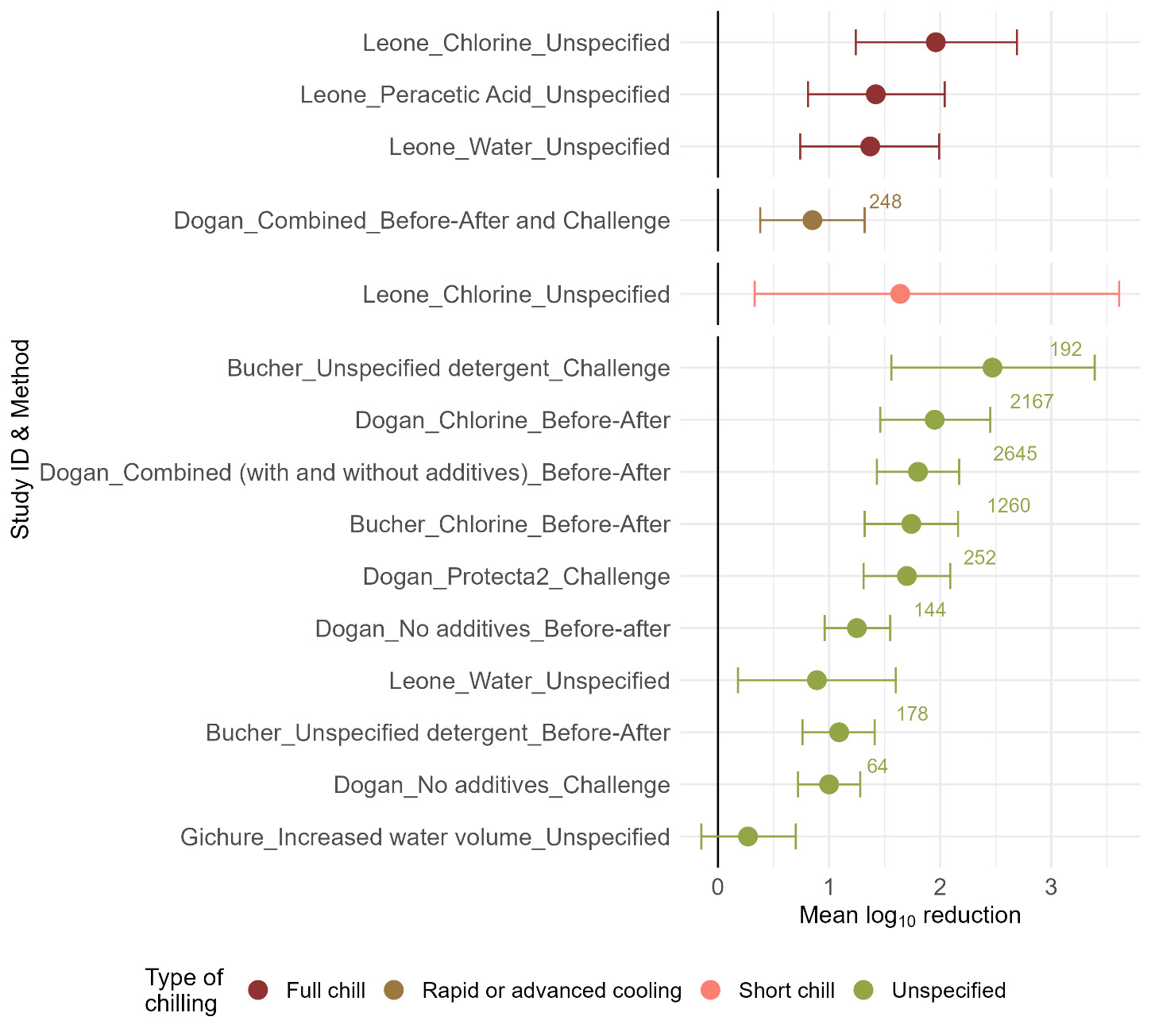
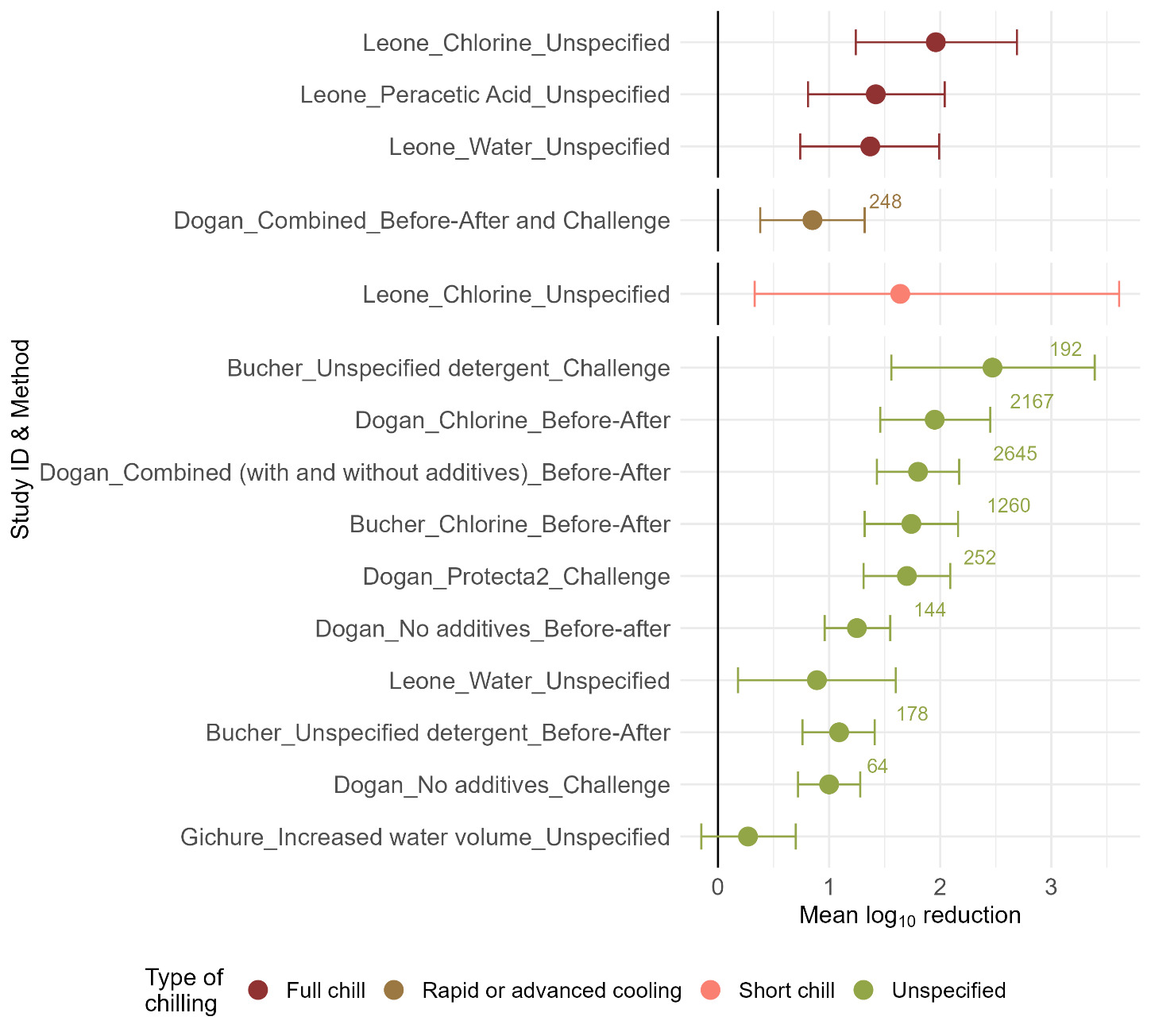
Dogan et al., 2021 reviewed 23 before-after (BA) trials from 23 studies reporting concentration changes due to immersion chilling. All trials (with and without additives) consistently reported log10 reductions, with a pooled size effect of 1.80 log₁₀ (95% CI: 1.43 to 2.17, I² = 98%) (Figure 11).
Without additives
Leone et al., 2024 investigated water-based immersion chilling interventions (without additives). Immersion chilling in water demonstrated a log₁₀ reduction of 1.37 (95% CI: 0.74 to 1.99, I² = 99%). Short-duration chill immersion in water demonstrated a log₁₀ reduction of 0.89 (95% CI: 0.18 to 1.60, I² = 63%).
Gichure et al., 2022 also evaluated the effect of increasing chill water volume using a fixed-effect model. The log₁₀ reduction was 0.27 (95% CI: –0.15 to 0.70, I² not available), with the result not reaching statistical significance. The confidence interval includes zero, suggesting that the intervention does not reduce microbial loads.
Dogan et al., 2021 also evaluated the efficacy of water-based immersion chilling without additives in reducing Campylobacter contamination. The pooled effect size, derived from two trials, indicated a statistically significant reduction of 1.25 log₁₀ CFU/unit (95% CI: 0.96 to 1.55, I² = 88%), suggesting efficacy. However, data was obtained from only two trials, which reduces the reliability of the estimate. Therefore, while the results suggest this intervention can be effective, the evidence should be interpreted with caution. Further studies are needed to validate these findings across diverse operational settings, such as facilities with varying throughput volumes, and water quality management practices.
With additives
Chlorine
Several studies have consistently demonstrated that immersion chilling with chlorine is effective in reducing Campylobacter contamination, though the degree of effectiveness varies depending on the timing and duration of the treatment.
Dogan et al., 2021 and Bucher et al., 2015 found that immersion chilling with chlorine reduced Campylobacter by 1.95 log₁₀ (95% CI: 1.46 to 2.45, I² = 98%) and 1.74 log₁₀ (95% CI: 1.32 to 2.16, I² = 86%), respectively. This indicates consistent effective microbial reduction. Moreover, Leone et al., 2024 found a similar effect with full chill immersion (>30 minutes) with chlorine as there was a reduction of 1.96 log₁₀ (95% CI: 1.24 to 2.69, I² = 99%).
Leone et al., 2024 also evaluated the variations in immersion timing and found short chill immersion (2-15 minutes) in chlorine resulted in a reduction of 1.64 log₁₀ (95% CI: 0.33 to 3.61, I² = 96%). Therefore, it could be suggested that short chill immersion in chlorine is slightly less effective, compared to full chill immersion with chlorine. However, the overlapping CIs between interventions implies that no conclusion can be drawn about the relative effectiveness without further quantitative analysis.
Peracetic Acid (PAA)
Leone et al., 2024 evaluated the antimicrobial efficacy of peracetic acid (PAA) applied during full chill immersion. Full chill immersion with PAA reduced Campylobacter by 1.42 log₁₀ (95% CI: 0.81 to 2.04, I² = 96%).
Other additives
Dogan et al., 2021 reported that immersion chilling with ‘Protecta2’, a proprietary antimicrobial agent, results in a microbial reduction of 1.70 log₁₀ CFU/unit (95% CI: 1.31 to 2.09, I² = 93%). However, the results are based on only three challenge trials in one study which limits the reliability of the outcome.
Detergent
Bucher et al., 2015 assessed the impact of immersion chilling with an unspecified detergent, though the specific agents were not disclosed, across two experimental designs: Before and after (BA) trials and challenge trials (ChT).
In the challenge trials (five trials across two studies), Campylobacter spp. were reduced by 2.47 log₁₀ (95% CI: 1.56 to 3.39, I² = 96%). This indicated that the disinfectant in question is an effective antimicrobial. In contrast, the Before-After studies (six trials across three studies) demonstrated a lesser reduction in microbial load, with a pooled log₁₀ reduction of 1.09 (95% CI: 0.76 to 1.41, I² = 0%). The lack of detail about the specific disinfectant used in these studies limits the practical application of the findings.
These findings underscore the critical influence of study design and full disclosure of treatments used on the utility of reported outcomes, highlighting the need to consider all relevant factors when interpreting efficacy data, as these can significantly affect both the magnitude and consistency of the reported outcomes.
Chilling
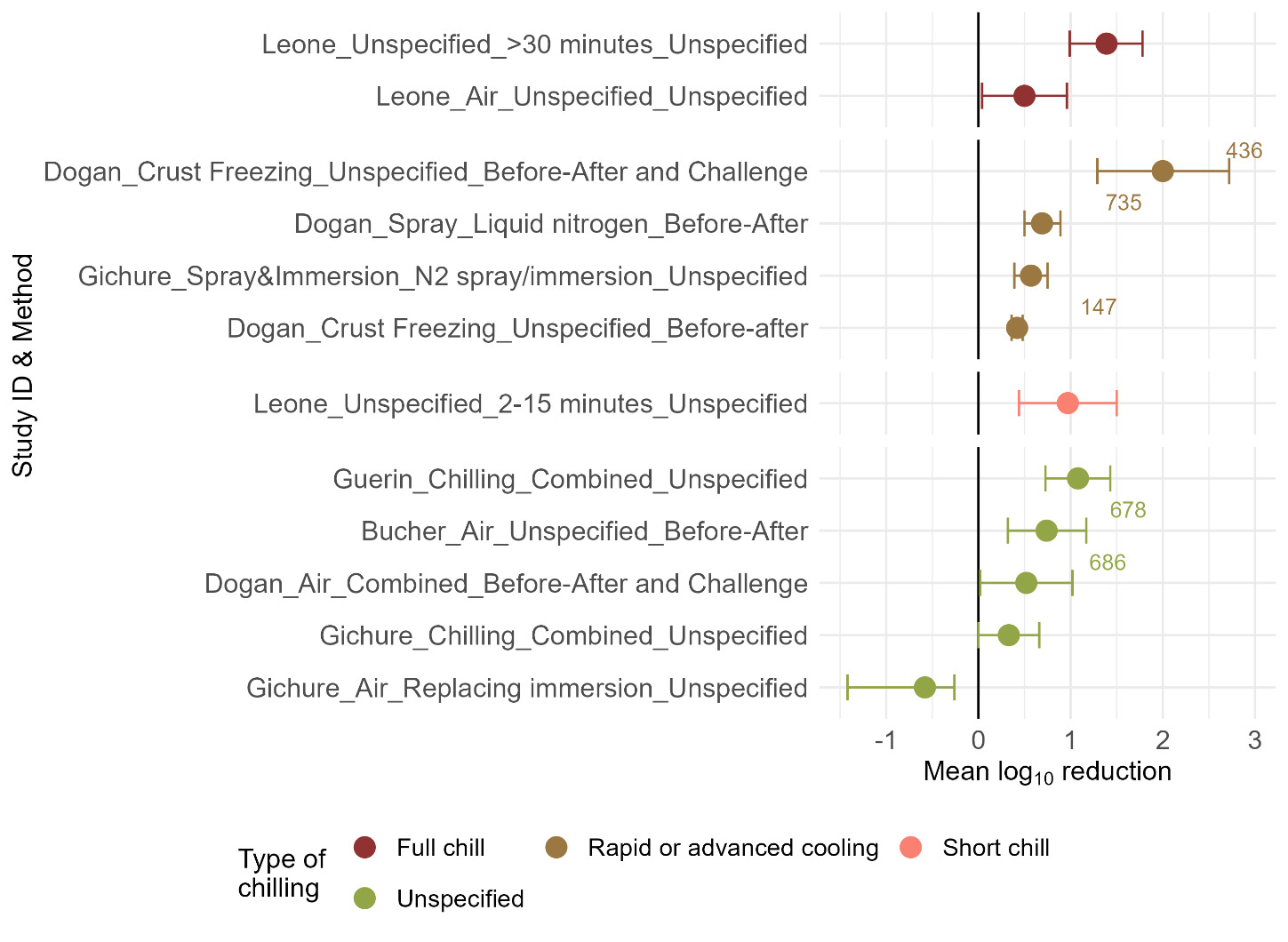
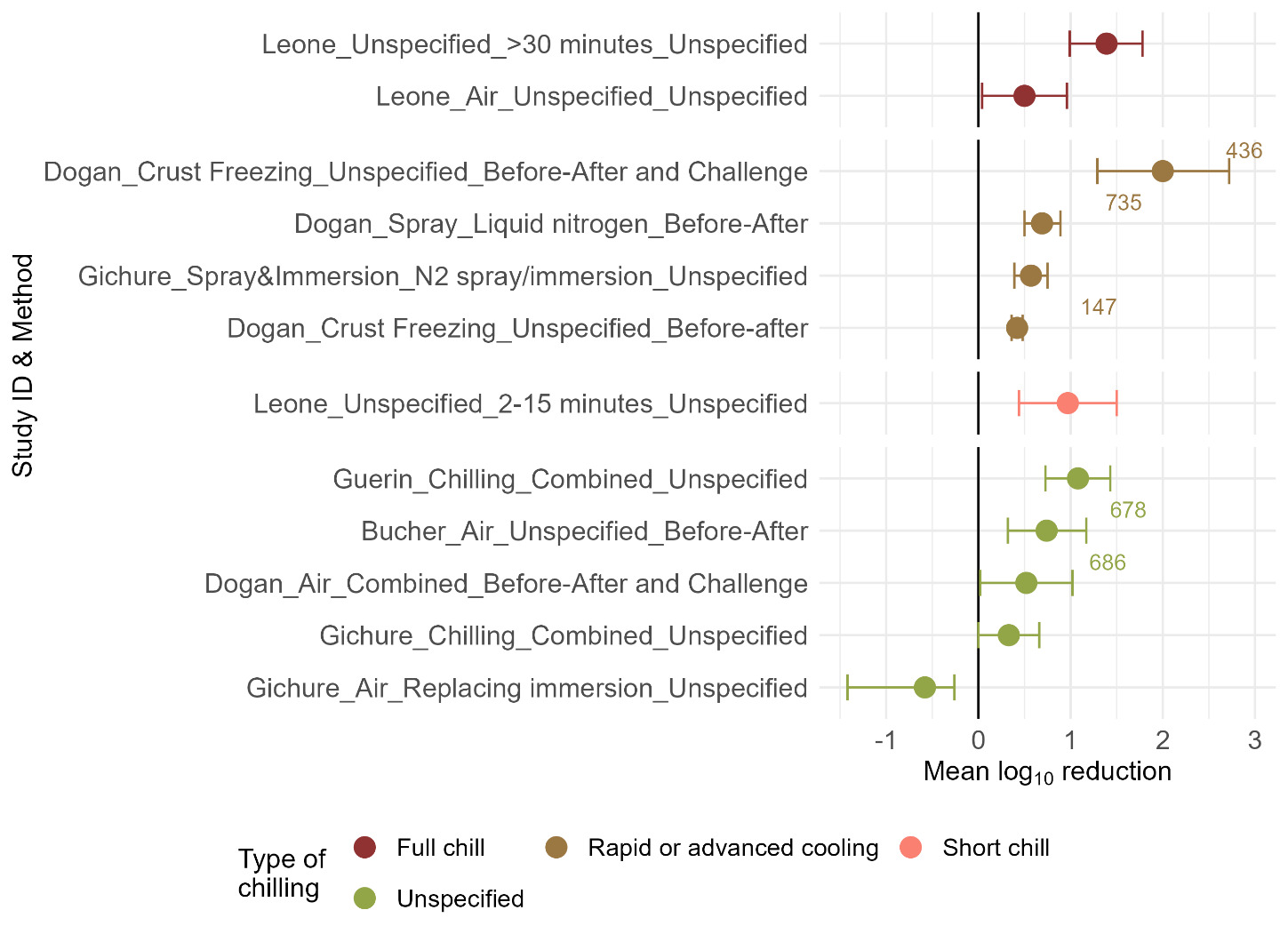
Two reviews assessed the overall impact of chilling (specifications not defined) on microbial reduction, with different outcomes (Figure 12). Guerin et al., 2010 reported a pooled log₁₀ reduction of 1.08 (95% CI: 0.73 to 1.43, I² = 98%). In contrast, Gichure et al., 2022, reported that chilling had a lesser effect and resulted in a log₁₀ reduction of 0.33 (95% CI: 0.00 to 0.66, I² = 98%). The confidence interval includes zero, indicating that in some studies, chilling may have had no statistically significant impact. These findings highlight the inconsistency in microbial reduction outcomes associated with chilling.
Air Chilling
Several studies have assessed the effectiveness of air chilling as a microbial control intervention, with mixed results (Figure 12). Air chilling is a form of refrigeration, specifically in poultry slaughterhouses, that involves cooling carcases using cold, circulating air. Bucher et al., 2015 reported a reduction of 0.74 log₁₀ CFU/unit (95% CI: 0.32 to 1.17, I² = 91%), across 5 Before-After trials. Dogan et al., 2021 found a slightly lower, pooled mean reduction of 0.52 log₁₀ (95% CI: 0.02 to 1.02, I² = 94%).
Furthermore, Leone et al., 2024 examined the effect of full air chilling (>30 minutes) and observed a reduction of 0.50 log₁₀ (95% CI: 0.04 to 0.96, I² = 99%). These findings suggest that while air chilling may offer some reduction on Campylobacter, the effect is relatively low compared to immersion chilling and is variable.
Gichure et al., 2022 assessed air chilling as a replacement for immersion chilling and reported a slight microbial increase of -0.58 log₁₀ (95% CI: –1.42 to –0.26, I² = 95%). This suggests that air chilling was less effective at reducing Campylobacter concentrations than immersion chilling. The high heterogeneity further indicates that results varied significantly across trials, which limits the confidence in a single pooled estimate. Therefore, while air chilling may still contribute to Campylobacter reduction, the evidence suggests it may not be the most effective standalone intervention, especially when used as a direct alternative to immersion chilling.
Rapid or Advanced Cooling Techniques
Rapid cooling is a process used to quickly lower the temperature of poultry carcases after slaughter to inhibit bacterial growth without freezing the meat. Rapid cooling is typically applied via immersion or spray systems using coolants such as liquid nitrogen (Dogan et al., 2021) (Figure 12).
Immersion and spray-based rapid cooling
Immersion-based rapid cooling was evaluated by Dogan et al., 2021 who pooled data from nine trials across two studies. The meta-analysis yielded a log₁₀ reduction of 0.85 (95% CI: 0.38 to 1.32, I² = 99%), indicating a measurable effect.
Spray based rapid cooling using liquid nitrogen was assessed in two reviews. Gichure et al., 2022 reported that rapid surface cooling using nitrogen spray resulted in a reduction of 0.57 log₁₀ (95% CI: 0.39 to 0.75, I² = 97%). Moreover, Dogan et al., 2021 found a similar reduction of 0.69 log₁₀ (95% CI: 0.50 to 0.89, I² = 86%) across 28 Before-After trials. These treatments were applied using patented rapid surface chilling systems, either in continuous tunnels or batch cabinets. Therefore, both reviews suggest the intervention has measurable effects.
Crust Freezing
Crust freezing, which involves rapidly freezing the surface of a carcase without freezing the underlying meat, was evaluated by Dogan et al., 2021. In one Before-After trial in a commercial setting, the intervention reduced Campylobacter spp. by 0.42 log₁₀ CFU/unit (95% CI: 0.36 to 0.48) (Figure 12).
In contrast, six challenge trials under pilot plant settings assessed crust freezing either as a standalone intervention or in combination with steam or hot water immersion (two trials per group). These trials demonstrated a pooled reduction of 2.00 log₁₀ CFU/unit (95% CI: 1.29 to 2.72, I² = 98%). This indicates a potentially effective and relatively consistent effect under controlled conditions.
Chilling Duration
Leone et al., 2024 investigated how the duration of chilling influences Campylobacter reduction, comparing three categories: full chill (≥ 30 minutes), short chill (2 to 15 minutes), and post-chill treatments (≤ 30 seconds); post-chill treatments are applied immediately after the primary chilling step and are short in duration (Figure 12).
Full chill (≥ 30 mins) resulted in a reduction of 1.39 log₁₀ CFU/unit (95% CI: 0.99 to 1.78, I² = 99%). In contrast, short chill (2–15 mins) achieved a smaller point estimate reduction of 0.97 log₁₀ (95% CI: 0.44 to 1.50, I² = 58%).
While longer chilling durations generally enhance microbial reduction in conventional systems like air or immersion chilling, this relationship does not apply uniformly across all interventions.
Post-chill interventions
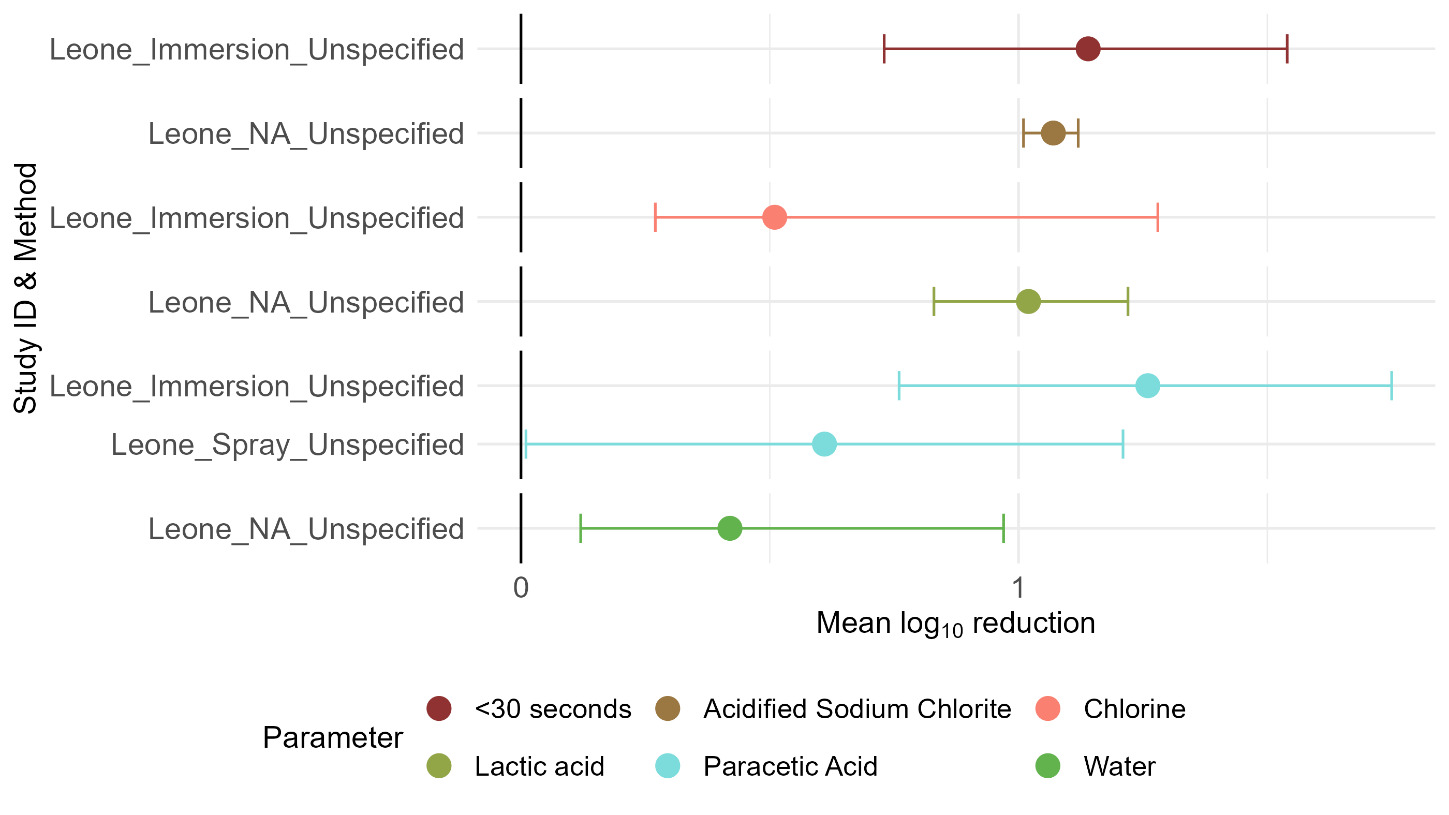
Post-chill interventions represent an additional strategy to reduce microbial contamination after carcases have reached the required internal temperature (interventions that occur after chilling). These treatments include simple water immersion and chemical additives such as lactic acid, chlorine, peracetic acid, and acidified sodium chlorite, applied either by immersion or spray, and applied for under 30 seconds (< 30 s). In this review, interventions were evaluated under controlled conditions to determine their effectiveness in reducing Campylobacter contamination on poultry carcases. These intervention methods were assessed in one review (Leone et al., 2024) (Figure 13).
Without additives
Post-chill immersion with water (without additives), can be used to help ensure that the carcases reach and maintain the required internal temperature (below 4°C). This parameter resulted in a reduction of 0.42 log₁₀ (95% CI: 0.12 to 0.97, I² = 96%).
With additives
Lactic acid
The study reported that post-chill application of lactic acid achieved a reduction of 1.02 log₁₀ (95% CI: 0.83 to 1.22, I² = 0%). The data was pooled from two studies, hence there is low statistical power to detect heterogeneity. Thus, there is limited confidence that the results would be consistent across a broader range of settings, populations, or methodologies.
Chlorine
Post-chill immersion (<30 seconds) in chlorine achieved a reduction of 0.51 log₁₀ (95% CI: 0.27 to 1.28, I² = 98%).
Peracetic Acid
Post-chill immersion in PAA resulted in a reduction of 1.26 log₁₀ CFU (95% CI: 0.76 to 1.75, I² = 99%), indicating effectiveness. Post-chill spray application of PAA yielded the reduction at 0.61 log₁₀ CFU (95% CI: 0.01 to 1.21, I² = 94%).
Acidified Sodium Chlorite
Post-chill application of acidified sodium chlorite achieved a reduction of 1.07 log₁₀ CFU (95% CI: 1.01 to 1.12, I² = 11%).
Duration of post chill
Leone et al., 2024 reported that post-chill treatments lasting less than 30 seconds achieve a pooled reduction of 1.14 log₁₀ CFU (95% CI: 0.73 to 1.54, I² = 97%), comparable to longer chilling times. These rapid treatments operate via different mechanisms, such as rapid surface freezing, which may explain their effectiveness despite short exposure. Therefore, time alone is not a reliable predictor of efficacy across all chilling methods.
Storage conditions
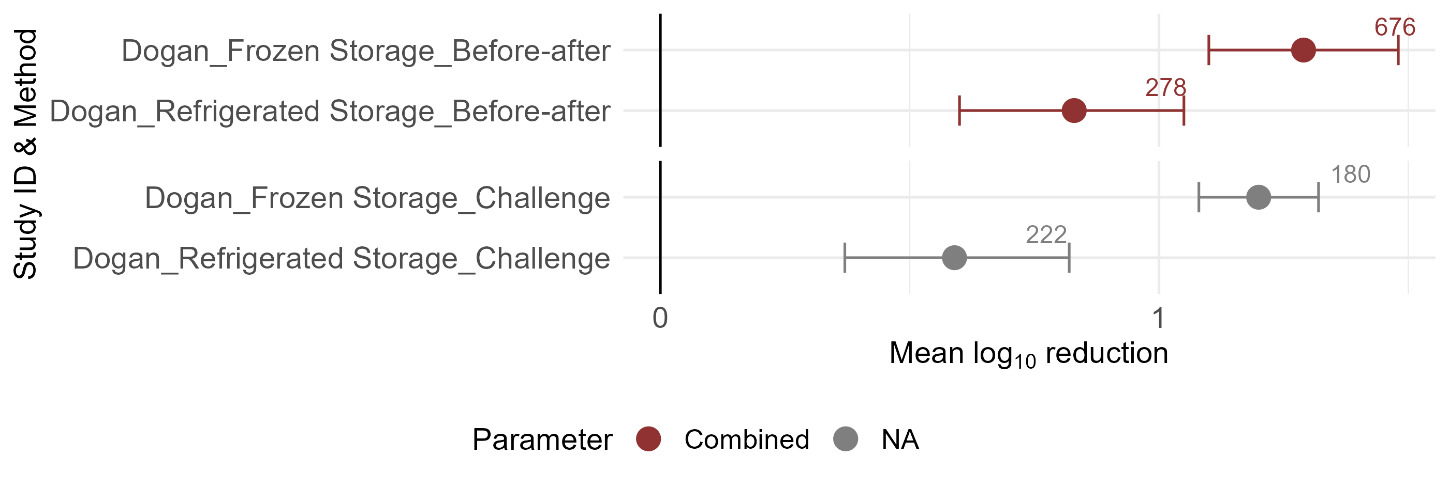
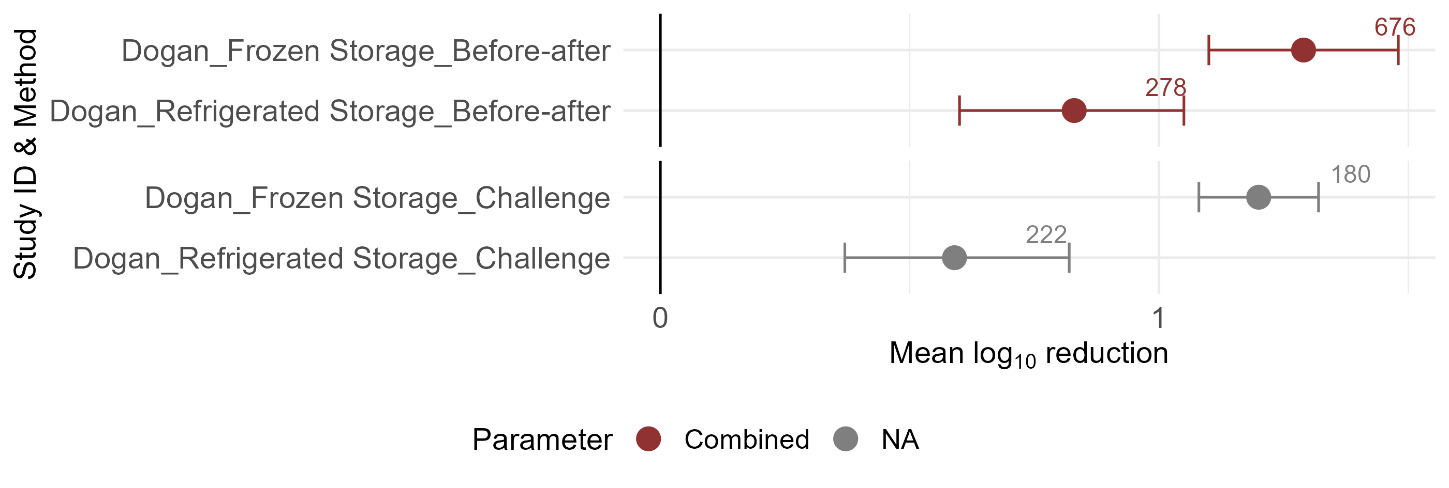
Cold storage, such as refrigeration and frozen storage, refers to longer-term preservation of poultry products after chilling (e.g., immersion or air chilling). In this review, storage parameters were evaluated in both before–after trials and challenge trials (Figure 14).
Refrigerated storage
Dogan et al., 2021 assessed the effect of refrigerated storage (3 to 5 °C) from 19 Before-After trials (from three studies) and 25 challenge trials (from six studies). The meta-analysis from Before-After trials produced a combined reduction of 0.83 log₁₀ CFU (95% CI: 0.60 to 1.05, I² = 81%), under laboratory settings with artificial contamination on chicken parts or skin. This indicates that refrigeration has a positive effect on Campylobacter reduction. Although the I² value is one of the lowest reported in this study, it is still relatively high and suggests variability across studies or conditions.
The challenge trials on refrigerated storage of skin and parts reported a pooled reduction of 0.59 log₁₀ CFU/unit (95% CI: 0.37 to 0.82, I² = 97.28%).
Overall, these findings suggest that refrigerated storage contributes to a reduction in Campylobacter concentrations.
Frozen storage
Dogan et al., 2021 reported on the effect of frozen storage (-20 to -30 °C) in twenty-eight before-and-after (BA) trials conducted across four studies using whole carcases. The pooled analysis showed a reduction of 1.29 log₁₀ CFU/unit (95% CI: 1.10 to 1.48, I² = 69%). Moreover, the effect of freezing was studied in challenge trials under laboratory conditions. Thirty-two challenge trials from three studies resulted in a pooled estimated reduction of 1.20 log₁₀ CFU/unit (95% CI: 1.08 to 1.32, I² = 98%). Despite the I² value indicating high variability in the pooled data, the confidence interval indicates narrow uncertainty in the point estimate.
Physical Interventions other than cold temperatures
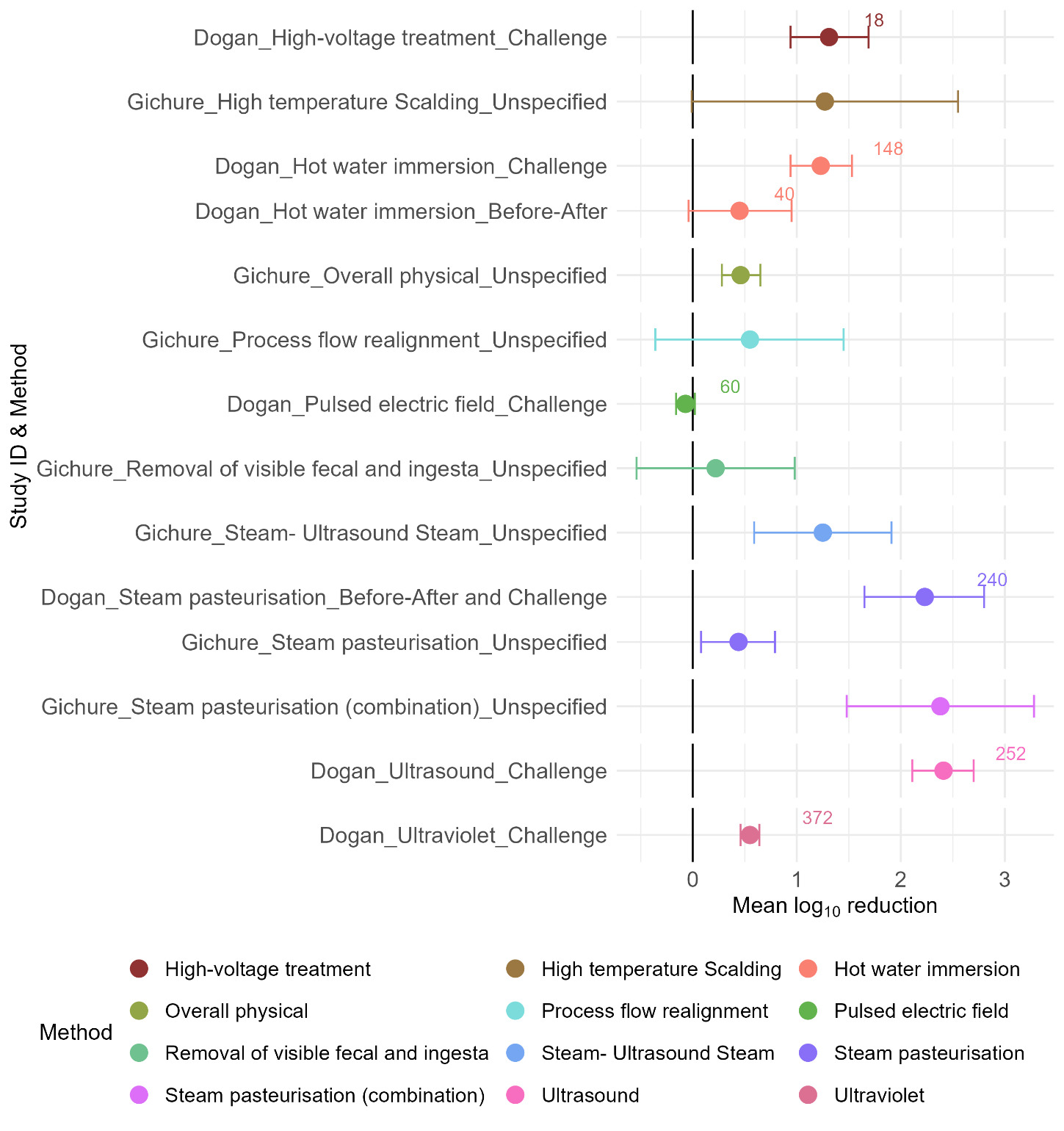
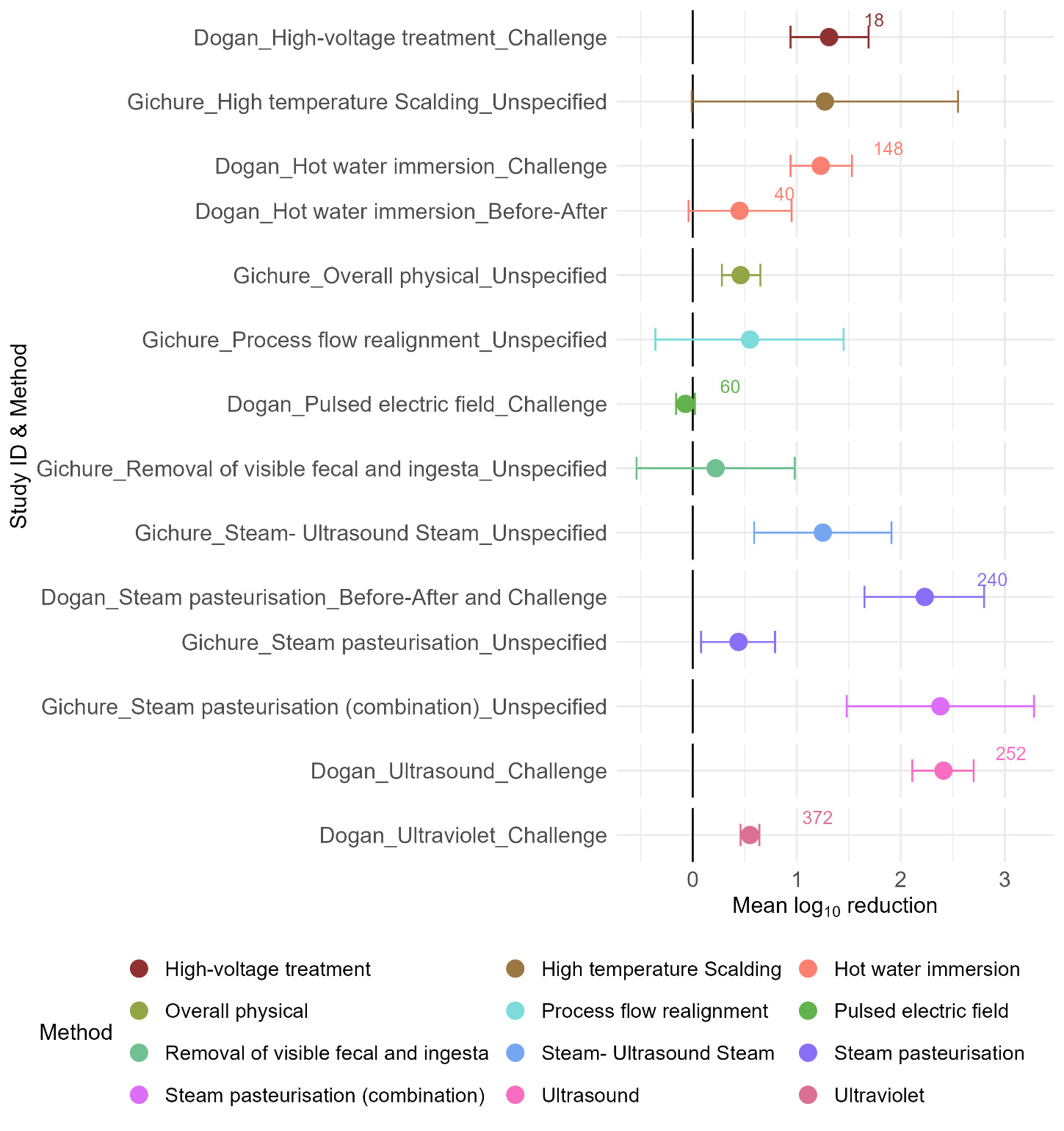
Physical interventions represent a diverse set of strategies aimed at reducing Campylobacter contamination on poultry carcases through thermal, non-thermal, and process-based approaches. These include steam pasteurisation, hot water immersion, ultrasound (often combined with chemical aids), high-voltage electrical treatment, pulsed electric fields, ultraviolet light, and operational changes such as process flow realignment and removal of visible contamination (Figure 15).
Thermal
High temperature scalding
High-temperature scalding is typically +1 to +3°C higher than the standard or baseline temperature typically used in scalding of broiler carcases. One example of high-temperature scalding achieved a 1.27 log₁₀ reduction in Campylobacter levels (95% CI: -0.01 to 2.55). While the pooled estimate (four trials from one study) suggests a potentially effective intervention, the confidence interval indicates a high degree of uncertainty, spanning from ineffective (-0.01 log₁₀) to an effective reduction (2.55 log₁₀) (Gichure et al., 2022).
Steam-Based Treatments
Steam pasteurisation has been explored as a thermal intervention for reducing Campylobacter contamination, but the evidence suggests inconsistency in effectiveness depending on the method, application parameters and study conditions.
Dogan et al., 2021 reported a log₁₀ reduction of 2.23 (95% CI: 1.65 to 2.80, I² = 83%) across 18 trials using steam. In contrast, Gichure et al., 2022 observed a much lower reduction of 0.44 (95% CI: 0.08 to 0.79, I² = 93%) across 6 trials using 70 °C steam spray for 20 s. Thus, there is a large degree of inconsistency for this intervention.
Gichure et al., 2022 evaluated a steam-ultrasound combination (steam at 90 to 94 °C with ultrasound at 30–40 kHz for 15 to 20 minutes), which achieved a reduction of 1.25 log₁₀ (95% CI: 0.59 to 1.91, I² = 95%). This is 6.5-fold more effective than steam alone in Gichure’s report. Therefore, it can be suggested that combining treatments may enhance microbial reduction. However, this was based on five trials from two studies; thus, further research is needed to get a better understanding of how reliable and consistent this combination is when used in different settings.
Steam based interventions were also evaluated in both FS990010/M013030 and FS121014A/M01058 (Table 3). These included superheated steam (steam that has been heated beyond its boiling point without condensation, allowing it to transfer heat more efficiently and penetrate surfaces) and dry steam applications on poultry carcases. Superheated steam achieved a 0.05 log₁₀ reduction, indicating a lack of effectiveness. Standard steam treatments applied to breast skin demonstrated an effect, achieving log₁₀ reductions ranging from 0.81 to 1.28. On the contrary, steam treatments applied to neck skin achieved log₁₀ reductions from 0.53 to 0.55.
Hot Water
Dogan et al., 2021 evaluated the effectiveness of hot water immersion (70 to 80 °C for up to 40 seconds) on broiler carcases, with samples taken from the skin. The intervention was assessed in two different study designs: before-and-after (BA) trials and challenge trials (ChT) (Figure 15).
In the four Before-After trials (from one study) the log10 reduction was 0.45 CFU/unit (95% CI: -0.04 to 0.95, I² = 41%). The confidence interval included a negative result, indicating that the reduction is not significant and that the intervention may have minimal effects. In contrast, the seven challenge trials (from two studies), reported a more pronounced pooled reduction of 1.23 CFU/unit (95%CI: 0.94 to 1.52, I² = 58%).
It should be noted that the difference in outcomes between before-and-after and challenge trials are not unexpected.
Non-Thermal Physical Technologies
High-voltage treatment
High-voltage electrical treatment has been explored as a non-thermal physical intervention. Dogan et al., 2021 estimated a pooled 1.31 log₁₀ reduction in Campylobacter spp. levels (95% CI: 0.94 to 1.69, I² = 0%), across three challenge trials conducted on skinless chicken breasts (Figure 15). This places high-voltage treatment among the more effective non-thermal interventions.
Ultrasound-Based
Ultrasound treatment, when used in combination with chemical processing aids (TSP with capric acid, TSP with citric acid, citric acid with capric acid, capric acid, citric acid, TSP, and distilled water as a control), demonstrated the highest efficacy among the non-thermal physical interventions.
According to Dogan et al., 2021, the overall pooled log₁₀ reduction was 2.41 (95% CI: 2.11 to 2.70, I² = 89%) across 42 challenge trials conducted in a laboratory setting. However, grouping results revealed that the chemical processing aid was the primary driver of efficacy, rather than ultrasound alone. For instance, the least effective treatment was ultrasound with distilled water, which achieved a 0.86 log₁₀ reduction (95% CI: 0.64 to 1.09), highlighting the lesser impact of ultrasound when not paired with active chemical agents (not plotted in Figure 15).
Electric Field-Based
Pulsed electric field (PEF) treatment was evaluated in a single study comprising of 10 challenge trials under laboratory conditions on skinless chicken breast meat (Dogan et al., 2021). The pooled analysis showed no effect on Campylobacter concentration, with a change of -0.07 log₁₀ (95% CI: -0.16 to 0.02, I² = 22%). Heterogeneity is low which indicates low variability in the data, lending some reliability to the conclusion that PEF does not effectively reduce Campylobacter.
Ultraviolet light
Ultraviolet (UV) treatment (Dogan et al., 2021) achieved a 0.55 log₁₀ reduction (95% CI: 0.46 to 0.64, I² = 85%) (pooled from 18 challenge trials on whole carcase, skin and skinless breast). While less effective than ultrasound or steam, UV offers a non-invasive option with some efficacy.
UV treatment was also evaluated as part of FS121014A/M01058 (Table 3). When using UV at 12 mW/cm² for 20 seconds, the average Campylobacter counts were reduced by 0.10 log₁₀ CFU/g. This indicates that there is no meaningful effect and under the treatment parameters in this study, UV radiation was ineffective in reducing Campylobacter.
Process flow realignment
Process flow realignment, referring to strategic changes in the sequence or method of slaughterhouse operations to improve hygiene, efficiency, and product quality was evaluated in nine trials across two studies. This included interventions such as pre-scald or pre-pick evisceration and altering how birds are suspended in shackles (by the neck or wings). This intervention was evaluated in nine trials across two studies by Gichure et al., 2022. The pooled analysis reported a 0.55 log₁₀ CFU/ unit reduction (95% CI: -0.36 to 1.45, I² = 98%). While the estimate suggests a potential benefit, the confidence interval indicates a possible increase in contamination and the result was not significant. Therefore, there is high uncertainty in the true effect size, likely reflecting the fact that this analysis encompasses a range of different process modifications, some of which may be more effective than others, rather than a single, uniform intervention.
Removal of visible faecal and ingesta contamination
In Gichure et al., 2022, this intervention achieved a pooled 0.22 log₁₀ reduction (95% CI: -0.54 to 0.98, I² = 99%). As the confidence interval overlaps with zero, it is not possible to say that the observed effect is significant.
Overall physical interventions
The considerable heterogeneity (I² = 99%) indicates that while physical interventions are generally effective, their success is highly context-dependent and may vary across processing environments. In the meta-analysis conducted by Gichure et al., 2022 physical interventions (high temperature scalding, steam, process flow realignment, removal of visible faecal and ingesta) aimed at reducing Campylobacter concentration achieved a pooled 0.46 log₁₀ CFU/carcase reduction (95% CI: 0.28 to 0.65, I² = 99%) (Figure 15). This was based on data from 91 trials across 20 studies. The confidence interval suggests a positive effect, indicating that physical decontamination methods reduce the presence of Campylobacter on poultry.
Other physical interventions reported in FSS/FSA studies
Ozonated water (water that has been infused with ozone, a form of oxygen) was evaluated in FS121014B / M01059, where it was applied via spray to poultry carcases (Table 3). The treatment achieved a 0.31 log₁₀ reduction in Campylobacter counts at Day of kill +1. Despite this reduction, the study concluded that ozonated water spray was not an effective intervention under the tested conditions as the effect was not significant and no greater than the effect produced by plain water.
Cold plasma treatment (non-thermal ionised gas that contains reactive compounds that damage microbial cell walls, DNA and protein, leading to microbial inactivation), also assessed in FS121014B / M01059, involved a 20-second exposure followed by a 4-minute and 40-second holding period. The average Campylobacter counts were 2.3 log₁₀ CFU/g in untreated samples and 2.2 log₁₀ CFU/g in treated samples, corresponding to a 0.1 log₁₀ reduction (Table 3). This minimal change was not statistically significant. The study concluded that cold plasma, as applied in this trial, did not produce a meaningful reduction in Campylobacter contamination.
Discussion
The control of Campylobacter contamination in poultry remains a challenge for food safety. This umbrella review synthesises a spectrum of evidence to evaluate the effectiveness of slaughterhouse-level interventions. While many interventions demonstrated measurable reductions in microbial load, their efficacy is not uniform and is influenced by a range of operational factors. Therefore, interventions are multifactorial, with outcomes dependent on the stage of processing, the method of application, and the duration of treatment. The following discussion examines the efficacy of interventions, and highlights opportunities for optimisation and further research.
Processing interventions
This review summarised quantitative evidence from three systematic reviews to evaluate the effectiveness of four poultry processing interventions (scalding, defeathering, evisceration, and washing) in reducing Campylobacter contamination. The findings highlight the varying degree of efficacy across interventions.
Scalding
The first stage of processing is scalding. The scalding tank, unsurprisingly, has been shown to reduce Campylobacter contamination on chicken carcases. This is due to physical removal and cell inactivation under elevated temperatures (FAO & WHO, 2024).
Scalding was effective and demonstrated significant reductions ranging from 0.64 to 2.16 CFU/unit across the three systematic reviews. The studies reviewed by Guerin et al., 2010 demonstrated the highest reductions, with scalding temperatures ranging from 45°C to 62 °C and the use of multiple tanks. Notably, triple- tank scalding systems (series of tanks with progressively increasing or decreasing water temperatures) were associated with the greatest reductions, suggesting that both temperature and system design play critical roles in efficacy. Some studies included in the meta-analysis also added chlorine as an additive to the scalding water. However, the impact of chlorine on the overall antimicrobial effect was not found to be significant.
These findings suggest that increasing scalding temperatures could enhance microbial reduction, however, there are practical limitations. The FSA-commissioned report FS101141, which explored modernisation of poultry inspection systems, included trials where Food Business Operators raised scald tank temperatures from 52°C to 55°C. While they concurred that Campylobacter counts decreased with the higher temperatures, changes to the carcase were unacceptable and the plucking machine became less efficient. As a result, the FBO reverted to their standard temperatures. Furthermore, as scalding is performed only on the external tissues of the chicken, faecal contamination can still occur during subsequent processes, particularly evisceration. Therefore, while scalding is a critical control point, further improvement beyond current industry usage may not be straightforward: thus, improving the efficiency of later stages may offer more significant benefits and fewer negative reactions to the end product.
Defeathering and Evisceration
Defeathering was found to increase Campylobacter spp. levels with log10 reductions. This process typically involves mechanical plucking using rotating rubber fingers or, less commonly, manual feather removal after scalding (Keener et al., 2004). It is possible that faecal contamination is passed between chickens during this process, which some slaughterhouses attempt to mitigate with cloacal plugging (Berrang et al., 2018). In the study by Berrang et al., 2018 cloacal plugging with 50 cc shredded sponge was found to significantly reduce Campylobacter contamination on broiler carcases during automated defeathering. However, smaller volumes of shredded sponge or paper plugs were ineffective. This suggests that plugging can be effective, but only when the material and volume are sufficient to withstand processing forces. Therefore, further improvements to minimise contamination could be made during the defeathering stage and warrant further investigation.
The next step is evisceration, which involves the removal of internal organs from the chicken either manually or by using mechanical methods. This step presents a significant contamination risk due to the potential rupture of intestines and subsequent faecal leakage. This was reflected in the data as studies showed conflicting results. Log₁₀ reductions ranged from –0.15 to 0.49 CFU/unit, indicating that the step may either reduce or even increase contamination. These apparent reductions are likely attributable to reducing the risk of pathogens remaining inside the carcase and contaminating the edible meat as well as associated rinsing or handling steps. As defeathering and evisceration are standard practice, not an intervention specifically designed for Campylobacter control, it is not expected that the processes would have significantly decreased bacterial contamination. However, steps could be taken to improve outcomes for cross-contamination and minimise the bacterial load.
Washing
Carcase washing (including combined protocols and Inside-Outside carcase washing, IOCW) demonstrated an effect across the three systematic reviews, with reductions in Campylobacter spp. Washing, typically performed post-evisceration, plays a key role in mitigating contamination introduced during earlier stages such as defeathering and evisceration. The effectiveness of this step was enhanced using antimicrobial agents (further discussion can be found in the chemical section). However, the level of decontamination does not meet or exceed that obtained via the scalding stage. This comparison is not to suggest that washing must be equally effective as scalding, but rather to highlight that scalding, being an earlier and more intensive decontamination step, sets a benchmark for microbial reduction. Optimising washing could help compensate for contamination that may occur after scalding, particularly during defeathering and evisceration, ensuring that downstream interventions maintain or improve contamination levels. Further research could optimise washing to mitigate for potential contamination that occurs during defeathering and evisceration.
Chemical interventions
In the UK and EU, the use of chemical decontaminants directly on poultry carcases for pathogen reduction is not permitted, in line with regulatory frameworks (Chapter II, Article 3 of assimilated Regulation 853/2004) that prioritise hygiene controls throughout the production process (Commission Regulation (EU) No 853/2004 of 2004 Food Hygiene Regulations). Therefore, while chemical treatments are widely discussed in the scientific literature and used in countries such as the United States, their practical relevance in the UK context is currently limited. According to the systematic reviews assessed, these interventions as typically applied via spray or immersion, and more recently through edible coatings. Spray treatments are commonly applied post-evisceration or during final washing (Dogan et al., 2021), whereas immersion treatments can be conducted after defeathering, evisceration or chilling. These methods have demonstrated varying degrees of efficacy.
Their efficacy depends on factors such as chemical concentration, application method, and the stage of processing in which they are applied. Due to the large number of chemicals reviewed, this discussion focuses on those that are currently approved for use in other countries (e.g., USA), most studied and demonstrated to be effective. This includes Acidified Sodium Chlorite (ASC), Trisodium Phosphate (TSP), and Cetylpyridinium Chloride (CPC) (EFSA, 2006; SCOGS (Select Committee on GRAS Substances), 2025).
It should be noted that this report did not assess the consumer safety of the substances discussed, nor any long-term implications (such as antimicrobial resistance), suitability for use or practicality for large scale implementation.
Acidified Sodium Chlorite
Acidified Sodium Chlorite (ASC) is one of the most effective chemical interventions for reducing Campylobacter on broiler carcases. Meta-analyses by Dogan et al., 2021, show that immersion treatments with ASC achieved a mean reduction of 2.07 log₁₀ CFU/unit (95% CI: 1.30 to 2.83), while spray applications resulted in a reduction of 1.26 log₁₀ CFU/unit (95% CI: 0.94 to 1.57). The greater efficacy of immersion may be due to more uniform surface contact, although spray methods are operationally simpler and reduce the risk of cross-contamination.
As ASC is a composition product of sodium chlorite solution and citric acid (though any approved-for-food-use acid can be used) it can interact with organic or inorganic compounds on the surface of the chicken. Notably, the production of chlorous acid is at varying quantities, depending on the pH of the solution (EFSA, 2006). However, other species such as chlorite, chlorate and chlorine dioxide can also occur. These byproducts are not produced in concentrations high enough to be hazardous to human health (WHO, 2016). However, ASC application can temporarily affect the appearance and texture of poultry meat resulting in ‘transient whiteness’, caused by chlorous acid (Kemp et al., 2000). Therefore, changes in the appearance and texture of meat may be important considerations for uptake by FBOs.
Importantly, the stage of application within the processing line influences ASC’s effectiveness. When applied post-chill, ASC achieved a reduction of 1.07 log₁₀ CFU/unit (95% CI: 1.01 to 1.12) according to Leone et al., 2024. Therefore, it could be suggested that ASC is more effective when applied earlier in the process. However, this estimate was based on a limited number of studies, and the low statistical power to detect heterogeneity suggests caution in interpreting the consistency of results across broader settings. Further research is needed to confirm the reproducibility of ASC’s effectiveness post-chill under diverse commercial conditions.
ASC is approved for use in the USA by the USDA, and its safety for human health has also been evaluated by the European Food Safety Authority (EFSA), which concluded that, based on available data, the use of ASC to treat poultry carcasses does not raise any safety concerns (EFSA, 2006). While ACS has antimicrobial properties, it is not authorised for use on poultry carcases within the UK or the EU under current legislation.
Cetylpyridinium chloride (CPC)
CPC is a quaternary ammonium compound that is used in dental products for the purpose of disinfection (Nasila et al., 2021). EFSA conducted a risk assessment of CPC in 2012, and concluded that it was efficacious in reducing microbial contamination on poultry carcases and did not pose safety concerns for human health at concentrations up to 1% (EFSA Panel on Biological Hazards (BIOHAZ), 2012). However, no official approval for use has been granted. This review also found CPC to be an effective method, showing significant log10 reductions (1.38 to 2.16 log₁₀ CFU/unit) of Campylobacter by both Dogan et al., 2021 and Gichure et al., 2022. In Dogan et al., 2021, the CPC was applied via spray on either the skin or the whole carcase (as designated in the reviews) with the skin application being the most successful.
Trisodium phosphate (TSP)
TSP is an alkaline chemical agent that acts as a detergent, disrupting bacterial cell membranes and facilitating the removal of pathogens from the surface of broiler carcases (EFSA, 2006). TSP is a permitted food additive in the EU under E339(iii) and is considered safe for consumption within regulated limits (EFSA, 2006). TSP has also been evaluated for its effect on chicken meat in regard to consumer preference and it has been found to confer no effect to the taste, texture or appearance of chicken meat (Capita et al., 2000). Immersion treatments tended to show higher point estimates for reduction compared to sprays; however, these interventions were not directly compared within the same study, and overlapping confidence intervals indicate that differences should be interpreted with caution.
Peroxyacetic acid
Peroxyacetic acid (also known as peracetic acid or PAA) is a broad-spectrum antimicrobial used in poultry processing in the United States, though it is not approved in the UK or the EU. One of PAA’s advantages is its breakdown into non-toxic byproducts (water, acetic acid, and oxygen), making it safe for human health and environmentally acceptable (Bauermeister et al., 2008; EFSA, 2014).
The method and timing of PAA application appear to influence its antimicrobial efficacy. Immersion techniques, particularly when integrated into chilling stages, tended to show higher point estimates for reduction compared to sprays; however, these interventions were not directly compared within the same studies, and overlapping confidence intervals indicate that differences should be interpreted with caution. Immersion effectiveness may be due to improved surface contact and exposure duration. Therefore, further investigation into the difference between application and effectiveness of decontamination warrants further investigation.
Other acids including acetic acid, capric acid, caprylic acid, citric acid, formic acid, lactic acid, malic acid, propionic acid and tartaric acid (as well as some combined acids) as immersions were reviewed by Dogan et al., 2021 and showed an overall reduction in Campylobacter concentration with a range of 0.91 to 2.18 CFU/unit.
Edible coatings
Edible film coatings represent a increasingly researched intervention for reducing Campylobacter contamination. These coatings are typically applied at the end of processing, during packaging, and are composed of natural materials such as lipids, polysaccharides (e.g., chitosan, pectin), proteins, or bio-composites (Wagle et al., 2019). Unlike chemical rinses or sprays that are removed during processing, edible coatings remain on the product throughout its shelf life, offering sustained activity.
Coatings by themselves as well as coatings with the addition of anti-microbial compounds were reviewed by Dogan et al., 2021. The antimicrobials used include eugenol, carvacrol, cinnamaldehyde and mustard extract, all of which are compounds derived from natural sources.
The microbial additive with the most significant effect was eugenol, a derivative of clove oil which has been deemed safe to consume by the FDA as a food additive and has previously shown to have anti-microbial effects against Campylobacter (Gürbüz & İrem Omurtag Korkmaz, 2022). Though edible film coatings do show a reduction of Campylobacter, the utilisation of this method may not be possible or practical for large scale production yet as it is still a developing process (Song et al., 2021). Therefore, edible film coatings show potential as an alternative or complementary intervention to traditional chemical processing aids. However, further research is needed to validate their effectiveness and practicality for use in large-scale poultry processing environments.
In summary, this review found that most chemical interventions, with the exception of chlorine dioxide spray and sodium hypochlorite spray, demonstrate the ability to reduce Campylobacter contamination with varying degrees of effectiveness. This effectiveness is also highly dependent on both the method (spray and immersion) and stage of application.
Chilling and freezing interventions
Chilling is the final stage in the poultry processing line at slaughterhouse. While it generally contributes to a reduction in Campylobacter levels, the effectiveness of this intervention varies depending on the specific chilling method applied. This report also evaluated the outcomes of post-chill interventions, which refers to any antimicrobial or decontamination step applied after the carcase chilling process in slaughterhouses. This is to further reduce microbial contamination that may remain after chilling.
Immersion chilling
Immersion chilling has been widely studied as a method for reducing Campylobacter contamination on poultry, with varying degrees of effectiveness depending on whether chemical additives are used and exposure durations. Reviews by Bucher et al., 2015; Leone et al., 2024 and Dogan et al., 2021 evaluated immersion chilling both with and without antimicrobial agents. When no additives were used, immersion chilling achieved reductions ranging from 1.25 to 1.37 CFU/unit.
Immersion chilling with additives also resulted in effective reductions. The most effective strategy reviewed was by Bucher et al., 2015, who found a log10 reduction of 2.47 CFU/unit using an unspecified disinfectant. While this suggests that disinfectants can significantly enhance microbial reduction during chilling, the limited availability of detailed data prevents specific recommendations at this time.
Immersion chilling with chlorine has been shown to reduce Campylobacter concentrations, depending on the timing of the application. While chlorine is effective, it is not authorised for use on poultry carcases in the UK.
An alternative antimicrobial, Protecta2, was assessed by Dogan et al., 2021. Protecta2 is a commercial product derived from herbal extracts, though its exact composition is undisclosed (Dickens et al., 2000). While promising, the findings are based on only three trials within a single study, limiting confidence in its reproducibility across different processing environments.
PAA as another additive during the immersion chilling process was assessed by Leone et al., 2024, who described the log10 reduction from a full chill as 1.42 CFU/unit and post chill as 1.26 CFU/unit. PAA, as discussed, is a commonly used anti-microbial agent in the USA but is not authorised for use in the UK which impacts the practicality of this as an intervention. In contrast, chilling in combination with spraying PAA had less of a reduction, yielding only a 0.61 CFU/unit reduction (Leone et al., 2024). It is possible that spray chilling is not as thorough as immersion chilling, and the concentration and temperature range cannot be as carefully controlled. It has been shown that longer exposure times of PAA on contaminated poultry provides a more effective result against microorganisms: thus, it is possible that spray chilling does not provide sufficient exposure times compared to immersion (Nagel et al., 2013). However, these interventions were not directly compared within the same studies, and overlapping confidence intervals indicate that differences should be interpreted with caution. As previously noted, further investigation into the influence of application method on contamination reduction is warranted.
Air chilling
Air chilling provided a log10 reduction of 0.5 to 0.74 CFU/unit and was generally less effective than immersion chilling. Immersion chilling could have a mechanical effect on microorganisms, physically removing them from the surface of the chicken, which is not achieved by air chilling (Belk et al., 2021).
The effectiveness of chilling interventions in reducing microbial contamination is also influenced by treatment duration (Leone et al., 2024). The review demonstrated greater point estimate microbial reductions during longer chilling durations (>30 minutes), compared to shorter durations (2 to 15 minutes), however, the overlapping confidence intervals mean no firm conclusion can be drawn without further quantitative analysis. This difference highlights that sufficient dwell time may play an important role in achieving effective Campylobacter control and warrants further investigation.
Freezing
Freezing has demonstrated greater effectiveness than refrigeration in reducing Campylobacter contamination on chicken. Studies were generally conducted at temperatures of -20°C, for varying times. The findings by Dogan et al., 2021, highlight the notable impact of storage conditions on microbial reduction. While refrigeration is more commonly used in the UK due to consumer preference for fresh poultry, frozen storage offers a more effective microbial intervention. In Iceland, following an epidemic of campylobacteriosis between 1998-2000, a series of measures -including a programme of freezing contaminated chicken and the two following flocks- resulted in more than 95% reduction in the numbers of Campylobacter on naturally contaminated broiler carcasses (WHO, 2002). This measure was accompanied by processing contaminated and non-contaminated birds in a specific order and issuing consumer advice. A report by the Food Safety Authority of Ireland (FSAI) recommended that processors should ensure flocks with >7 log10 CFU/g are used to produce frozen product (FSAI, 2011)(FSAI, 2025). Given this evidence, freezing contaminated carcasses as a targeted intervention may be scientifically justified, however its implementation needs to be evaluated within the context of industry and consumer practices.
Among freezing-based interventions, crust freezing emerges as a particularly promising option. It involves rapidly freezing a thin layer of the surface of the chicken, allowing the product to retain its ‘fresh’ classification under Regulation (EC) No. 543/2008, if the internal temperature remains above –2°C (Commission Regulation (EU) No 538/2008 of 2008 Marketing Standards for Poultry Meat.; Dawson et al., 2013). This makes it an attractive option for processors aiming to enhance microbial safety without compromising product labelling or quality. In a series of six challenge trials, conducted in a pilot plant setting, Dogan et al., 2021 reported a pooled 2 log₁₀ CFU/unit reduction in Campylobacter. This was the highest point-estimate reduction observed among all rapid chilling techniques reviewed. This suggests that crust freezing can be highly effective under controlled conditions.
Dogan et al., 2021 also indicated that effectiveness may be context dependent. In a commercial setting, a single Before-After trial showed a much smaller impact, with only a 0.42 log₁₀ CFU/unit reduction. Furthermore, the pooled results from the six challenge trials described above also contain data from trials that used crust freezing in combination with steam and hot water immersion. Therefore, the effectiveness of crust freezing may be largely influenced by other interventions and environmental conditions.
Despite these challenges, crust freezing offers the practical advantage of having minimal impact on the appearance and texture of chicken (Dawson et al., 2013), making it more acceptable to consumers. In contrast, liquid nitrogen, while effective to a degree, is cost-prohibitive and logistically impractical for large scale slaughterhouses (Burfoot et al., 2016). It is also less effective than other, cheaper and more easily adapted techniques for cooling such as immersion chilling as discussed above.
Crust freezing is a promising intervention, particularly in pilot or small-scale settings. However, its scalability, cost-effectiveness, and consistency in commercial environments remain uncertain. Further research and more industrial trials are needed to determine whether the reductions observed can be replicated in different slaughterhouses. Hence, crust freezing should be considered a promising but still experimental intervention, that is possibly best used in combination with other validated control measures.
Physical interventions other than cold temperatures
This review synthesises findings evaluating the effectiveness of thermal and non-thermal physical interventions. Thermal treatments such as steam and hot water appear most applicable during the scalding stage and offer opportunities for early microbial load reduction. Steam and hot water are most applicable during the scalding stage. Dogan et al., 2021 reported efficacy for hot water immersion (1.23 log₁₀ reduction in challenge trials), however, the before-and-after trials showed only a 0.45 log₁₀ reduction. Therefore, it may transpire that there is a difference in laboratory efficacy compared to commercial settings.
Furthermore, steam treatments showed highly inconsistent outcomes. Dogan et al., 2021 reported a 2.23 log₁₀ reduction, while Gichure et al., 2022 observed a reduction of only 0.44 log₁₀. FSA/FSS studies further confirmed this, with reductions ranging from 0.05 (superheated steam) to 1.28 (standard steam on breast skin). Steam treatments applied to neck skin achieved lower log₁₀ reductions of around 0.5. The difference between breast and neck skin includes different surface structure, morphology, and deeper bacterial penetration in neck area (Purnell et al., 2014). Therefore, it can be concluded that steam can be an effective but inconsistent intervention that may support Campylobacter reduction: however, efficacy depends on application, duration, and carcase area (unlikely to be universally effective across the entire carcase).
Based on the non-thermal methods evaluated in this report, ultrasound-based treatment coupled with chemical processing aids were the most effective. However, when ultrasound treatment was coupled with distilled water, a lesser reduction was found. Therefore, it can be concluded that ultrasound has a lesser effect on Campylobacter concentration than other interventions described, and the successful outcome is highly dependent on the chemical and concentration used (Dogan et al., 2021). As chemical pathogen reduction treatments are not permitted in the UK, the effectiveness of ultrasound treatment is likely to be reduced and may limit the practical application in UK processing environments.
High voltage treatment was another successful non-thermal intervention and demonstrated a consistent reduction effect. However, the reliability of this result is limited by the small sample size (three trials from one study). This means that the result may overestimate the true effect size, and the confidence intervals may be narrow as all trials came from a single study, likely under similar conditions (e.g., same equipment, processing environment). This limits the external validity as it cannot be certain that the same results would occur in different slaughterhouses.
Other interventions such as removal of visible faecal and ingesta and pulsed electric field treatment yielded either low Campylobacter reductions or even enhanced microbial contamination. While these practices may contribute to extending shelf-life or improving consumer perception and general hygiene (Cha et al., 2023), the practices are insufficient to meaningfully reduce Campylobacter risk.
Emerging Interventions
The interventions included in this report are not an exhaustive list and other promising novel interventions are being developed. For example, violet-blue light treatment has emerged as a promising non-thermal intervention for Campylobacter control (Walker et al., 2022). This approach uses photodynamic inactivation, where exposure to violet-blue light induces high levels of intracellular reactive oxygen species, leading to oxidative damage of key metabolic enzymes and disruption of electron transport. C. jejuni has been found to be particularly susceptible to violet-blue light due to its reliance on reactive oxygen species sensitive iron sulphur cluster enzymes (Murdoch et al., 2010). While these findings highlight the potential of violet-blue light as a novel food-chain intervention, current evidence is largely laboratory-based, and further research is needed to validate its effectiveness under commercial processing conditions.
Summary and recommendations
This umbrella review highlights the broad range of interventions used throughout poultry processing to reduce Campylobacter contamination. While some steps are highly effective, others present a risk of increasing contamination, which highlights the need for a strategic, evidence-based approach to intervention design and implementation.
Scalding consistently demonstrated high reductions in Campylobacter contamination. However, its effectiveness can be compromised by subsequent steps, particularly defeathering and evisceration, which can reintroduce contamination likely by faecal transfer and intestinal rupture. Evidence shows that defeathering increased contamination, and evisceration can also contribute under certain conditions. These findings highlight the need to prioritise improvements at these high-risk stages. This can include further research into process modifications or interventions that could reduce contamination during defeathering and evisceration. Strengthening control measures at these points would lower the microbial load entering later stages, thereby enhancing the effectiveness of downstream interventions such as washing and chilling.
Washing and chilling are the critical control points later in the processing line. Their effectiveness is highly dependent on the use of antimicrobial agents and process parameters (e.g., temperature, duration). Among washing interventions, Acidified Sodium Chlorite (ASC), Trisodium Phosphate (TSP), Cetylpyridinium Chloride (CPC) and Protecta2 are effective at reducing Campylobacter contamination. Antimicrobial agents are also particularly effective when applied via immersion, which ensures more uniform contact with the surface of the carcase. However, as documented throughout this report, antimicrobial agents are not permitted for use in the UK.
Immersion chilling may also outperform air chilling, especially when combined with additives such as Peracetic Acid (PAA). While air chilling does reduce Campylobacter, the combination of mechanical and chemical action via immersion likely contributes to its efficacy: thus, further investigation into the influence of application method on contamination reduction is warranted. Unsurprisingly, frozen storage was found to be more effective than refrigeration storage, with a 4-fold greater reduction (based on point-estimate reduction only) in Campylobacter. A risk-based product allocation strategy, similar to that proposed by the FSAI, could be used where poultry with high contamination levels is used for frozen products. However, due the popularity of fresh produce in the UK, crust freezing may offer an alternative. It achieves reductions of up to 2 log₁₀ CFU/unit while maintaining the product’s fresh classification under EU regulations. Crust freezing also preserves meat quality and is more acceptable to consumers, making it a highly promising intervention that should be encouraged where feasible.
Lastly, some physical interventions such as ultrasound treatment combined with chemical processing aids and high voltage treatments showed reduction effects. However, the evidence is limited due to small sample size and lack of diverse testing conditions to reduce the external validity of the findings. Therefore, the results may not be representative of other processing environments. Further research is recommended before these interventions can be confidently endorsed for widespread use in slaughterhouses. Additional studies, ideally across diverse processing environments, are needed to fully determine their effectiveness and practical applicability.
Based on the findings of this review, the following recommendations are proposed to enhance Campylobacter control in poultry processing at slaughterhouse level:
-
Target high risk stages for improvement- further research on modifications of processes at defeathering and evisceration stages that may be implemented to reduce contamination
-
Enhance effectiveness of downstream processes (washing and chilling) by conducting further research to determine optimal application methods
-
Further research is needed to determine the specific conditions under which immersion chilling may offer practical and effective advantages over air chilling. While immersion chilling has shown promise in certain contexts, it remains unclear whether there are scenarios in which air chilling could be equally or more effective. Comparative studies that account for operational feasibility, microbial outcomes, and environmental factors are essential to guide evidence-based recommendations.
-
Fund further research studies on promising but under researched interventions (e.g., high voltage treatment, edible films). Many interventions, especially the newer or less common ones are only tested in controlled or small-scale environments. This is a limitation and there is a need for larger scale trials to assess performance under real processing conditions.
-
Further research into effectiveness, feasibility and appropriateness of freezing e.g., crust freezing or frozen storage.
Limitations with the studies used for the review
Systematic reviews can be used to report findings at a study level as well as an overview. However, the meta-analysis used in systematic reviews is not without limitations. One significant limitation in meta-analysis is the interpretation of heterogeneity across included studies and its implications for the reliability of pooled estimates. Heterogeneity was commonly quantified using the I² statistic, which reflects the degree of variability in effect estimates between studies that cannot be attributed to chance. While I² values below 25% suggest high consistency and reliability, values above 80% indicate considerable heterogeneity, warranting cautious interpretation of pooled results (Mohan & Adler, 2019). Most pooled results reported in this review fall into the above 70% category, reducing our confidence in the pooled effect and suggests that the results should be interpreted with caution.
Moreover, in meta-analysis, small sample sizes can underestimate the heterogeneity due to low statistical power. The studies in this review varied in scale, and often small-scale studies underestimated or could not determine heterogeneity. For example, High Voltage treatment reported in Dogan et al. had a heterogeneity score of 0%. However, the findings were based on only three trials from a single study: thus, in this context should not be interpreted as evidence of consistent effectiveness. Instead, it likely reflects insufficient data to detect study variability.
Systematic review methodologies are largely developed for healthcare research. In contrast, food safety studies are often different and may not use similar study designs (e.g., Before-after or challenge trials), study settings (e.g., laboratory, commercial plant), treatment time, sampling type (e.g., rinse or swab), randomisation, or ways of reporting. Moreover, some studies and reviews lacked clarity on certain operational parameters such as air flow rate or chemical/ antimicrobial concentration (Dogan et al., 2021). Therefore, methodological variability is common and often not reported or fully elucidated. As a result, this report cannot accurately estimate the extent to which variation in results can be attributed to differences in study design or test parameters.
Despite this limitation, the meta-analysis and pooled results allow us to draw conclusions and determine the overall effectiveness of the interventions. However, efficacy may vary in different plants and processing contexts. For example, the pooled data suggests that immersion chilling when combined with PAA tends to be more effective than air chilling. This does not mean that immersion chilling with PAA will always outperform air chilling in every context.
Another limiting factor in this report’s interpretation of Campylobacter data arises from the variation in how bacterial loads are quantified across different studies. Specifically, inconsistencies in how Campylobacter colony forming units (CFU) are reported, such as CFU per carcase, CFU per gram, or CFU per unit. These differences are related to the sample type and measurement unit used, rather than the intervention itself, and should be considered when evaluating the effectiveness of control strategies. These methods of reporting are valid: however, the use of different reporting units between studies complicates direct comparisons and may lead to misinterpretation of results. However, the systematic reviews focused on changes in concentration rather than absolute values, enabling a broader synthesis of intervention effectiveness while acknowledging differences in sampling units. Therefore, future research would benefit from a standardised reporting or dual reporting to enhance comparability, reduce ambiguity, and support more accurate synthesis across studies.
As discussed, a common limitation of umbrella reviews is the challenge of accounting for variability in study conditions across included meta-analyses. In this review, the pooled effect estimates were extracted from multiple systematic reviews evaluating interventions to reduce Campylobacter in poultry at slaughterhouses. However, the underlying primary studies within each review often differed in key methodological aspects such as chemical concentration, specific application method, contact time, and operational context. These details were not consistently reported across all reviews, making it difficult to standardise or directly compare intervention efficacy. Moreover, presenting all experimental parameters, such as chemical concentrations or exposure durations, is inherently difficult, as pooled estimates often derive from multiple studies with differing protocols. While such granularity would enhance interpretability, it is not essential for the purposes of this report, which aims to provide a high-level summary of how effective different interventions can be. As a result, while pooled meta-analysis values offer a useful overview of overall effectiveness, they should be interpreted with caution. This limitation is inherent to umbrella reviews, which rely on secondary data and are constrained by the reporting of the included systematic reviews.
Another limitation of this umbrella review that affects the interpretation of findings is the overlap in primary sources. The corrected covered area (CCA) was calculated at 12%, due to the presence of 60 shared references between two or more systematic reviews. Study overlap can result in data duplication and biased results in umbrella reviews, by inflating the perceived strength or consistency of evidence (Fernandez et al., 2025). This can compromise the independence of findings and reduce the overall reliability of synthesised conclusions. Overlap is expected in umbrella reviews, and while a CCA of 12% is not alarming, it does warrant some caution. Therefore, the findings in this report should not be over-interpreted, for example, claiming that a particular intervention is the best and should be widely implemented. Instead, these findings highlight areas that warrant further investigation through high-quality, original research. This will help ensure that future recommendations are based on robust and unbiased evidence.
A narrative synthesis and comparison of the key findings from each review were conducted in this report. This was due to variabilities in study design, methodologies and outcomes measured across the included reviews. Further quantitative analysis or meta-analysis may be possible, giving further insights into the data and allowing more robust conclusions to be drawn.
This review also does not capture all recent technological innovations in Campylobacter control. This reflects the time frame of the included studies rather than a lack of relevance of the newer approaches. Therefore, the findings should not be interpreted as comprehensive across all current intervention strategies.
Acknowledgements
We wish to acknowledge the Food Standards Agency Statistics Team for their contributions to this work. In particular, we extend our thanks to Mark Jitlal and Sam Jukes for their expert statistical guidance and review, which enhanced the analytical quality of this review.