
Abbreviations
COT Committee on Toxicity
CV Coefficient of variation
dGCB Dispersive graphitized carbon black
dSPE Dispersive solid phase extraction
EFSA European Food Safety Authority
EMR Enhanced matrix removal
EU European Union
EURL European Union reference laboratory
FSA Food Standards Agency
GB Great Britain
GCB Graphitized carbon black
HBGV Health-based guidance value
HPLC High-performance liquid chromatography
IS Internal standard
LC-MS/MS Liquid chromatography-tandem mass spectrometry
LOD Limit of detection
LOQ Limit of quantitation
MRM Multiple reaction monitoring
N/A Not applicable
NR No result
NRL National reference laboratory
NS Native standard
OECD Organisation for Economic Co-operation and Development
OL Official laboratory
PFAS Per- and polyfluoroalkyl substances
PFHxS Perfluorohexanesulfonic acid
PFNA Perfluorononanoic acid
PFOA Perfluorooctanoic acid
PFOS Perfluorooctanesulfonic acid
POPs Persistent organic pollutants
PP Polypropylene
QuEChERS Quick, easy, cheap, effective, rugged, and safe
RB Reagent blank
RCF Relative centrifugal force
RL Reporting limit
SD Standard deviation
SPE Solid phase extraction
TWI Tolerable weekly intake
UPLC Ultra-Performance Liquid Chromatography
Veg Vegetables
WAX Weak anion exchange
ww Wet weight
Lay Summary
Per- and polyfluoroalkyl substances (PFAS) are manufactured chemicals previously, and for some, currently, used for their water-, grease-, and stain-resistant properties in a wide range of products. They are also known as “forever chemicals”. In 2018, the Organisation for Economic Co-operation and Development (OECD) had identified 4730 PFAS compounds. Efforts are being made to strengthen how PFAS are regulated to reduce their presence in both the environment and the food chain. These measures aim to mitigate potential long-term health and environmental consequences associated with exposure to PFAS.
The Food Standards Agency (FSA) identified a lack of official control laboratory capacity in Great Britain (GB) to test for PFAS in food. To address this, Fera Science Ltd, acting as the National Reference Laboratory (NRL), was commissioned to develop and validate analytical methods for detecting PFAS in a variety of plant-based foods, including fruit and vegetables. This project would allow Fera to build on the previous FSA-funded work where methods were developed and validated for the detection of PFAS in products of animal origin (meat, fish and milk). Overall, these methods will enable the FSA to assess potential health risks to consumers from PFAS contamination in food and to respond effectively to food safety incidents.
The developed methods comply with European guidance, and the lowest level of PFAS detected by the methods were in accordance with EU recommendations.
Ten different food types were selected to represent a broad range of fruit and vegetables, including those rich in pigments, starch, sugar, and water. These samples were sourced from supermarkets and contained detectable levels of PFAS.
Methods were developed and tested (validated) for their ability to measure a range of PFAS in fruit and vegetables to monitor and regulate their presence in food. When carrying out the method validation, as the concentration of PFAS added to the samples was increased, the number of samples in which the four EU-regulated PFAS analytes could be detected, also increased. Notably, beetroot was the only food type that met validation criteria for all four regulated PFAS compounds at the lower level.
To achieve full validation at the lowest level tested, further screening of fruit and vegetable types will be necessary to identify samples that contain levels of PFAS below the lowest level of detection.
Additional validation was attempted for 23 emerging PFAS compounds. However, due to issues with sample preparation and contamination, data for several of these compounds were incomplete. This will be addressed in future work.
Executive Summary
The FSA have identified that per- and polyfluoroalkyl substances (PFAS) are an emerging food safety issue. To evaluate dietary exposure of PFAS, methodology for the determination of PFAS in foods needs to be established. The FSA identified limited capability within GB laboratories to offer PFAS testing and, as a result, the FSA previously commissioned Fera (as the National Reference Laboratory (NRL)) to develop and validate methods for the detection of PFAS in a range of products of animal origin. For this current project, the objective was to develop and validate methods for the detection of PFAS in a range of plant materials (fruit and vegetables). This project will allow Fera to build on previous FSA-funded work for PFAS.
There are no maximum levels for PFAS compounds in GB but Commission Recommendation (EU) 2022/1431 recommends limits of quantification (LOQs) should be 0.002 μg/kg for perfluorooctanesulfonic acid (PFOS), 0.001 μg/kg for perfluorooctanoic acid (PFOA), 0.001 μg/kg for perfluorononanoic acid (PFNA), and 0.004 μg/kg for perfluorohexanesulfonic acid (PFHxS) in fruit, vegetables, starchy roots and tubers, and in food for infants and young children. However, 0.001 μg/kg was selected as the target LOQ for the method. For this project, Fera developed and optimised methods for the 4 EU regulated PFAS in fruit and vegetables. An additional 23 emerging PFAS were also tested during method development and validation. Clean-up protocols using different solid phase extraction (SPE) cartridges from laboratory consumables vendors were assessed.
To assess different clean-up protocols, example products were used to represent groups of fruit and vegetables, e.g. kale for leafy greens; potato for starchy tubers; carrot, beetroot, tomato, and blueberries for highly pigmented produce. In addition, fruit (apples/pears), cereal grain (wheat flour), and fungi (mushrooms) were assessed. Following this, the liquid chromatography-tandem mass spectrometry (LC-MS/MS) method for PFAS was developed and optimised for fruit and vegetables, and validation of the methods was conducted following in-house protocols for flexible scope of ISO17025 accreditation.
The availability of these methods will allow the FSA to determine the risk to the consumer from exposure to vegetables and fruit which have been contaminated with PFAS, and additionally respond to incidents. In the future, the developed methods can be distributed to Official Laboratories (OLs) under the future NRL for Chemical Hazards.
Introduction
Background to the study
Per- and polyfluoroalkyl substances (PFAS) are a vast group of anthropogenic organic compounds consisting of a hydrophobic fluorinated alkyl chain and a hydrophilic functional group. In 2018, the Organisation for Economic Co-operation and Development (OECD) had identified 4,730 PFAS compounds (OECD, 2018). Due to their water, grease, and dirt repellent properties, they have been widely used in industrial processes since the 1950s (Buck et al., 2011). PFAS are also extensively used in consumer products such as paper, textiles, non-stick coated cooking utensils and cosmetics and as such we are exposed to them in many aspects of our daily lives.
Many of the PFAS are resistant to biological, chemical, and physical transformation because of the chemical stability imparted by the carbon-fluorine (C-F) bonds. As a result, PFAS are extremely long-lived and are widely detected in the environment (water, air, soil, sediments and biota). Long half lives in the range of years have been reported depending on the PFAS and matrix combination (Roberts, 2016). Food can become contaminated through the soil and water used to grow the food, through the concentration of these substances in animals, and through food packaging or processing equipment that contains PFAS (Genualdi et al., 2021).
The FSA have identified that PFAS are an emerging food safety issue. The European Food Safety Authority (EFSA) reassessed the health risks posed by PFAS in food in September 2020 (Schrenk et al., 2020). A Tolerable Weekly Intake (TWI) of 4.4 nanograms per kilogram of bodyweight per week was established. The TWI applies to the sum of four PFAS: perfluorononanoic acid (PFNA), linear and branched perfluorohexanesulfonic acid (PFHxS), linear and branched perfluorooctanesulfonic acid (PFOS) and perfluorooctanoic acid (PFOA).
The Committee on Toxicity (COT) has considered PFAS on a number of previous occasions and recently published a statement on the EFSA opinion (COT, 2022). The COT considered there were substantial uncertainties over the derivation of the TWI. Future COT work includes an independent review of the toxicological data available for PFAS, whether and how different PFAS can be grouped for assessment and deriving a health-based guidance value (HBGV) or several HBGVs as the data allow. In the meantime, where risk assessments are undertaken for the potential risks associated with exposure to PFAS, consideration should be made of the available HBGVs for the specific compounds identified, recognising the uncertainties with respect to the critical effects and modelling approaches adopted.
Whilst there are currently no maximum levels for PFAS in food in GB, the EU has established maximum levels for four PFAS (PFOS, PFOA, PFNA and PFHxS) and for the sum of these four in various foods as set out in Commission Regulation 2023/915 (Commission Regulation (EU) 2023/915 of 25 April 2023 on Maximum Levels for Certain Contaminants in Food and Repealing Regulation (EC) No 1881/2006, n.d.). In addition, Commission Recommendation 2022/1431 (Commission Recommendation (EU) 2022/1431 of 24 August 2022 on the Monitoring of Perfluoroalkyl Substances in Food, 2022) contains a monitoring recommendation for these and other PFAS in additional food commodities. The FSA identified limited capability within GB laboratories to offer PFAS testing in food which impacts the ability to assess the risk to consumers. Therefore, a methodology for the determination of PFAS in all foods needs to be established. The analysis of PFAS in food is challenging due to the matrix and the need to eliminate background contamination.
Aims and objectives of the study
The objective of this project is to develop and validate methods for the detection of PFAS in a range of plant materials (fruit, vegetables etc.) which are among the food categories that contribute the most to dietary exposure to PFAS. The proposed project would allow Fera to build on the previous FSA-funded work where methods were developed and validated for the detection of PFAS in products of animal origin (meat, fish and milk). Methodology for the determination of PFAS in a range of food types has been developed and validated at Fera within the scope of the UK National Reference Laboratory function. This method has been accredited to ISO17025 by UKAS and is listed on Fera’s Fixed Scope of Accreditation Schedule.
The 4 EU regulated PFAS compounds will be validated in accordance with limits of quantitation (LOQs) stated in EU Commission Recommendation 2022/1431 for fruit, vegetables, starchy roots/tubers, and food for infants and young children: 0.002 μg/kg for PFOS, 0.001 μg/kg for PFOA, 0.001 μg/kg for PFNA and 0.004 μg/kg for PFHxS. The methods will be validated following in-house protocols to establish method performance characteristics such as recovery, LOQ and measurement uncertainty.
Ten matrices were agreed with the FSA for method validation to cover the full range of fruit, vegetable, cereal, and fungi food types along with highly pigmented produce (Table 1). Consideration was given for coverage of produce constituents to include foods high in certain pigments (carotenoids, chlorophyll, betalains, anthocyanins, melanin), starch, sugar, and water. Following validation, an application will be made for ISO17025 accreditation using flexible scope accreditation to add these matrices to the scope of Fera’s accreditation for PFAS.
Materials and Methods
Evaluation of current methodology
Six recently published methods for the determination of PFAS in fruit and/or vegetable matrices were evaluated and summarised in Table 2. From the literature (Anastassiades, et al., 2003), methods employing quick, easy, cheap, effective, rugged, and safe (QuEChERS) extraction/clean-up involved freeze-dried material while wet material was mainly extracted using basic methanol or acetonitrile with weak anion exchange (WAX) and graphitized carbon blank (GCB) SPE clean-up steps (Table 2). Sample weights ranged from 0.1 g to 0.5 g for dry material and 0.3 g to 10.0 g for wet material. Since the established Fera PFAS method (FSG/417) employs a basic methanol extraction with WAX SPE clean-up, this method was selected for further method development. A 10 g sample size was initially selected for extraction to maximise attainment of target LOQs; this was set to 0.001 µg/kg for all 4 PFAS analytes.
Sample preparation
All laboratory consumables and reagents were screened beforehand for the presence of PFAS and were found to be PFAS-free. Two kilograms of each commodity were purchased and included kale, carrot, beetroot, potato, onion, wheat flour, apple, pear, tomato, blueberry, and mushroom. However, to identify a blank PFAS sample for method development, additional carrot samples were sourced from 2 different suppliers. Preparation of materials was conducted in a positive pressure laboratory that is dedicated for PFAS analysis. All equipment (chopping board, knives, peelers, spatulas, mill bowl and blade) were rinsed 3 times with methanol and allowed to vent in a fume cabinet. To remove potential background levels of PFAS from the surface of fruit and vegetables, samples were either rinsed or peeled. Leafy greens, blueberries, tomatoes, and mushrooms were rinsed with high-performance liquid chromatography (HPLC) grade water before preparation. All other fruit, root vegetables and tubers were peeled without rinsing. Samples were then chopped into roughly 1-inch pieces and frozen in polypropylene (PP) bags before homogenisation. Frozen samples were milled in a GM300 knife mill by first pre-grinding at 872 relative centrifugal force (RCF) for 30 secs by direction impact, followed by fine-grinding at 872 RCF for 30 secs by direction cut. For apples and pears, a 50:50 (w/w) composite was prepared. Homogenates were distributed into 500 mL PP pots and stored at -20°C until analysis.
Method development 1
The in-house PFAS method was evaluated for 10 g of carrot sample with the addition of a GCB clean-up step to remove carotenoid pigments. Carrots from 3 different suppliers were also screened for endogenous PFAS content. Therefore, triplicate blank samples and spiked samples (to assess relative analyte recovery) were extracted and analysed for carrots from different suppliers. For the spiked samples, PFAS native standards (PFHxS, PFOA, PFNA, and PFOS) were added at a final concentration of 0.001 µg/kg. Stable isotope labelled PFAS internal standards were added to carrot blanks, spikes and the reagent blank. Samples were then extracted in 10 mL of 20 mM sodium hydroxide (NaOH) in methanol, shaken for 1 hour on an orbital shaker, and centrifuged at 3,488 RCF for 10 minutes. The supernatant was transferred to a 15 mL PP centrifuge tube and dried down under nitrogen to a volume of circa 3 mL. The extraction was repeated, and the supernatant was combined with the first extract and dried down again to 3mL. Extracts were made up to volume with 10 mL of water for SPE clean-up. The whole extract was loaded onto a Waters WAX SPE cartridge which was then washed sequentially with 25 mM ammonium acetate (pH 4.5) and methanol. PFAS were eluted with 0.1% ammonia in methanol. Further extract purification was achieved using an ENVI-Carb GCB (500 mg) flow-through cartridge. Resultant eluates were evaporated to dryness, reconstituted in 200 µL of methanol and transferred to LC-MS/MS vials. LC-MS/MS analysis was carried out using a Waters Acquity Premier Ultra-Performance Liquid Chromatography (UPLC) coupled to a Xevo TQ Absolute triple quadrupole mass spectrometer and MassLynx software. The UPLC system consisted of a Waters BEH C18 (1.7µm, 2.1×100 mm) analytical column equipped with a Waters PFAS delay column (2.1×50 mm) and mobile phases of: (A) 10mM ammonium bicarbonate (pH 6.5) and (B) acetonitrile/methanol (50:50, v/v). The analytical column was maintained at a temperature of 35°C and the injection volume on-column was 10 µL. The liquid chromatography gradient profile is listed in Table 3. For MS/MS analysis, MRM of native and mass-labelled PFAS analytes was performed in negative electrospray ionisation mode with the following ion source conditions: gas temperature 110°C, desolvation temperature 500°C, cone gas flow 150 L/h, desolvation gas flow 900 L/h, collision gas flow 0.15 mL/min, nebuliser gas flow 300 L/h, cone voltage 20 V, capillary voltage 0.5 kV. The MRM transitions for PFAS analytes and mass-labelled internal standards used are listed in Table 4. Analyte peak identification acceptance criteria was ±1% for retention time and ±30% for ion ratios to that of the calibration standard.
None of the carrot samples tested negative for the 4 regulated PFAS (Table 5). However, when blank-corrected, obtained concentrations were at the 0.001 µg/kg level of the native PFAS spike (Table 7). Calculated LOQs (signal/noise ≥ 10x average baseline noise) from the extraction and clean-up method tested were <0.001 µg/kg (Table 8).
Method development 2
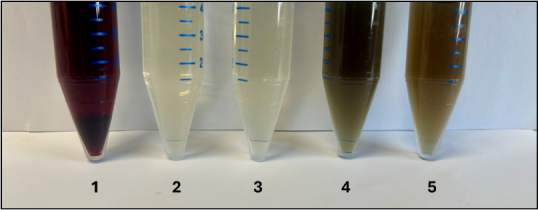
Since the carrot extracts were minimally pigmented with carotenoids, a second method development batch was undertaken to test different SPE cartridge combinations to clean-up anthocyanin pigments from blueberries. Anthocyanins are much more soluble in the methanol extraction solvent than carotenoids from carrots. Blueberry samples (10 g) were spiked with PFAS internal standards and native standards (NSs) at 0.001 µg/kg and extracted as stated previously. Then, 4 different SPE clean-up cartridge combinations were tested in triplicate: WAX/GCB, WAX/Agilent enhanced matrix removal (EMR), Waters stacked GCB/WAX, Phenomenex stacked GCB/WAX. Both the Waters and Phenomenex stacked cartridges contained a 50 mg GCB upper layer compared to 500 mg of GCB in the ENVI-Carb cartridge.
_and_after_spe_clean-up_with_wax_gcb_(2)__wax_emr.svg)
Although clean-up with individual WAX and GCB/EMR cartridges yielded relatively clear extracts (Figure 1), absolute recoveries of PFAS internal standards were poor (Table 9). It was noted that the WAX layer became saturated with anthocyanin pigments which were not removed with subsequent washings of the cartridge before elution of PFAS. Although the stacked SPE cartridges contained an upper GCB layer to remove pigments, the mass of GCB was not sufficient.
Method development 3
Due to the competitive binding between anthocyanin pigments and PFAS to the WAX cartridge, the clean-up procedure was reversed to have the greatest mass of GCB (500 mg) for pigment removal before the WAX step. To do this, methanol extracts were passed through the GCB cartridge first before evaporation and aqueous reconstitution for WAX clean-up. A range of fruit and vegetable samples were selected and spiked with PFAS internal standards and NSs at the target LOQ of 0.001 µg/kg and extracted in triplicate. A marked improvement in internal standard recovery was observed for blueberry samples (Table 10), however it was necessary to perform a second GCB clean-up before WAX SPE. For all other matrices, a single GCB clean-up was performed.
Method validation
A total of 10 matrices were selected for method validation: kale, carrot, beetroot, potato, onion, wheat flour, apple/pear composite, tomato, blueberry, mushroom. Three validation batches were performed for 1 matrix (carrot) while 9 subsequent matrices were validated once. Each validation batch consisted of 22 samples: 1 reagent blank, 3 matrix blanks, 6 matrix NS spikes at the lowest recommended LOQ (0.001 µg/kg), 6 matrix spikes at the lowest indicative level requiring further investigation (0.005 µg/kg), and 6 matrix spikes at 10x the indicative level (0.05 µg/kg). However, for 2 of the carrot matrices, intermediate spikes of 0.003 µg/kg, 0.010 µg/kg and 0.030 µg/kg were selected to provide a more comprehensive concentration range for further validation calculations. Target method LOQ levels were set to the lowest individual PFAS (0.001 µg/kg) stated in EU Commission Recommendation 2022/1431. Method validation performance was assessed using the EURL halogenated persistent organic pollutants (POPs) in Feed and Food guidance (version 2.0, 10th September 2024) (EURL POPs, 2022) where respective ranges for compliance testing and monitoring purposes are: 80-120% and 65-135% for apparent recovery (trueness); ±20% and ±25% for laboratory reproducibility (intermediate precision). Analyte identities were confirmed by LC-MS/MS relative retention times (±1%) and quantifier/qualifier ion ratios (±30%) in relation to authentic PFAS standards (EURL POPs, 2022).
Validation results
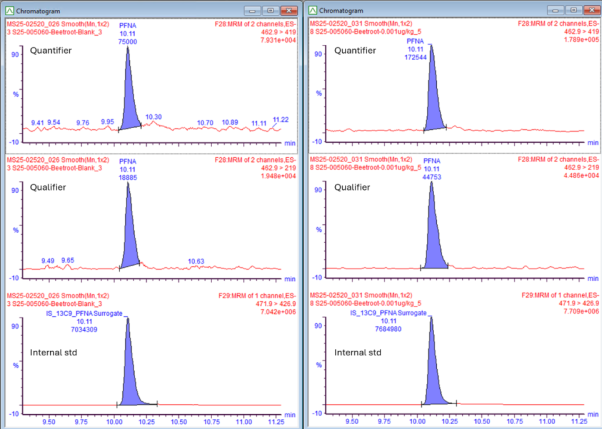
None of the matrices were devoid of PFAS at the level of the required LOQ (Figure 2) and, as such, no matrix could be considered a true blank. Thus, concentrations of the spiked samples were blank-corrected from the mean of the ‘matrix blank’ samples. The highest background level of PFAS in matrix blanks was found in onion, where PFHxS was 12 times higher than the lowest spiking level (0.001 µg/kg).
_in_a__blank_matrix__beetroot_sample_(left)_and_a_sa.svg)
Analytical trueness was calculated as apparent recovery while within-laboratory reproducibility was calculated as the coefficient of variation (CV). Results of the fruit and vegetable validation batches, including LC-MS/MS system LOQs, for the 4 regulated PFAS at 3 different spiking levels (0.001, 0.005, 0.05 µg/kg) are presented in Appendix A: Tables 1 – 11. Table 11 summarises analyte conformance with apparent recovery and reproducibility criteria for all 10 matrices. At the 0.001 µg/kg spiking level, 11 out of 40 total analytes passed both recovery and reproducibility criteria for compliance testing. However, this increased to 31 out of 40 total analytes passing validation criteria for compliance testing at the 0.005 µg/kg spiking level.
Appendix B (Tables 1 – 11) summarises validation data for 23 emerging PFAS compounds in the fruit and vegetable matrices. The established method could not validate a further 3 compounds (FOSA, FHxSA, FBSA) since they were either retained on the GCB or did not adsorb to the WAX SPE cartridges employed. Furthermore, it was found that the reagent blank contained certain emerging PFAS compounds at levels above the NS spikes. These compounds were identified as: perfluorohexanoic acid (PFHxA), perfluoroheptanoic acid (PFHpA), perfluorobutanoic acid (PFBA), 4:2 fluorotelomer sulfonic acid (FTA), and 6:2 FTA.
Summary and conclusions
A method was developed to analyse PFAS in a diverse range of fruit and vegetables in accordance with LOQs stated in EU recommendation 2022/1431 and validation criteria in the EURL POPs guidance document on analytical parameters for the determination of PFAS in food and feed. Matrices represented produce groups that were high in either pigments, starch, sugar, or water. Due to the range of pigments contained in certain fruit and vegetables, it was essential to utilise a GCB clean-up step first before extraction of PFAS by WAX SPE. For highly pigmented samples, such as blueberries and beetroot, it was necessary to perform 2 GCB clean-up steps. Absolute recoveries of PFAS internal standards from selected matrices ranged from 53-96% which is well within the 30-140% tolerance stated in the EURL POPs guidance.
None of the 10 matrices tested negative for PFAS with endogenous levels of individual analytes ranging from 0.001 to 0.012 µg/kg. Therefore, spiked sample concentrations for validation batches were blank-corrected to calculate apparent recovery (trueness). Only the beetroot batch passed validation criteria (trueness and reproducibility) for compliance testing at the 0.001 µg/kg level for all 4 EU regulated PFAS analytes (PFOS, PFOA, PFNA and PFHxS). This highlights the inherent problem of validating methods for matrices that contain endogenous PFAS levels above the required LOQ. Improved method performance was observed at the 0.005 µg/kg level with 31 out of 40 total analytes across the 10 matrices passing the validation criteria for compliance testing.
In the future, to validate the PFAS method at a LOQ of 0.001 µg/kg, a more comprehensive screen of fruit and vegetables would be required to identify blank matrices. In this project, all efforts were made to reduce background PFAS levels by either peeling or rinsing samples with HPLC grade water, solvent rinsing equipment used, and performing all procedures in a positive pressure laboratory.