
Abbreviations
Executive Summary
The Food Surveillance Programme Year 1 (FSP) was a £1.65 million programme that took place between March 2025 to March 2026. The programme set out to build upon existing infrastructure, research, and partnerships established during the Pathogen Surveillance in Agriculture, Food and Environment (PATH-SAFE) programme (2021-2025), and aims to bridge the gap between animal, human and environmental health while aiming to improve coordination across industry and government.
This Monitoring, Evaluation and Learning (MEL) review aims to assess the processes and governance underpinning the programme, and the extent to which the FSP is contributing to the realisation of its outcomes. The timing of this MEL report (March 2026) took place prior to some outputs from the programme being made available. As such, this review will aim to assess whether the programme is on the pathway to achieving its outcomes, however, longer-term measurement of expected outcomes from the programme is needed to understand the full impact of the programme.
Overall, the programme has achieved many of its aims, with developments made across all workstreams and a number of engagement activities undertaken to support coordination across industry and government. However, there still remain challenges regarding data sharing, which has impacted on some workstreams.
The programme has made contributions towards the ‘One Sample, Many Analysis (OSMA)’ approach via a feasibility study using river water samples for Shiga-toxin producing E. coli (STEC), demonstrating the potential for more efficient use of samples across surveillance activities. Key enhancements have been made to the Genomic Data Platform, informed by end user engagement, improving its usability. In addition, there have also been a number of recommendations arising from the AI discovery work, identifying both immediate efficiencies for the FSA and longer-term ambitions aligned with the wider biosurveillance landscape.
In many areas of the programme, the work undertaken represents early-stage development or proof of concept. There is a continued need for further resource and sustained support to build on the progress made under the FSP Year 1 and PATH-SAFE, to secure the FSP’s continuation beyond the current funding period, and to support the transition towards business-as-usual (BAU) activities and longer-term impacts.
Introduction
Foodborne illness remains a significant risk to public health, with an estimated 2.4 million[1] cases of foodborne illness occurring each year in the UK. Foodborne pathogens carry antimicrobial resistance (AMR) and pose a major risk of spreading from animals to humans.
Despite this, the UK’s investment in food surveillance is limited and fragmented. The Food Surveillance Programme (FSP)[2] set out to build upon existing infrastructure established during the PATH-SAFE programme[3] (2021-2025) and aims to bridge the gap between animal, human, and environmental health and join up industry and government.
The FSP received a total of £1.65 million for the financial year 2025 to 2026 via two funding pipelines: £1 million funded via the Integrated Security Fund (ISF), and £0.56 million funded through the FSA’s research budget.
The FSP adopts a One Health[4] approach to biothreats, bringing together multiple workstreams across HM Government (HMG) to help strengthen integrated working. Its key aims include:
-
asset enhancement, implementation and knowledge generation to improve biosurveillance
-
exploring and deploying new technologies and approaches to enhance efficacy and efficiency of future surveillance programmes
-
continued collaboration and facilitation as part of a cross-government, One Health approach to UK biosecurity
The programme was made up of key workstreams, including: Data and Tools, Shiga-toxin E.coli (STEC) surveillance, Onsite Diagnostics (OSD), and Engagement. These workstreams brought together stakeholders from across government and academia under one national FSP.
Partners involved in the programme included Food Standards Agency (FSA), Food Standards Scotland (FSS), Animal and Plant Health Agency (APHA), Catalytic AI, Department for Environment, Food & Rural Affairs (Defra), Fera Science, Home Office (ACE), Public Health Scotland (PHS), Newcastle University, UK Health Security Agency (UKHSA), University of Oxford and University of Edinburgh.
This MEL review aims to assess the processes and governance underpinning the programme, and the extent to which the FSP is contributing to the realisation of its outcomes. Due to the timing of this MEL report (March 2026), many of the final outputs may not be fully completed at the time of writing, and outcomes not yet realised. This review will aim to assess whether the programme is on the pathway to achieving its outcomes, however, longer-term measurement of expected outcomes from the programme is needed to understand the full impact of the programme.
1. Theory of Change and MEL Framework
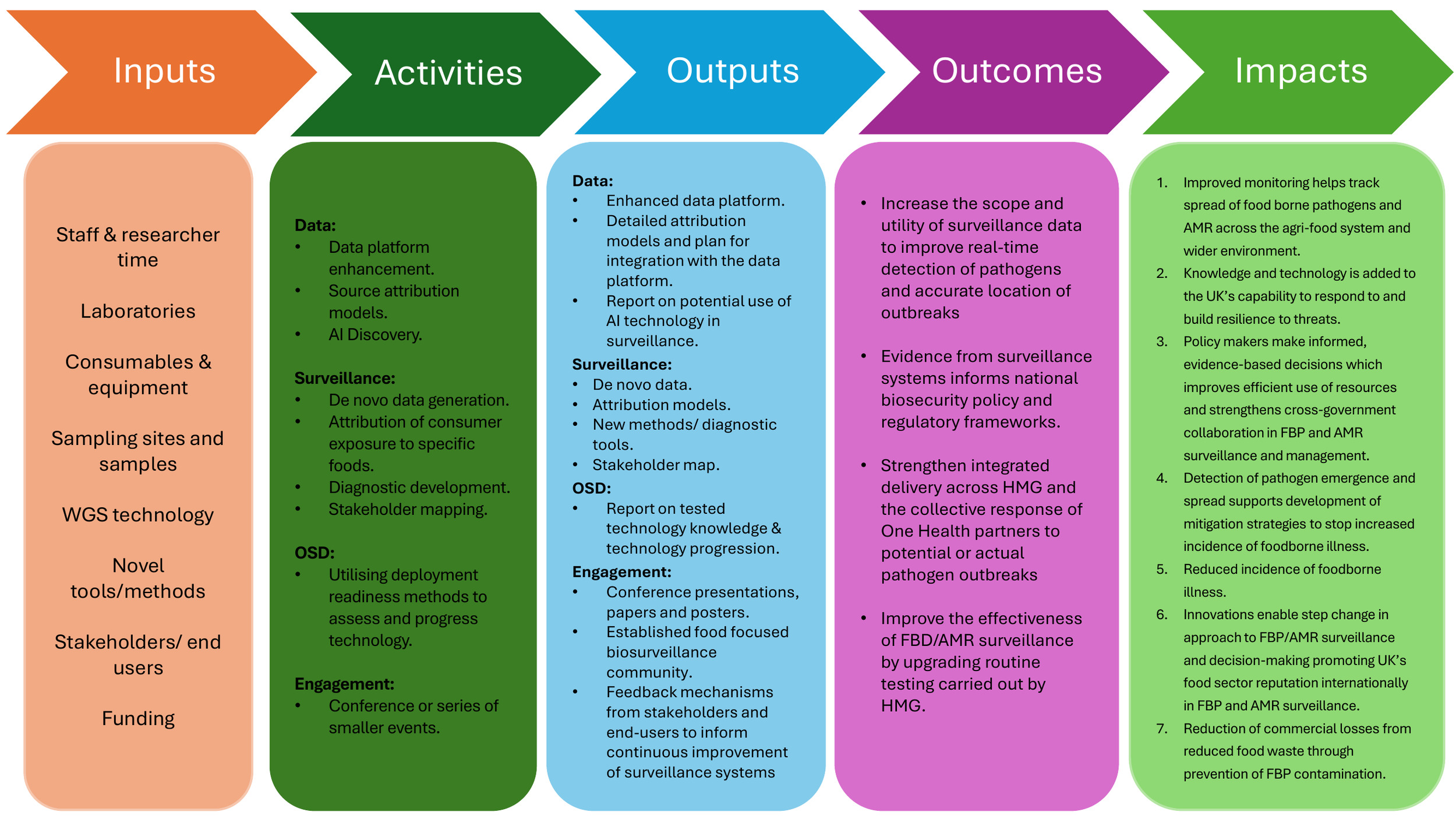
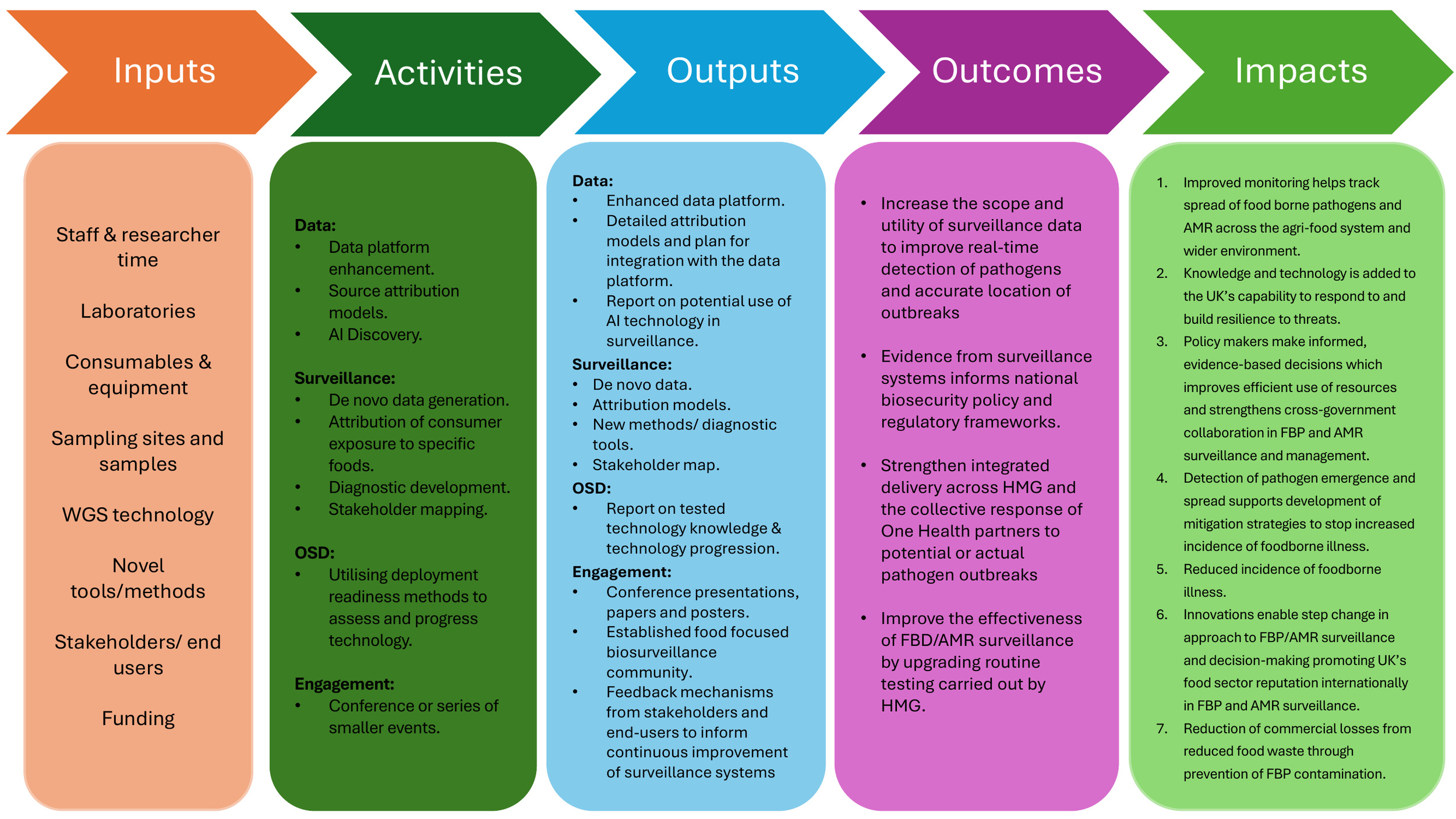
A theory of change (ToC) for the programme was developed using the principles outlined in the magenta book[5]. The proposed inputs (i.e. investment, resources) were mapped out, and the causal chain from these inputs fed through to the anticipated outputs, outcomes and impacts.
The ToC outlined in Figure 1 looks at the programme in terms of 4 key themes – Data and Tools, Surveillance, Onsite Diagnostics, and Engagement.
This ToC was also supported by a MEL framework (Table 1). This framework outlined the key evaluation questions for the programme, and the key data sources for each. A breakdown of the data sources and methodology is outlined in section 2.
2. Methodology and Data Sources
This review draws upon multiple data sources, including: project briefs/documentation, highlight reports, lessons learned logs, and feedback forms, as set out in the MEL framework.
The review primarily draws upon primary data collected through qualitative interviews. All available documentation was reviewed and triangulated with interview insights to strengthen the robustness of the findings.
Closure reports and many other planned outputs were not available at the time of writing (ending March 2026, while work on some outputs was ongoing).
2.1. Primary data collection
Semi-structured qualitative interviews were conducted with delivery partners involved in the FSP to gather deeper qualitative insights and perspectives. 8 interviews were conducted in total with delivery partners from each key workstream: Genomic data platform (1), source attribution modelling (2), AI discovery (1), OSD (2), STEC water sampling (1), and Infectious Intestinal Disease (IID) 3 (1). The focus of these interviews was to gather insights on the work conducted within the programme to better understand the effectiveness of the programme (and its delivery) and expected outcomes. The topic guide is included in Annex A.
The one-to-one interviews were held on Microsoft Teams and took place in February 2026, with each interview lasting around 45 minutes. The majority of partners interviewed were either the project or technical lead for their project, and one bioinformatician was also interviewed.
2.1.1. Data analysis
Once the interviews were completed, they were analysed using a thematic framework approach. The interviews were initially coded into broad themes, using the topic guide as a high-level structure; however, a semi-inductive approach was also applied to allow additional themes to emerge from the data. This ensured that common themes across interviews were captured beyond those anticipated in the topic guide.
To enhance the reliability and robustness of the analysis, each theme and its associated coding were independently reviewed by three researchers. Coding comparisons were undertaken to assess consistency, and any discrepancies were discussed and resolved through consensus.
Limitations
Some key limitations that should be considered in utilising the findings from this review are set out below.
Firstly, due to the timing of this review (March 2026) coinciding with the end of the FSP (25/26) some planned outputs (e.g., final reports) were not yet available. Additionally, the interviews took place in February 2026, while some outputs were still in progress. Reflections during these interviews may therefore have been based on incomplete work or evolving processes.
A further limitation is the relatively small sample size, with only eight interviews conducted. This reflects the targeted and specialist nature of the programme, which involved a limited number of key stakeholders with in-depth knowledge of its design and delivery. Whilst there was representation from project and technical leads from each project it is possible that additional results would have been found if more, or different stakeholders (such as external stakeholders) were interviewed. However, the decision to focus on individuals directly involved in the programme was intended to ensure that the data collected was informed by detailed, experience-based perspectives on its implementation and operation.
Additionally, there is a risk of potential response bias, as those interviewed were directly involved in the programme. This may have increased the likelihood of socially desirable responses or a reluctance to critique programme processes. While this was partially mitigated through the use of semi-structured interviewing and assurances of confidentiality, it remains a consideration when interpreting the findings.
Research Findings
3. Experiences of governance
The programme governance included monthly programme oversight group (POG) meetings. From October 2025 onwards, these meetings were held online for one-hour each month, with the exception of the December 2025 meeting which was conducted via correspondence.
Each delivery partner was responsible for completing a highlight report ahead of each meeting. These highlight reports included a summary of the key achievements, updates, any risks, and other monitoring information such as lessons learned and engagements.
Among delivery partners, the highlight reports were seen as useful and weren’t burdensome to complete. Comparisons to previous reporting conventions during the PATH-SAFE programme were also noted, with some partners feeling that the highlight reports for the FSP were less burdensome than they were during the prior PATH-SAFE programme. It is worth noting, however, that PATH-SAFE was a £24m programme, and therefore required more extensive reporting compared to the FSP.
“I really like the structure this year in comparison to how it’s been previously.”
- Delivery partner interview: February 2026
Other unintended benefits of the highlight reports for one partner included more frequent contact with lab teams directly. In order to provide the relevant information for the monthly highlight report this partner was in regular communication with the labs team directly. This resulted in earlier detection of issues and opportunities, which the delivery partner felt may not have been as quick to detect if they weren’t in as regular contact.
Reflections of the POG meetings were also broadly positive. It was felt that the meetings were well organised, and there was appropriate notice given for the meetings which allowed partners to plan and ensure there was representation from their projects. Some also reflected on the fact that actions and minutes from each meeting were provided promptly.
For some partners the POG meetings were seen as a valuable forum to share experiences with other partners who may have experienced similar challenges. However, others reported that attendance from partners was inconsistent and declined over time. They also felt that the meetings did not always include sufficient representation, or the appropriate partners, resulting in a lack of discussion during some of the meetings.
Some felt that there was a useful introduction to each project at the initial POG meeting, however they felt that an information pack including details of each workstream would have been a useful resource for partners to be able to refer back to. While slides from POG meetings were shared with partners after each session, and high-level information about the programme included on the FSP website, some felt that more comprehensive supporting materials would have further enhanced their understanding.
When reflecting on their experiences with the central management team many delivery partners felt the team were open and approachable. Many were favourable and felt they had good relationship with the team at the FSA.
“the team has been really open and helpful as well - really approachable.”
- Delivery partner interview: February 2026
Some felt they would have benefited from greater input from the central management team during the project initiation phase. In particular, some felt they would have benefitted from input from the team with regard to establishing governance structures such as help in drafting terms of reference (ToRs) and user agreements.
Others reflected on the frequency and extent of reporting, and contact with the FSA, and in particular how this compares to other, similar, programmes. Some reported that the frequency of contact with the central management team was greater compared to other programmes, but they felt this was proportionate given the short duration of the programme overall.
“…the short timescale of this project and quite a lot of deliverables, I think it’s been very helpful for us to keep on top of what we’re doing and make sure that we’re not going off track and that we have ample opportunity for feedback from the FSA to come into the project.”
- Delivery partner interview: February 2026
Overall, it was felt that there is a good balance with the level of contact between delivery partners and the central management team. The contact is regular enough that support is there when needed, but it equally didn’t feel burdensome.
“So the opportunities to connect with projects are there, but it’s not an onerous extra thing.”
- Delivery partner interview: February 2026
3.1. Engagement
The FSP also facilitated a number of engagement activities including hosting an STEC virtual consortium, environmental biosecurity centre workshop and a One Health connections event.
An STEC virtual consortium was created to facilitate awareness of ongoing and planned activities in STEC research and development across government. Membership of the consortium not only included relevant delivery partners involved with the FSP, but also colleagues from FSA and FSS who also deliver STEC focussed research. The group were asked to provide feedback[6], with most reflecting that the main value of the group was to connect and collaborate. In future members would like to see greater coordination of future project ideas and synthesis and planned dissemination of outputs.
During the delivery of the FSP these meetings were voluntarily organised by the Biosurveillance team at the FSA, however, they were intended to be participant led and it is unconfirmed if this group will continue to meet after the FSP year 1 closed in March 2026.
The environmental biosecurity centre workshop convened stakeholders from across government, agencies and external partners to explore the potential role and value of a dedicated environmental biosecurity centre, including feasible delivery models (distributed, hybrid or physical). It was an exploratory discussion to surface insights, assumptions and uncertainties to inform future engagement.
The FSP also hosted a one health connections event with collaborators from across government, industry and academia. The event provided a space for open dialogue, allowing participants to share perspectives on the current biosecurity and biosurveillance landscape, and identify opportunities for strengthened collaboration. It also aimed to build connections and facilitate the exchange of knowledge and ideas around emerging challenges and opportunities beyond the event.
4. Project Outputs and outcomes
4.1. Genomic data platform
The Genomic Data Platform (GDP) developed through the PATH-SAFE programme, is an operationally-focused, cross-government capability which provides genomic analytics linked to contextual metadata, visualised in user friendly reports for end-users within partner UK agencies[7]. It ultimately aims to improve the rapid identification and tracking of foodborne pathogens, clusters and AMR.
The work undertaken through the FSP intended to build upon the work completed during the PATH-SAFE programme by conducting a pilot exercise, which aimed to further data integration, deployment and enhancement to support end user needs.
Its overarching objectives were to:
-
Establish data sharing arrangements to enable data integration and complete a pilot deployment exercise with partner agencies.
-
Enhance the platform as needed to advance its design and meet end user needs.
-
Foster and grow the cross-agency partnership for the project
This work intended to complete a pilot deployment exercise with partner agencies (UKHSA, APHA, FSS and PHS) and establish a data sharing agreement between the FSA and participating agencies to support this exercise. However, due to challenges sharing commercially sensitive data, a temporary partition was created within the platform to keep UKHSA and APHA data separate from that of FSS and PHS.
The pilot exercises were conducted to get users from the different agencies using the platform, by uploading real data and testing out how the system works, as this isn’t something they were able to do previously. There were several user types for these pilots, including those who uploaded data to the platform, those who used the insights generated, and those who did both. By including these different groups of end users, valuable feedback was gathered around not only how easy it is to upload data on a day-to-day basis, but also around the ease of navigating and analysing data.
Monthly end user group meetings were a helpful way of maintaining engagement and capturing feedback. Additionally, compared to previous ways of working during the PATH-SAFE programme, giving end users ownership over their pilot projects has been a huge improvement in sustaining engagement from them due to the greater ownership of work.
Key changes to processes and the platform itself were made through end user feedback. One of the key changes was enhancing the documentation associated with the platform (i.e., information about the upload process, and metadata file requirements), as it was reported this information wasn’t signposted clearly enough. Other enhancements have been made so that any filters etc. applied to the data when exploring the platform can be saved. This makes it easier for users to retain and share customised filters more easily.
"you can change the colours in the collection when you’re exploring it, but you couldn’t necessarily keep those changes and save them and share them with someone else like every time you refreshed or shared it with someone else, those kind of little changes as you’re exploring data weren’t persisting. So that has also been an enhancement to the platform that we’ve rolled out as a direct response to feedback."
- Delivery partner interview: February 2026
However, continued concerns relating to data sharing have remained. Despite the data being fully anonymised, the metadata uploaded to the platform is still very minimal.
“data minimisation is stretched to its limit here. When we initially started designing the platform, we wanted the county information instead of just the UK, because that will give you so much more value in the data you’re looking at. So, it was a massive problem in the metadata design.”
- Delivery partner interview: February 2026
This is borne from hesitancy from agencies to upload data seen as potentially commercially sensitive to the platform, and concerns that if this metadata is too granular it could impact trust from industry partners.
“the data sharing is a real problem and will continue to be the biggest problem and the biggest barrier…we had to do two different pilot exercises because of that. So, the aim was to do one pilot exercise for everyone to use the platform in one place. And what we had to do was actually put this kind of temporary partition in the platform.”
- Delivery partner interview: February 2026
By showing users the benefits of the platform’s utility and by demonstrating that all data held within it is safe and secure, supported by well-established user access agreements, it is hoped the approach taken will help build trust and confidence, and over time lead to increases in the level of detail in the metadata shared.
Further detail on data sharing challenges is expanded upon in section 5.1.
To complement the pilot exercise, work was also undertaken in collaboration with the Accelerated Capability Environment (ACE)[8] to set out a long-term operating model implementation framework for the GDP.
The model produced from the work is organised around six interdependent components, all of which are important considerations for a capability such as the GDP:
-
Strategy & Governance
-
Services & Users
-
Processes & Capabilities
-
People, Organisation & Ecosystem
-
Technology, Data & Locations
-
Performance & Assurance
The proposed operating model reflects the recognition that current barriers to scale are not primarily technical, but relate to trust, governance clarity, and service maturity, with all requiring coordinated development in order for the GDP to be integrated into BAU operations.
The recommendations set out in the model will be contingent on appropriate resourcing and cross-agency commitment, particularly to operationalise governance arrangements, address trust and data-sharing barriers, and build the capabilities needed for BAU transition.
4.2. Source Attribution Modelling
The source attribution modelling research is a development on work established during the PATH-SAFE programme[9]. Previously, two machine learning host attribution model types were developed. The work conducted under the FSP aimed to integrate the modelling pipeline(s) into the GDP to allow for host attribution of E. coli isolates. It intended to make these models more accessible to users of the GDP by ensuring they are optimised for usability, scalability, and integration.
Secondly, the research aimed to combine the datasets available for STEC from previous projects in the UK towards to develop methods to predict the animal source, geography and human threat of any newly sequenced STEC. It intended to build a model(s) to generate ‘human’ score of STEC isolate and estimate the geographical origin of STEC isolate (using Scotland data)[10].
The project has made improvements to the accessibility and usability of the attribution models by including these models within a pipeline, making the use of the model more straightforward and accessible. At the time of interviewing the tools had not yet been integrated into the platform as benchmarking work was still ongoing to better establish how computationally expensive it would be and end user preferences in terms of the trade-off between prediction speed and model accuracy[11].
A significant challenge with this work has been the data sharing limitations. The project team have faced barriers with accessing the data needed for the modelling. For example, the team needed access to hospitalisation data for their threat to human health predictions as part of the STEC project, which ultimately was not shared and the team could not access.
“we were hoping we would be able to get some hospitalisation data because then we have our models, we were able to predict almost like a risk to human health, but then that data never got processed through. The same thing was happening in the original PATH-SAFE”
- Delivery partner interview: February 2026
Further issues were experienced regarding the level of metadata provided within the platform.
“people are very hesitant to share just even very basic metadata, like for example…we want to know if this isolate came from a cow or from a chicken, but even that would be too much.”
- Delivery partner interview: February 2026
Due to these issues in accessing the necessary metadata meant that the team were unable to undertake planned geographical modelling.
“we weren’t able to do a lot of the geographical isolate distribution, and again, that’s because we - just the metadata that we needed to have, we weren’t given that in the 1st place”
- Delivery partner interview: February 2026
For further detail on data sharing challenges within the FSP see 5.1.
4.3. AI discovery
The aim of this project was to better understand the opportunities for AI to enhance UK surveillance capabilities, with a particular focus on opportunities of relevance for biosurveillance in the FSA.
As a discovery piece, the focus of this work was to produce actionable insights and recommendations for applying or integrating AI, looking at immediate efficiencies for the FSA and longer-terms goals in alignment with the wider Biosurveillance landscape[12].
The work was focussed on three key areas: microbiological risk assessment, horizon scanning and operational incident response.
Discovery work was undertaken through interviews with FSA stakeholders from the aforementioned areas to understand the pain points experienced, and these have been mapped into clusters – identifying a total of six key clusters across the FSA. These were then transformed into six key innovation focus areas, that are in alignment with the biological security strategy (BSS).
Recommendations have been made for improvements that can be made in the short-term, which may enable the longer-term opportunities identified. These recommendations are advisory in nature and would require additional resource, and organisational support to be implemented and integrated into BAU operations.
Suggested AI improvements in the FSA are focussed on helping staff to speed up their day-to-day tasks, allowing them to respond more quickly and efficiently to incidents. One example of this is using AI to look at organisational memory and turning this into useful insights. By using AI to look at metadata from historic incidents and making this discoverable, relevant teams can look at this data and identify common trends, which can be applied to help prioritise risks and new incidents that are emerging. Ultimately, using AI in this way is intended to support team and enable teams to move from more of a reactive space towards a more preventative space.
“Making all of that historical data discoverable, reducing the time it takes for people to do day-to-day tasks”
- Delivery partner interview: February 2026
Longer term, if the suggested improvements are implemented, it could create greater efficiencies, which may contribute to a reduction in incidents, and incident severity.
“our hope is that once the individual elements are addressed, it will enable a reduction in incidents by enabling earlier intervention on emerging incidents so that they don’t escalate, but also enabling, by being able to understand and characterise the history and forecasting of incidents and changing risk type that mitigations will need to be able to be put in place. So, we’re hoping to see a reduction in overall incidents, and incident severity.”
- Delivery partner interview: February 2026
4.4. STEC Water Sampling and Detection Technology using the Brown Rot River Survey
This project was a feasibility study to evaluate whether existing river water sampling programmes can be adapted to serve multiple purposes, leveraging a ‘OSMA’ One Health approach[13].
The study draws upon an existing river water survey samples to analyse river waters for the presence or absence of STEC, using both the traditional Environment Agency (EA) water testing method and using a novel diagnostic technology, Loop Mediated Isothermal Amplification (LAMP).
The overall aim of this work was to assess the feasibility of a ‘OSMA’ approach by analysing river water samples for STEC using both traditional and novel detection methods. The objectives were to:
-
Test river water samples for STEC using EA method and LAMP
-
Compare detection limits and performance of LAMP versus traditional methods.
-
Cryogenically store confirmed STEC isolates
-
Review the feasibility of the ‘OSMA’ approach, and a feasibility assessment of LAMP for in-field diagnostics.
Additionally, the project later undertook additional work, comprised of a work package to enable the Whole Genome Sequencing (WGS) of E. coli isolates recovered during the project[14].
The study was able to successfully test this approach of using samples collected for other purposes and analysed for different targets. However, an important insight from this work is the effect that original sampling designs can have on the usefulness of secondary analysis. In this case, the original sampling plan was largely focussed on plant health, targeting rivers known to be used for crop irrigation. If the sampling approach had incorporated human and animal health perspectives at the design stage, this could have informed the collection of additional samples from livestock farms, slaughterhouse areas, and rivers close to runoff from these types of establishments. Access to more detailed contextual information about sampling sites (e.g. proximity to agricultural activities) would have strengthened the ability to interpret findings, particularly in relation to understanding potential sources and transmission pathways[15].
Using novel detection methods was useful to explore, however they didn’t work as well as anticipated. With the LAMP method there wasn’t enough confidence in the limits of detection to successfully differentiate between other types of E coli and STECs, as there was not enough STEC data for reliable conclusions to be made.
Additionally, this project also highlighted that traditional methods were not as reliable as first thought.
“What we have seen through this work is that the traditional methods are definitely not reliable and not robust enough, so it’s further highlighted the limitations we were already aware of and presented with others too.”
- Delivery partner interview: February 2026
Overall, this study was a proof of concept to assess the ‘OSMA’ approach. The project was able to successfully test the principle, despite encountering unexpected challenges with the detection methods.
Compared to previous ways of working, a major advantage of this approach is the potential for efficiencies. Using the same samples across different testing regimes significantly reduces the costs associated with sampling, which is often a large proportion of project expenses. This frees up funding that could be applied to further progress testing technologies and advancements in other areas.
4.5. On-site Diagnostics
Previous work completed as part of the PATH-SAFE programme demonstrated the utility of using on-site diagnostics as inspection tools for foodborne disease (FBD) but also highlighted that there were no “ready-made” solutions on the market that meets the specific needs of end-users and instead found that there are a wide variety of emerging technologies. Utilising these outputs from PATH-SAFE, the project conducted under the FSP aimed to further explore the use of OSD technologies for deployment at borders and/or abattoirs, and to better understand and work towards resolution of the barriers to deployment of OSD technologies.[16]
The project was centred around four interconnected objectives, including:
-
Operational challenges,
-
Technical barriers
-
Exploring the deployment decisions for OSD including,
-
Better understanding of the cultural/attitudinal barriers associated with OSD
The project has made progress towards assessing the use of OSD technologies, but these have primarily been small proof of concept studies in the lab and landscape mapping of technologies.
“what we’ve been looking at is small studies or proof of concept or just sort of landscape mapping of technologies and what could or couldn’t be there…. I don’t think we’ve gone through this and found like a silver bullet that’s going to like change everything, but there are lots of things that could be put together to, you know, like small incremental gains could give a larger improvement with more work to sort of get those to a feasible state”
- Delivery partner interview: February 2026
There has been progress in addressing technical barriers experienced during the PATH-SAFE programme, with work being undertaken on the sensitivity of testing, specifically looking at the enrichment of food pathogen testing and reducing the time to result.
However, there have been challenges in addressing non-technical barriers, such as processes and culture, which impact on whether these technologies are actually deployable.
“If we just focus on sort of the technological challenges or, you know, what we’d like to see happen, we’ll just then end up with good technology that’s still undeployable because of all the other barriers.”
- Delivery partner interview: February 2026
There are also specific regulatory barriers, such as accreditation of laboratories and legislation, that are challenges that need to be addressed in order to introduce these technologies within the food sector and to make these technologies feasible in real world applications.
A result of the challenges experienced is that there have been strengthened relationships and joined up thinking to help tackle these challenges across sectors.
“I think one of the outcomes is probably a better relationship with the FSA and Fera and how we can sort of work together and, you know, utilise, it’s not quite one health because it’s only plants and food, but you know, those sort of like two sectors working together to tackle similar challenges.”
- Delivery partner interview: February 2026
A cost benefit analysis was also undertaken for assessing on-site testing for food pathogens, specifically in abattoirs to better understand what the benefits are, the scale of these benefits, and for whom. This was a new facet of the project under the FSP and has been a critical part of the project in establishing how these technologies should be employed in real world settings, and will be an integral part of future thinking.
“the cost benefit part of this project… it’s going to have quite a big impact on how we sort of consider what to do next”
- Delivery partner interview: February 2026
Overall, there have been incremental developments in addressing some of the technical barriers, however for on-site testing to be applied more widely it is felt there needs to be a step change for meaningful changes to occur.
“the incremental developments bring you incremental benefits and that is useful in some purposes, but like more radical and envisaged scenarios of using on-site testing more widely, we need step changes”
- Delivery partner interview: February 2026
4.6. IID3 metagenomics and metatranscriptomics pilot
The infectious intestinal disease (IID) project aims to estimate the burden and causes of infectious intestinal disease in the UK population. Two previous IID studies have been undertaken to examine the rates of IID: In 1993-1996, the Study of Infectious Intestinal Disease (IID) in England (IID1 study)[17] and in 2007-2009, the Second Study of Infectious Intestinal Disease in the community (ID2 study)[18].
The FSA are now undertaking a third IID study (IID3)[19], which aims to:
-
Assess the overall burden of IID in the UK and find out its key causes;
-
Work out what proportion of cases are not reported to healthcare providers;
-
Look at how many of these cases are likely caused by foodborne diseases
The IID3 Study aims to generate up-to-date, comprehensive data on the incidence, causes, and outcomes of IID in both the general population and healthcare settings. The study is split into cohorts. Cohort one is representative of the general UK population, and they submit samples whenever they feel unwell, and cohort two are a GP recruited cohort (they have gone to their GP and have reported symptoms). From cohort one, around 80% of patients didn’t have pathogens detected in their samples, and for cohort two this was around 55%[20].
“with cohort 2 about 55% didn’t have any pathogens detected. So that means that there’s a huge gap in our knowledge about what’s going on with those patients because we weren’t able to attribute them to a pathogen or a disease.”
- Delivery partner interview: February 2026
Consequently, there is a huge knowledge gap about what’s going on with these patients as there are no detectable pathogens, highlighting a critical limitation in the current diagnostic approaches, and as a result, a substantial portion of IID cases remain unexplained.
To help address this evidence gap, the FSP funded a pilot looking to integrate metagenomics and metatranscriptomics sequencing into the IID3 study. Metagenomics captures the full spectrum of microbial DNA in a sample, and metatranscriptomics complements this by analysing RNA to reveal which microbes are actively expressing genes (including antimicrobial resistant genes), providing insight into the functional activity and pathogenicity[21]. This pilot also took the approach of ‘OSMA’ by utilising samples from the IID3 biobank.
“it’s using that principle of sample once tests multiple times. So yes, we have a biobank full of the IID3 samples that we’re taking to run this pilot and what we would use if we were to want to do a wider study, so we’re not having to collect specific samples for this pilot.”
- Delivery partner interview: February 2026
IID3 has traditionally taken a targeted approach, looking at 22 specific pathogens that were screened for and if detected, were sent to the lab for further isolation and AMR testing. Many samples analysed have returned as non-pathogen detected and the pilot aims to address these data gaps by looking to detect novel pathogens outside of the targeted list to help identify whether this list of priority pathogens should be updated in future studies. An unintended consequence of this work is that changes in the general public’s microbiome will also be able to be monitored – looking at whether they have been in contact with the pathogen, how long it takes to resolve etc.[22]
At the time of writing this, the results from the study aren’t available, but it is anticipated that this pilot will fill the non-pathogen detected gap the study currently has. It is also hoped that it will fill other evidence gaps, such as providing a better picture of AMR communities by looking at diets, and how these may be affecting pathogens, microbiome, etc.
5. Barriers and enablers
The FSP is formed of multiple projects with distinct approaches to delivery, so most barriers experienced are unique to their individual projects. Some of those encountered are summarised below. A common barrier that arose across multiple projects was the issue of data sharing, which will be expanded upon in 5.1.
For the STEC water sampling project a challenge was accessing necessary media and reagents and experiencing quite long delays. In particular one chromogenic agar had a lead time of 16-weeks, this is compared to the typical 24–48-hour delivery. This was an unexpected challenge and meant the project team had to source the agar from colleagues in order to remain on time.
Within the source attribution modelling project there were delays experienced with recruitment and procurement. A specific computer server needed to conduct the analysis took much longer to procure than expected, which incurred some delays in kicking off the project.
Some projects also cited challenges with delivering the project within short timeframes, with particular reflections on time needed to get up to speed on the food sector and needing to commence multiple work strands concurrently and at pace.
5.1. Data sharing
A persistent challenge for many cross-government programmes, and one evidenced previously in the PATH-SAFE evaluation report[23] is data sharing. Cited as an issue by many delivery partners, the FSP has also experienced data sharing issues.
“…the red tape, the bureaucracy, the data sharing is a real problem and will continue to be the biggest problem and the biggest barrier”
- Delivery partner interview: February 2026
A common emerging theme is that it is not necessarily sensitive data that is the issue, but instead establishing the relevant information governance arrangements and gaining the trust of data owners to enable sharing of the information with others that are the challenges.
Some felt that to better work towards One Health ambitions, data needs to be shared between different organisations and be co-analysed to better understand the links between the different strands of One Health and how each strand will impact the other, as they are by their very nature interconnected.
It is felt that there needs to be a better foundation of trust, and a cultural shift amongst organisations for there to be any meaningful improvements on data sharing. Some felt that these changes in culture need to be driven by senior leadership.
“I think that the change in culture has to come from senior. It’s got to come top down”
“to trust in sharing data, we need reporting pathways that are clear, and robust information governance”
- Delivery partner interviews: February 2026
Some common issues raised when thinking about data sharing is the fear of multiple versions of the truth. To help mitigate this there need to be clear data owners and reporting pathways to facilitate trust and transparency with how the data is used. This is a key barrier for not only the FSP, but also other initiatives working in the One Health space. The ACE work (set out in 4.1) made recommendations in the form of a ‘governance trio’ to help tackle some of the data sharing challenges faced by the GDP. The trio is comprised of:
-
A Memorandum of Understanding (MoU): A shared purpose, authority, and principles for participation and data sharing.
-
Playbook: the primary operational control for access, escalation, notification, safe outputs, and assurance.
-
Data Sharing Agreements: used where additional, time-limited or context-specific controls are required.
If adopted, the governance trio approach presents a potential solution to mitigate some of the challenges, but is dependent on buy-in from stakeholders.
Another key issue is the hesitancy around sharing commercially sensitive data. Departments are reluctant to share any commercially sensitive data for fear that this could harm relationships with industry partners if the data were to be accessed inappropriately.
"With industry it tends to be like …because they have, you know, their IPs or for a lot of farms… they don’t want there to be publicised that they… have E. coli in their farms or something. Across government, again, I think there is some hesitation to share things across agencies, which it is more difficult"
- Delivery partner interview: February 2026
For the genomic data platform, one consequence has been that the available metadata is currently very high-level, which has reduced the usefulness of the data shared via the system. This has also had knock-on implications for the source attribution modelling work, and the planned geographical modelling could not be taken forward.
“initially we were looking at building this geographical model where, you know, really localised hotspots, but in terms of what data is actually available, it’s just kind of much more diluted. So my sequences, you can only say they’re from Scotland or England or Wales for privacy reasons, really. And I’m sure there are important reasons for why we can’t do that. But yeah, so that’s kind of been a bit of a barrier in terms of some of the geographical aspects of it.”
- Delivery partner interview: February 2026
Another key challenge experienced during the delivery of the project this year was the introduction of a temporary partition in the GDP. As set out in 4.1, the project originally intended to complete a singular pilot exercise across participating UK partner agencies, including UKHSA, APHA, FSS and PHS. However, due to data sharing sensitivities, a temporary partition was added to keep UKHSA and APHA data separate to that of FSS and PHS. This was a temporary solution established to enable completion of this pilot, however if the data platform is to be rolled out in future and integrated into BAU activities then there will need to be a more sustainable and long-term solution to the underpinning concerns.
It is hoped that building trust in the genomic data platform through demonstration that the platform works as intended, assuring that data is held safely and securely though use of clear access agreements and MoU’s (i.e. the governance trio), that the platform can get to a point where agencies are confident uploading data with the level of metadata detail that offers the most value.
5.2. Enablers
A key enabler of the FSP has been the central management team. Many delivery partners reported that they felt the central management team were helpful in setting out expectations, requirements and milestones, which helped keep the projects delivering to time. Regular check-ins with the central management team were seen as helpful and allowed for frequent progress reviews and timely feedback. Additionally, the team were seen as helpful in fostering connections with relevant specialists.
“…there’s definitely been a lot of support from the FSA to get us talking to the right people. That has definitely enabled us to understand things more.”
- Delivery partner interview: February 2026
Some also reflected on the fact that they had existing contracts with the FSA, which made initial stages of reviewing and implementing contracts and T&Cs much quicker.
For others, building on the work already established during the PATH-SAFE programme has been an instrumental part of delivering their work under the FSP. They have been able to build upon and utilise existing data sets and sequencing frameworks established during PATH-SAFE.
“without PATHSAFE, we wouldn’t really have any of these models or any of these huge data sets from the environmental sampling and from specifically the animal sampling as well.”
- Delivery partner interview: February 2026
The IID3 pilot was also enabled by utilising existing samples and pre-established lab teams with metagenomics capabilities. This meant it was relatively straightforward to expand upon existing work and have the samples sequenced without the need for extensive planning and logistics considerations.
6. Anticipated Outcomes & Impact
As projects are only beginning to conclude in March 2026 and given the timing of this report, the anticipated outcomes and impacts of the project have yet to be realised. This section reflects on the work completed by the FSP to-date and looks at some broad themes of how this work is contributing to these pathways to outcomes and impacts, which we would expect to see in the medium-to long-term.
6.1. Greater utilisation of samples
As demonstrated by the STEC sampling project, there is strong appetite for greater sharing and utilisation of samples across government. There are a number of regular regulatory surveillance programmes across government, providing plenty of opportunities to utilise these samples for further testing.
“there’s lots of opportunity to tap into those samples and with sampling being one of the more expensive parts of any surveillance programme, it seems to be something from an efficiency perspective that that makes sense and this really has sort of tried and tested that approach.”
- Delivery partner interview: February 2026
Overall, this study demonstrated the viability of the ‘OSMA’ approach, highlighting its potential to deliver greater efficiency and better use of resources. Using the same samples across different testing regimes significantly reduces the costs associated with sampling, which is often a large proportion of project expenses. It also creates scope to redirect funding towards supporting innovation in other areas. The findings also highlight a key consideration for this approach, that without early, coordinated planning from across research disciplines, sampling designs may limit the full benefits of the approach. Building on the learnings from this study, and strengthening collaboration at the design stage for future projects would help address this, enabling a more integrated and efficient system over time.
6.2. Improvements for cross-government collaboration
Meaningful improvements in biosurveillance across the UK is reliant on stronger relationships and communication across agencies. Through its 25/26 work, FSP helped facilitate connections but there are still further challenges across-government to enable relevant specialists working together in practice. Some partners felt there needed to be more frequent and centralised collaborations across government. Recognising this, and building on the success of PATH-SAFE’s communities of interest, the FSP created the STEC virtual consortium which brought together partners from across agencies to share knowledge and build connections, and was valued by participants as a mechanism for collaboration; however, it also highlighted that sustaining regular engagement and coordinated activity remains an ongoing challenge. Overall, while the FSP has played an important role in supporting more joined-up working in line with its objectives, there remains a need for wider cross-government collaboration.
“for a lot of the One Health, it’s about…having the UK have a very robust like tracking, monitoring, surveillance, and prevention framework. And that means that means many different people working with each other on a more centralised basis.”
- Delivery partner interview: February 2026
There is a clear opportunity to strengthen system-wide coordination by moving towards a more unified cross-government approach. While agencies have yet to fully operate as an integrated system in practice, the FSP has begun to enable more joined-up working through its project delivery and engagement activities. Building on this progress, and creating further alignment and collaboration across government could significantly improve overall efficiency and delivery of shared outcomes. Siloed thinking and approaches to biosurveillance also remains a challenge.
“In theory, every agency is working as a team to reduce foodborne disease, but in reality, that’s not happening. And forcing the conversations towards, okay, how do we actually make this whole system more efficient should be a priority.”
- Delivery partner interview: February 2026
“I think that sort of cross learning and, you know, trying to tackle similar problems, but from a multi-angled view, can drive forward innovation across the whole landscape rather than sort of keeping in silos trying to sort of look across what are the common challenges that we’re all facing and how do we work collectively to deal with that rather than each individual area trying to make its own progress. Sort of the sum of the parts is greater than individuals.”
- Delivery partner interview: February 2026
6.3. Addressing data sharing and non-technical barriers to progress towards ‘One Health’
Getting the right people together into conversations about data sharing is essential for the valuable tools and approaches from programmes such as FSP to create meaningful change and impact on biosurveillance in future.
Delivery partners highlighted the need for stronger, long-term collaboration between government bodies and industry. Building positive relationships and encouraging the use of tools developed within the FSP are an essential step to building trust and demonstrating their value.
“just making sure that all of the agencies are working together, they keep working together, and sharing the data and everything…and more long term, like just try to build like more positive relationships, either with the public or with the farm industry, just basically … here is the tools that we have you know, please like use them because again, the more people use them and rely on them, the more they prove their worth in a way”
- Delivery partner interview: February 2026
There have been efforts made through the 25/26 FSP work to try and address some of the data sharing challenges (such as the proposed governance trio), but there are further improvements to be made across the biosurveillance community. There needs to be clear reporting pathways and robust information governance for government agencies to have trust in sharing their data.
“The data sharing problem isn’t about how you share data, it’s about how you respond to that data that you’ve shared and share that information governance… It’s trust of what you’re going to do with the intelligence you get out of that data. But everyone’s like, why wouldn’t you share your data with me? It’s like, well, because I don’t know what you’re going to do with the stuff you find or how are you going to check with me that you’ve interpreted it right”
- Delivery partner interview: February 2026
Similarly, there are challenges with non-technical barriers that need to be addressed in order to move further towards ‘One Health’ ambitions.
“huge non-technical barriers that also require somebody to be thinking about. Because you can make all the tests in the world, but if nobody’s going to you know, put them into legislation, then they’re not, they’ve got no use.”
- Delivery partner interview: February 2026
6.4. Effective coordination and programme governance
The coordination and governance of both the FSP and PATH-SAFE programmes were seen to have worked well, and these processes should continue to be followed for any future initiatives.
Many partners reflected positively on the governance of the FSP this year and reported that connections with the central management team stuck a good balance of light-touch but consistent engagement, which helped partners feel connected without being over-managed.
“I have been really impressed with the balance between feeling that the contact is continuous and it’s not just projects left to their own devices, but also that it’s been sort of light touch. So the opportunities to connect with projects are there, but it’s not an onerous extra thing.”
- Delivery partner interview: February 2026
Reflection on the PATH-SAFE programme was also positive, and the governance was attributed as a key success to the programme.
“PATH-SAFE has probably been one of the best led programmes I’ve ever seen in in government, especially as a shared outcome fund. I think the success of the programme is highly related to how well it’s been run through the different work streams and how well it’s bought in industry and government and multiple agencies of government on a common vision.”
- Delivery partner interview: February 2026
7. Lessons learned
7.1. Operational
A key lesson emerging from the programme was the importance of building sufficient contingency time into project plans. A three-month set up period was employed by the programme team and was useful in mitigating against most set-up delays. However, during delivery even small delays experienced, such as onboarding staff, or setting up accounts had knock-on effects on reporting schedules and created time pressures. Additionally, allowing realistic timelines for procuring materials or equipment was seen as essential for avoiding delays and ensuring the projects delivered on time.
“logistically, checking lead times with suppliers well in advance of any work start being planned or agreed, that’s definitely one for us”
- Delivery partner interview: February 2026
“We’ve had to delay that [account set up] by a week, which has compressed the report writing. So luckily we built in a little bit of time, but yeah, no one’s going to do things proactively, they’re all going to do the last minute.”
- Delivery partner interview: February 2026
7.2. Governance and collaboration
Reflections on project management processes also highlighted the limitations of relying solely on high-level project management structures. This was especially true within large, complex projects like IID3, and while regular check-ins with the overall project manager were helpful in tracking milestones, these updates sometimes failed to capture more granular, operational details. The IID3 pilot demonstrated the value of maintaining direct communication with laboratory teams as this allowed for greater connection with those physically conducting the testing and offered deeper insight than perhaps would’ve been gained through communications with project managers alone.
“Sort of large projects, you’re not going to speak to every single researcher doing a piece of work, but I think for these sort of maybe more important side projects where you’re sort of hoping that those results will then lead on to more, I think having that communication directly with somebody actually doing the work who’s responsible for that work has been really important and quite insightful actually.”
- Delivery partner interview: February 2026
As evidenced throughout the report, this programme has emphasised the need to establish robust and clearly defined data-sharing agreements where these are needed to support individual elements of work, though this forms only one part of the wider data sharing challenge across government, as discussed previously.
Some projects, such as OSD also demonstrated the benefits of interdisciplinary working. Delivery partners reported experiencing more meaningful collaboration across different scientific and analytic disciplines. This engagement helped to improve understanding of how different areas contribute to the wider biosurveillance landscape.
“I haven’t really worked particularly closely with economists or social scientists in projects before, for all we talk about interdisciplinary projects and stuff, they do still end up quite siloed, whereas this project, I feel like I’ve had more chance… to see how the different disciplines interact.”
- Delivery partner interview: February 2026
7.3. Strategy
A further lesson was the need for a clear long-term vision and sustained support for programmes of this nature. Some delivery partners noted that uncertainty about the future of programmes or working groups can limit momentum and that there needs to be a longer-term vision for how work from this programme will continue.
" some more support on the on the policy side of things, and you know, as always, like funding, but that’s you know, self-evident. But yeah, just having like a more long-term vision, because you can have like one-year project or two-year project…there needs to be some way to like show that this is like a long-term project."
- Delivery partner interview: February 2026
“I don’t know if it’s been made as clear as OK, what’s the lasting outcome of this group like does it continue? Does it end? Does it change? Does it evolve?”
- Delivery partner interview: February 2026
8. Conclusions
Overall, the Food Surveillance Programme (FSP) has made progress towards its intended aims, with developments delivered across all workstreams. Given the timing of this review, many outputs were still in progress, and longer-term outcomes have not yet been realised. As such, this report has focused on the extent to which the programme is on a pathway towards achieving its intended impacts, rather than assessing impact directly.
Across the programme, there is evidence of advancements in tools, approaches and understanding of biosurveillance. This includes enhancements to the Genomic Data Platform informed by end user feedback, improvements to the usability of source attribution modelling, and exploratory work identifying potential applications of AI to support biosurveillance activities. In addition, the STEC sampling study demonstrated the feasibility of a ‘OSMA’ approach, highlighting the potential for more efficient use of samples across surveillance activities, while also identifying considerations for future study design.
The programme has also contributed to strengthening connections across government, agencies and partners. Governance arrangements, including regular programme oversight groups and reporting processes, were generally viewed positively and helped to support delivery. Engagement activities created opportunities for stakeholders to share perspectives and build relationships, and while fully integrated cross-government working remains a longer-term ambition, the programme has supported incremental progress towards more joined-up approaches.
A key insight emerging from the programme relates to the importance of overcoming non-technical barriers to enable progress. Data sharing has remained a consistent challenge across multiple projects, reflecting wider issues around trust, information governance and the handling of commercially sensitive data. In some instances, such as the source-attribution modelling project, these constraints have impacted planned work or hindered potential progress. This highlights the need for clear governance frameworks, agreed reporting pathways and continued work to build trust between organisations if the full value of these tools and approaches is to be realised.
In many areas, the work undertaken through the FSP represents early-stage development or proof of concept requiring further resource and ongoing support to build on this work and progress towards BAU implementation. Without this, there is a risk that the progress made through the programme is not fully realised.
In summary, the FSP has contributed to strengthening the foundations for improved biosurveillance in the UK and has generated valuable insights to inform future activity. While further work is needed to address remaining challenges and realise longer-term impacts, there is evidence that the programme is moving in the right direction and providing a basis for continued development.
Food Standards Agency, FSA research suggests new higher estimates for the role of food in UK illness. Available at: https://www.food.gov.uk/news-alerts/news/fsa-research-suggests-new-higher-estimates-for-the-role-of-food-in-uk-illness (Accessed: 27 March 2026).
Food Standards Agency, Food Surveillance Programme (FSP). Available at: https://www.gov.uk/government/publications/food-surveillance-programme-fsp (Accessed: 25 June 2026).
Food Standards Agency, PATH-SAFE Programme. Available at: https://www.food.gov.uk/our-work/pathogen-surveillance-in-agriculture-food-and-environment-path-safe-programme#workstream-breakdown (Accessed: 27 March 2026)
One Health is “an integrated, unifying approach that aims to sustainably balance and optimize the health of people, animals and ecosystems. It recognizes the health of humans, domestic and wild animals, plants, and the wider environment (including ecosystems) are closely linked and inter-dependent.” UK Parliament (n.d.) POST-PN-0701. Available at: https://researchbriefings.files.parliament.uk/documents/POST-PN-0701/POST-PN-0701.pdf (Accessed: 27 March 2026)
HM Treasury (2020) The Magenta Book. Available at: https://www.gov.uk/government/publications/the-magenta-book (Accessed: 27 March 2026).
STEC virtual programme feedback
Genomic Data Platform FSP project brief
ACE End of Commission report
Chalka et al., “Genome-based Source Attribution Using a One Health Escherichia coli Isolate Collection from 2013 to 2023 in Scotland,” Microbial Genomics 12, no. 4 (2026): Article 001693, https://doi.org/10.1099/mgen.0.001693.
Source Attribution Modelling project brief
Delivery partner interview (February 2026)
ACE problem on a page project brief
STEC Water Sampling and Detection Technology using the Brown Rot River Survey project brief
STEC Water Sampling and Detection Technology using the Brown Rot River Survey Contract Variation
Delivery partner interview (February 2026)
OSD project brief
Food Standards Agency (2000) The IID1 study: final report of the infectious intestinal disease study in England. Available at: https://www.food.gov.uk/sites/default/files/media/document/iid1_study_final_report.pdf (Accessed: 27 March 2026).
Food Standards Agency (2011) The IID2 study: final report of the second study of infectious intestinal disease in the community in England. Available at: https://www.food.gov.uk/sites/default/files/media/document/711-1-1393_IID2_FINAL_REPORT.pdf (Accessed: 27 March 2026).
Food Standards Agency (n.d.) The third study of infectious intestinal disease in the UK (IID3). Available at: https://www.food.gov.uk/research/foodborne-pathogens/the-third-study-of-infectious-intestinal-disease-in-the-uk-iid3 (Accessed: 27 March 2026).
Delivery partner interview (February 2026)
IID3 project brief
Delivery partner interview (February 2026)
Food Standards Agency, RAND Europe, PATH-SAFE Final Evaluation Report. Available at: https://science.food.gov.uk/article/138396-path-safe-final-evaluation-report (Accessed: 27 May 2026).